David Schamis ’95
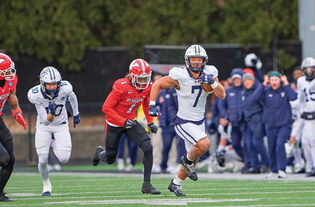
Running back Josh Pitsenberger ’26 ran 56 yards for the winning touchdown over Youngstown State in Yale’s first-ever FCS playoff game.
View full image
Football
Two days after Thanksgiving, the Yale football team found itself in uncharted territory. The team was trailing 35–7 at halftime in its first-ever Football Championship Subdivision (FCS) playoff game, and ESPN analytics gave Yale just a 1 in 200 chance of winning. Thirty minutes later, the Bulldogs had pulled off their biggest second-half comeback in 84 years—and their first FCS playoff victory.
The path to that miracle began in December 2024, when the Ivy League announced that its teams could compete in the FCS playoffs. An Ivy title would no longer be just the cap to an outstanding season, but a ticket to the 24-team tournament held yearly among the 129 FCS schools, one division below the powerhouses in the Football Bowl Subdivision (FBS).
To qualify, Yale first had to take care of business at the 141st playing of The Game: Harvard entered the Bowl ranked 8th in the country with an undefeated 9–0 record, while Yale was 7–2 with one Ivy loss. A Yale victory would not only give the Bulldogs a share of the Ivy title, but also the automatic bid to the FCS tournament. Adding to the story was a starting quarterback with a familiar last name. Dante Reno ’28, son of head coach Tony Reno and a sought-after recruit nationally, transferred to Yale over the summer after playing at South Carolina.
Against Harvard, the younger Reno showed his elite-level potential, throwing for 273 yards and three touchdowns in a game Yale dominated from the start. The Crimson fumbled the very first snap of the game, helping Yale to an immediate 7–0 lead, and the Bulldogs quickly pushed the margin to 17–0 in the second quarter. Yale’s stars led the way all afternoon. Captain Josh Pitsenberger ’26, the Ivy offensive player of the year, tallied 143 yards on the ground and three running touchdowns. The defense, including Ivy defensive player of the year (and next season’s captain) Abu Kamara ’27, held the Crimson to under 30 points for the first time all season in an eventual 45–28 win.
The next day, the Bulldogs learned they’d travel to Ohio to play Youngstown State in the FCS tournament’s first round the following Saturday. At first, it appeared that the Bulldogs weren’t quite ready for the postseason spotlight. The Penguins jumped out to a 21–0 lead, and Yale turned the ball over three times in a 35–7 first half in which nothing seemed to go right.
But one of the greatest moments in Yale football history unfolded after halftime. “The message in the locker room was, ‘The scoreboard is irrelevant,’” says Pitsenberger. “We took it one play at a time, knowing that we’re still in this game.”
Reno settled in and eventually threw for 260 yards and three second-half touchdowns. Two third-quarter scores made the score 42–22, but with time ticking away, the Bulldogs still needed big plays to dig out of their early hole. The spark came from a fumble forced by Inumidun Ayo-Durojaiye ’26 and recovered by Kamara in Penguins territory. Then, Yale scored to make it 42–29, and momentum noticeably swung the Bulldogs’ way. With under three minutes to go and Yale still down by six, Pitsenberger broke off a 56-yard touchdown run that put Yale ahead for good, 43–42.
From a deficit of 42–14, Yale scored 29 unanswered points to earn a first-ever FCS playoff win. In a career-defining performance, Pitsenberger racked up 209 yards and three touchdowns of his own. “We talk all the time about it being Yale vs. Yale—about holding ourselves to our own standard of excellence—and today they showed just how deeply that commitment runs,” said head coach Reno after the win.
After the thrilling win at Youngstown, the Bulldogs faced their second-round opponent, the Montana State Bobcats, who were ranked second among FCS teams. Landing in Bozeman, nearly a mile above sea level, the Bulldogs were greeted by seven inches of snow and a fan base used to winning, including runs to the FCS championship game in two of the previous four years. Some prognosticators favored the Bobcats by more than 20 points, but Yale gave the home team all they could handle. On a cold afternoon in December, a stout Yale defense held Montana State to just one score and a 7–0 lead at halftime.
The Bobcats scored late in the third quarter to make it 14–0, but in an exciting final 15 minutes, it seemed like the Bulldogs might pull off another comeback. After Kamara forced a fumble with four minutes to play, Pitsenberger scored his 19th touchdown of the year, making the score 21–13. The defense forced Montana State to punt, giving Yale the ball back with the chance to tie with just 59 seconds remaining. Unfortunately, a strip-sack fumble followed by a final attempt at laterals with time expiring ended the game and the dream run for the Bulldogs.
The season took on added significance the next day, when it was announced that Coach Reno would take a leave of absence to recover from an unspecified health issue he had been managing throughout the season. Head defensive coach Sean McGowan will be acting head coach until Reno’s return.
For a first taste of FCS play, Yale made not just an appearance but a statement, and a preview of postseason runs to come. Ivy League traditions may die hard, but this new chapter of Yale football lore appears to have been worth the wait.
Field hockey
When Melissa Gonzalez took over the field hockey program as head coach in 2022, one goal was clear from the outset—to make the NCAA Tournament for the first time in the program’s 54-year history. “One of the first things we did was sit down with the team and ask them to define their goals and vision for the program,” says Gonzalez, a two-time Olympian and former UConn standout. After four years of work, Gonzalez and her team finally made that first NCAA appearance this season. “The group never shied away from the work, whether it was the behind-the-scenes preparation, the ups and downs, or the grit and humility required to grow,” she says. “It wasn’t easy, and all credit goes to every player who committed to this program over the last four years.”
The year held promise from the start, as the Bulldogs began the season 5–0 for the first time since 1995. But it felt truly special by mid-October, when the team travelled to UConn and won in a penalty shootout, defeating the Huskies for the first time ever after 35 previous meetings. “That win was a major confidence boost,” says Gonzalez. “It validated the work we’d been putting in behind the scenes and reinforced that our process was moving us in the right direction.”
Despite falling in the Ivy League semifinals to Princeton, Yale still earned one of the eight at-large spots in the 18-team NCAA Tournament. There, they fell 5–1 in the first round to the eventual national champion, Northwestern, but not before setting a new high watermark for Yale’s first women’s varsity sport. “For this group to achieve something historic and deliver a first for generations of alums means a tremendous amount,” Gonzalez says. “It honors the foundation that was built long before us and hopefully will inspire those who come after.”
Tennis
Most Yale tennis players have enough on their plates balancing a two-season sport with academics. This fall, Vignesh Gogineni ‘26 added professional tournaments to the mix. In early November, the Cincinnati-area native had just finished competing in an International Tennis Federation (ITF) tournament on the campus of Michigan State before preparing for the NCAA singles tourney the following week.
“I had a midterm yesterday, but I had time to study during the tournament, so it wasn’t anything too crazy,” he said during the brief interlude between competition. In the ITF event, one level below the ATP Challenger Tour, Gogineni advanced to the semifinals and beat a player ranked in the world’s top 250. At NCAAs, the senior fell in the first round but was the first Yale men’s player to make multiple NCAA appearances in more than 20 years.
Another history-making run unfolded in women’s doubles. Orly Ogilvy ’27 and Leena Friedman ’29 won two matches to advance to the NCAA quarterfinals, marking the best-ever performance for a doubles pair in Yale history. Making it to the final eight was particularly impressive given the two hadn’t played together until Friedman arrived on campus in the fall. “Playing with Leena, we just clicked really quickly. Our energy, our chemistry was really there,” says Ogilvy, a former under-18 national champion in Canada. “Together, we have a great fearlessness on court.” The pair earned NCAA All-American honors for their tournament run, a first for the program..
 loading


 Print
Print Email
Email