 loading
Letters to the EditorLetters: January/February 2026Readers write back about Mark Twain, the foam house, and more. We welcome readers’ letters, which should be emailed to [email protected] or mailed to Letters Editor, PO Box 1905, New Haven, CT 06509-1905. Due to the volume of correspondence, we are unable to respond to or publish all mail received. Letters accepted for publication are subject to editing. Priority is given to letters of fewer than 300 words. 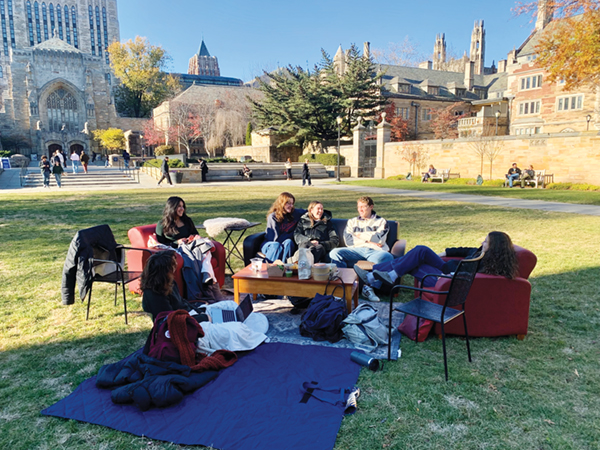 View full imageChat Every weekday, we post a photo on Facebook, Instagram, and our Daily Snap blog. In November, we spotted these students, who had moved their common room onto Cross Campus to enjoy one of the last mild late-fall afternoons. Readers on Facebook were impressed. “I am in awe of their efforts; some heavy furniture there,” wrote Ron Sipherd ’64. It was one particular detail that caught the eye of interior designer Elaine Griffin ’86: “They brought the rug! The RUUUUUUUUUG!!” Mark Twain and YaleShelley Fisher Fishkin’s article “Mark Twain’s Adventures at Yale” (November/December) is New Yorker–quality writing. Its style and wit are a perfect tribute to its subject. “Sometimes, of course, Twain was just having fun.” Yale did itself honor, as well as honoring Twain, with two honorary degrees. Finding the foam houseRegarding the foam house you featured (“In the Wild,” November/December): In the late 1960s and the early ’70s, the Yale cross country team used to compete on the golf course and practice on the trails surrounding it. We were prone to wandering (trespassing) on the water company and adjoining lands. I remember my bewilderment as a freshman encountering these bizarre structures. An upperclassman explained that they were an architecture school project. One of my favorite long runs on Sunday morning was to enter through the decrepit chain-link gate on Fountain Street and follow the trails past the foam buildings and then follow the trails back to the golf course and Edgewood back to Pierson. The president’s messageRegarding President McInnis’s address to the Class of 2029 (“Moments of Transition,” November/December): I found her words to be incisive, relevant, and appropriate for the occasion. She displayed the right tone in alluding to the problems of the day without elaboration or partisanship. I am a casual student of art, and I liked the way she succinctly interpreted the painting without getting overly didactic. Yale is blessed to have such a fine lady at the helm. As President McInnis pointed out, “there is more than one way to get to your destination and . . . the well-worn trail isn’t the only one worth taking.” A solution, as unconventional as it may be, does exist. The foundation lies in Thomas Merton’s sudden awakening in 1958 to the fact that we are all one people—that separateness is an illusion, that only our brains perceive differences. While the idea of a spiritual revolution may seem radical, it would eliminate the unconscious security issues now preventing healthy change. President McInnis’s tools of “open-mindedness, and mutual respect for each other’s dignity and humility” would no longer be a mere suggestion, but a reality. The founding mythWith regard to your very interesting article on the founding of Yale (“How Firm a Foundation,” November/December), I submit that, as with many foundational stories of great institutions (such as Christianity, Judaism, et al.), it is the essential truth of the story as opposed to the historical details that is most important. The First Congregational Church of Branford treasures the table on which the founding books were placed and uses it regularly as our communion table. The swim testStuyvesant Bearns’s letter (July/August) about Yale’s freshman swim test reminds me of mine in 1951. Not comfortable in any pool, I approached the test with trepidation. As I completed the requisite four laps, barely and with great effort, the instructor leaned down and proclaimed: “Kroloff, technically you passed, but I strongly advise you to take the freshman swim course.” The role of humilityYour latest issue mentions the founding of the Yale Center for Civic Thought. One thing I rarely see in public dialogue is intellectual humility—the expressed recognition that regardless of how much we know about a problem, we don’t necessarily have solutions which both solve the problem(s) and are collectively acceptable. People usually propose solutions or take positions, then support or defend them, rather than engaging those concerned to uncover issues and discuss possible solutions. It happened at NewnhamThere’s a small item in your recent issue about how the new movie After the Hunt begins with the claim “It happened at Yale,” when in fact the movie was shot in England (Campus Clips, November/December). Yale readers may be interested to know that the film was shot at Newnham College, Cambridge—the educational establishment I went to when I graduated from Yale in 1978.
The comment period has expired.
|

|

 Print
Print Email
Email