Dan Renzetti
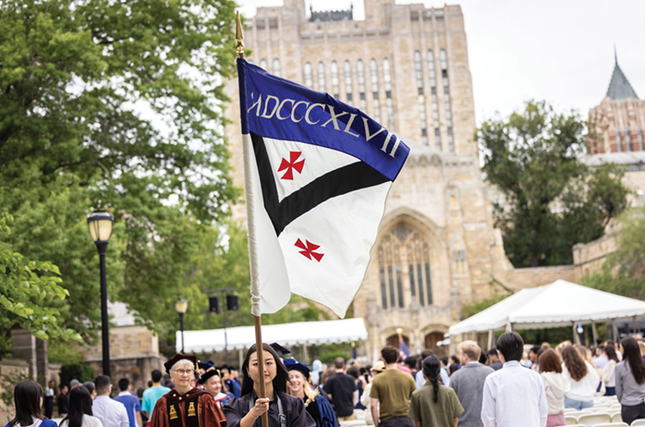
The Graduate School banner led the procession at the school’s Matriculation Ceremony last fall. Starting this fall, incoming classes of doctoral students will get smaller.
View full image

Dan Renzetti
The Graduate School banner led the procession at the school’s Matriculation Ceremony last fall. Starting this fall, incoming classes of doctoral students will get smaller.
View full image
In normal times, a 13 percent reduction in Graduate School enrollment in the humanities and social sciences—and 5 percent in STEM—would be dramatic and distressing news at Yale. But given the more dramatic cuts announced this year by some of the university’s peers, the plan has led to some sighs of relief.
Harvard, for example, announced in October that it would slash graduate-student admissions by 75 percent in the sciences and 60 percent in the arts and humanities in each of the next two years. The University of Chicago is planning to reduce its PhD student enrollment by 30 percent by 2030–31, and many of its nonscience programs are admitting no new students in the coming year. Brown is cutting its PhD admissions by 20 percent next year, and Penn cut its by 33 percent in the last admissions cycle.
Those universities, like Yale, are responding to new financial headwinds, from increased taxes on endowment income depending on the institution’s size and wealth (for Yale, the highest rate of 8 percent will be levied), to reduced research funding and deep uncertainty about future federal grant spending and reimbursement rates. But Yale’s more measured approach is based on what has happened here so far. Larry Gladney, dean of science in the Faculty of Arts and Sciences, says that Yale’s grant funding for the current year ended up slightly ahead of last year in total dollars. “Right now, there’s no fiscal justification for making drastic cuts,” he says. “We may get to that point quickly; maybe we’re a bad news cycle away.”
In the humanities and social sciences, each PhD program has a target total enrollment size. Over the next three years, each program will be required to limit admissions to reach a new, 13-percent lower enrollment target by 2028. The cuts will vary in programs that are above or below their current enrollment targets. In the sciences and engineering, enrollment will be reduced by 5 percent; however, some programs may decide on larger cuts based on anticipated reductions in federal research grants in their disciplines. Unlike past temporary belt-tightening measures pegged to economic downturns, this one is likely permanent, as no one expects the endowment income tax to go away.
“Nobody’s happy admitting fewer students, including me,” says Graduate School dean Lynn Cooley, the C. N. H. Long Professor of Genetics. “But we’re facing budget realities that make it imperative to do that in order to keep supporting our students the way we want to.”
That said, the cuts are coming after years of discussion about whether Yale and its peers are graduating too many PhDs, particularly in the humanities, where jobs in academia are getting harder to find. Administrators say that was not a consideration in the budget-driven decision, but Cooley acknowledges that “we want our students to be successful in their careers, and if it’s getting that much harder, perhaps we should have fewer students.”
Pamela Schirmeister ’80, ’88PhD, deputy dean of the Graduate School, says the school has been leading discussions with its various programs about “how we can support your program at a reduced size to maintain your excellence and your intellectual community.” Among the areas under discussion are finding ways to help students reduce their time to degree, and building and strengthening of interdisciplinary conversation among smaller programs.
Amid the cuts, Cooley says it’s important to understand the loss that comes with training fewer graduate students. “I often try to remind people who are not embedded in an academic place like we are that when they read news about a discovery on campus, it’s young people who are doing that,” she says. “It’s easy to think of the faculty as the stars of the show, which of course they are, but it’s also young people—grad students and postdocs—who are pushing discovery forward.”
 loading


 1 comment
 Print
Print Email
Email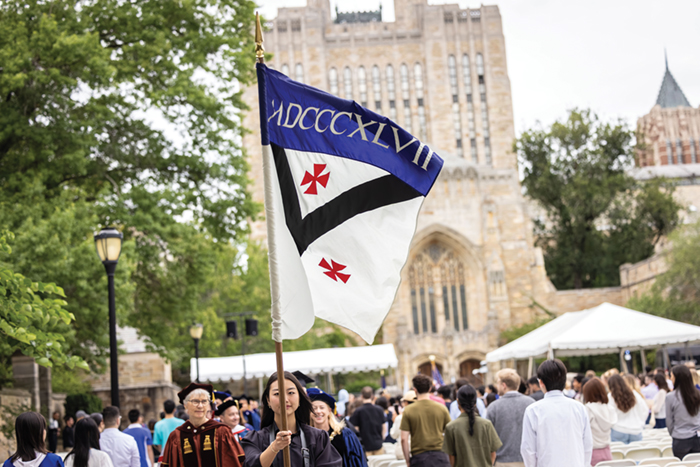
1 comment
-

Benjamin Huang, 4:47pm January 12 2026 |  Flag as inappropriate
The comment period has expired.Why are cuts in the humanities and social science admissions over teice that of those in STEM? The infrastucture required to teach a course in English Romantic Poetry is far less than for a Chemistry class. Also, fewer graduate admissions will discourage those from less affluent and diverse backgrounds from applying, as well as reducing the number of teaching assistants for large lecture courses. Granted, the job market is tight in these fields, but increased employment prospects depends on generating undergraduate demand for courses, and this will never happen if these departments are allowed to wither.
To take an example--when I was an undergraduate, enrollment in China-related courses were rapidly increasing. Jonathan Spence's class on Chinese History regularly drew hundreds, and enrollment in Chinese was surging. But both have waned, precisely at the time when an understanding of China is of paramount importance. The same can be said of courses in Arabic, Hinduism, Greek Philosophy, etc.
I would hate to see Yale's excellence in these fields fall to the budgetary ax. Maybe they could be a bit more imaginative-- increase the use of solar panels, use AI for routine administrative tasks, increase the number of college seminars, etc?
Ben Husng
SAY 1976