Manuscripts and Archives
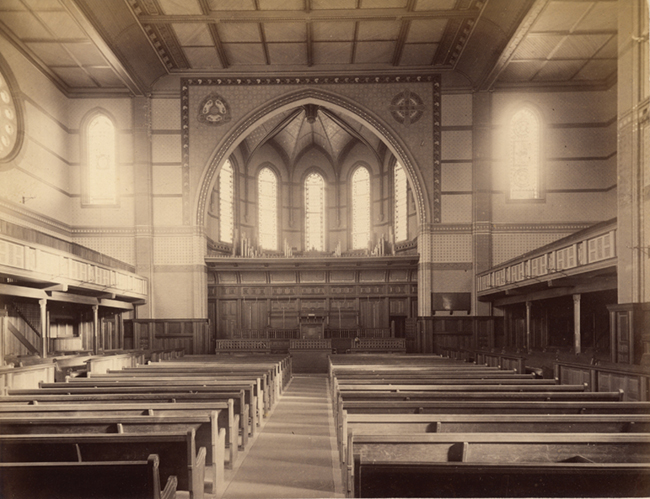
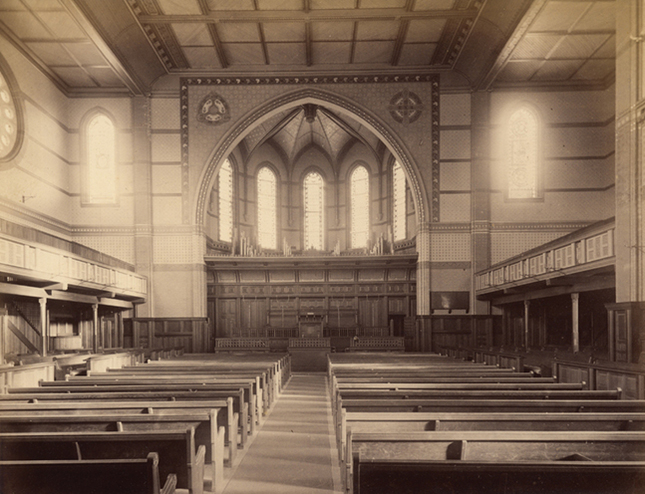
Battell Chapel was home to Yale’s daily chapel services from 1874 to 1931. After this photo was taken, it was expanded in 1894 to seat 400 more people.
View full image

Manuscripts and Archives
Battell Chapel was home to Yale’s daily chapel services from 1874 to 1931. After this photo was taken, it was expanded in 1894 to seat 400 more people.
View full image
Manuscripts and Archives
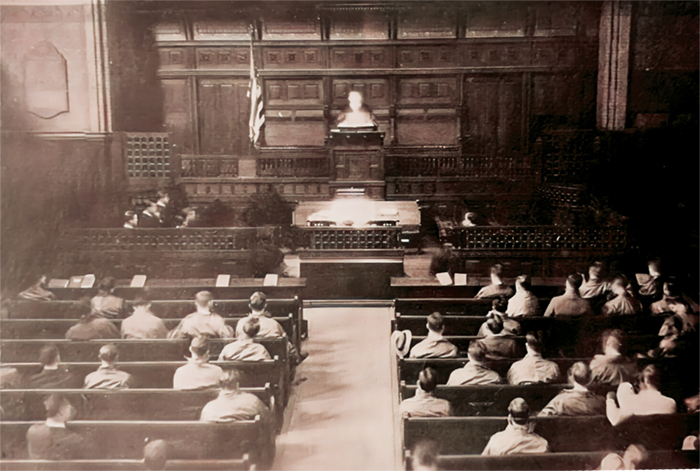
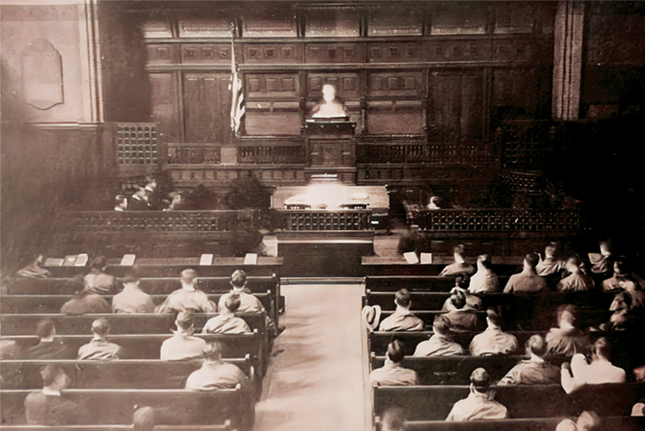
A blurry snapshot of the last compulsory chapel service, on June 5, 1926, was sent anonymously to President James Rowland Angell in 1928.
View full image

Manuscripts and Archives
A blurry snapshot of the last compulsory chapel service, on June 5, 1926, was sent anonymously to President James Rowland Angell in 1928.
View full image
On May 8, 1926, after a year of heated campus debate, Yale’s trustees announced that they were putting a stop to a feature of student life that they said “does not advance the interests of vital religion.” Were they going after speakeasies? Jelly Roll Morton records? No, the trustees ended the requirement that Yale College students attend daily morning chapel services.
Ever since Yale’s founding in 1701, students had been compelled to pray together. In the early years, there were morning and evening prayer services in the college every day, plus two additional services on Sunday at the local meetinghouse. In 1757, President Thomas Clap, dissatisfied with the preaching at New Haven’s First Church, established Sunday services on campus and built a suitable chapel four years later.
As the college grew, Yale had to build a larger chapel in 1824 and again in 1874, when Battell Chapel was dedicated. And as the college’s religious mission began to fade in importance, chapel became a dry, unloved institution. An alum from the 1860s later recalled in the Yale Alumni Weekly that students viewed daily chapel as “an arch foe and a weapon of discipline rather than a spiritual agency.” He described how faculty monitors kept an eye on students from raised boxes in the chapel: “A student who dropped his head to the rail of the seat in front—save during actual prayer—was officially asleep and so marked. But if he closed his eyes sitting upright . . . he was officially awake and exempt from penalty. This bonused upright slumber as a fine art.”
Students rebelled against their confinement—especially when preachers began to run long in their homilies—with a rash of coughs, sneezes, and shuffling of feet. Dogs, snakes, and roosters occasionally found their way into the chapel. One of the few things students enjoyed was “bowing out” the president as he left the chapel at the end of the service. Only seniors were afforded this honor; they lined up and bowed at the waist as the president passed through, making a game of seeing how close they could come to their leader without touching him.
Students began agitating for an end to the chapel requirement as early as the 1880s; Harvard made attendance voluntary in 1886. Opponents of compulsory chapel argued that it was a relic of the past and that it did little to inspire religious devotion (and maybe did the opposite). Defenders relied less on a religious argument than on the unifying value of gathering the entire college population together once a day. The debate was raised again and again over the next four decades.
In 1923, for the first time, the Yale Daily News began editorializing against compulsory chapel. Several factors militated against the requirement in the 1920s. Older students who had served in World War I felt that such compulsion was infantilizing, and students increasingly wanted to spend weekends in New York City instead of going to Sunday chapel.
But what finally brought matters to a head in the fall of 1925 was a recurrence of the space problem. The college had grown to the point where the whole student body could not fit in Battell Chapel, so that year classes went to chapel on alternating days. The division dealt a blow to the strongest argument for compulsory chapel: that it brought the whole college together. That fall, the News started campaigning hard against the policy, conducting a survey in which 1,681 students opposed compulsory chapel and only 241 wanted to keep it.
The administration appointed a faculty committee to consider the question. Their solution was to drop the requirement for Sunday chapel but keep daily chapel compulsory for all but seniors. But when the whole faculty considered the proposal, they voted 29 to 12 to eliminate all chapel requirements. The trustees ratified the decision, and the last compulsory chapel service was held on June 5. The next fall, in his matriculation sermon, President James Rowland Angell declared that “For the first time in its two and a quarter centuries of history, Yale holds its Sunday chapel services with no student present who does not come of his own free will.”
With student religious life now optional, the university for the first time appointed a chaplain to oversee daily chapel and Sunday services. In that first fall, daily chapel attendance attracted an average of 250 students, less than ten percent of the undergraduate body. Daily chapel continued in Battell Chapel until 1931, when it was moved to Dwight Chapel and continued until 1960 or later. Sunday worship evolved into the University Church in Yale, which calls itself an “ecumenical Christian community.”
But daily worship hasn’t completely disappeared from Yale life. Up on Prospect Hill, the Divinity School offers services every weekday at 11:30 a.m. in Marquand Chapel.
 loading


 Print
Print Email
Email