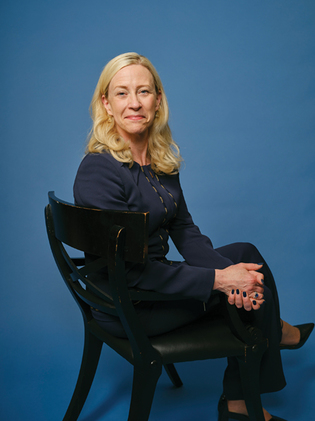
Chris Buck
The Yale Alumni Magazine publishes a short interview with President Maurie McInnis ’96PhD in every issue. In this one, the president discusses artificial intelligence with editor Pippa Jack.
View full image
YAM: It feels like AI is everywhere. Please share some campus developments.
MM: In 2024, Provost Scott Strobel convened the Yale Task Force on Artificial Intelligence to determine Yale’s vision for AI. I would encourage anyone interested to read it online. It points out that the research underpinning today’s AI has been happening at Yale for decades. But the last couple of years have brought exponential growth—and urgency.
There are three major buckets for how AI is used, studied, and developed on campus: in the research space, in pedagogy and teaching, and in operational matters. We want to harness AI to open new horizons for research and scholarship. But we also want to keep AI honest by creating frameworks for using it responsibly.
All these ambitions require engaging with AI. So, Yale has committed more than $150 million to support our faculty, staff, and students as they explore AI, including building a portfolio of graphics processing units (GPUs) with the power to analyze dizzyingly huge data sets.
We also launched Clarity, a chatbot that offers access to a variety of AI models. Inputted data is sealed off with private, encrypted connections. Yalies can use it to build fluency with AI and to experiment with more advanced applications. That’s a skill everyone will need, myself included.
YAM: What’s being done to mitigate AI’s energy hunger?
MM: AI uses an enormous amount of power, and we don’t want expanding AI to shrink our commitment to tackling climate change. Many of our new GPUs will be installed in a data center with LEED Platinum certification, the highest level for energy efficiency.
But there’s another way to think about this: AI can support our researchers who are developing more energy-efficient technologies, like low-energy chips. And we’re already seeing Yale researchers use AI to meet environmental challenges. Two Yale-related projects just won $2 million each from the Bezos Earth Fund. One is using AI to model removing carbon from the ocean, and the other is using AI to figure out how to reduce emissions from livestock.
YAM: Please talk about guardrails to make sure AI doesn’t do students’ learning for them.
MM: One of the most important reasons for higher education to engage with AI is so that we can critique it. Our jobs don’t depend on the financial success of a particular platform. We can evaluate its possibilities and pitfalls objectively.
AI is likely to rewire our brains on a massive scale. I think we all get that. But there’s a key question that’s raised in the Yale Task Force report: Where does the thinking happen? In other words, in any given assignment, which parts are about rote memorization and which parts engage critical thinking? If we can use AI to decrease the drudgery and increase the creativity, we’ll be using it the right way. And our faculty are already doing exactly that.
The Poorvu Center for Teaching and Learning offers guidelines and consultations, and Yale faculty are using AI in spaces that your readers might not expect. One example is my dissertation advisor, Edward Cooke. He asked his students to use ChatGPT to create labels for various ceramic objects in the Yale University Art Gallery. Then he asked them to critique those outputs, so they could see what AI misses. And two Yale faculty members—Theodore Kim and Julián Posada—are launching an interdisciplinary certificate in computing, culture, and society.
YAM: Will there be enough jobs for new graduates? And how does Yale prepare humanities majors for jobs that involve collaborating with intelligent systems?
MM: Previous technological transformations have brought booms in job creation. History isn’t always predictive, but it seems clear that the tricky part is navigating the transition between the old world and the new. For example, the printing press meant no more monks hand-illuminating manuscripts. But if you learned how to typeset, new work was opened to you.
The fundamental skills that foster professional success are perennial. I recently returned from a conference at which people discussed a softened focus on technical skills and an increased focus on students’ critical thinking and creative skills, their adaptability and grit—things that are a hallmark of a Yale liberal arts education. We have no idea what new jobs will be created. At the start of my career, I could’ve never imagined a job like “influencer.” But we do know that even an influencer—perhaps especially an influencer—needs to understand how to engage creatively with the world. All of which is to say, I’m confident there will be jobs for all majors.
 loading


 Print
Print Email
Email