Sono Brand Lab
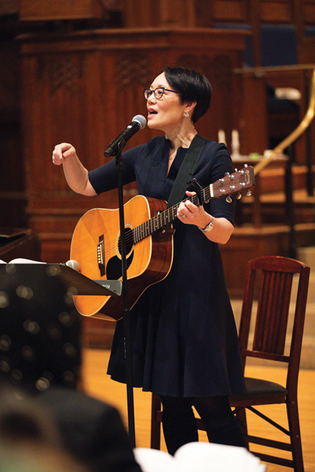
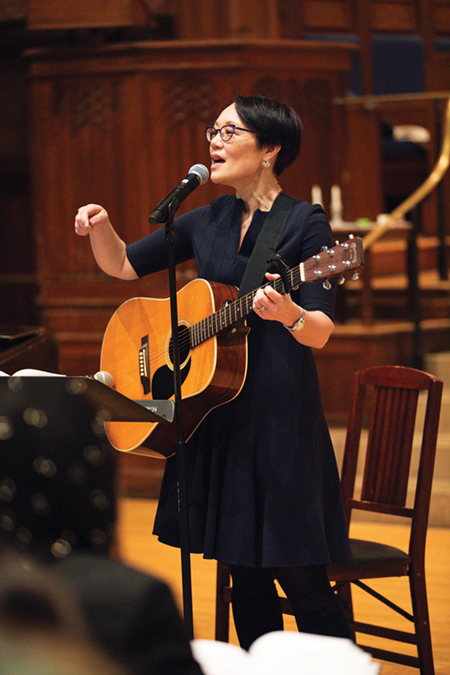
Rabbi Angela Buchdahl ’94, senior rabbi at New York City’s Central Synagogue, leads services in Battell Chapel as part of a two-day Asian Jewish gathering last fall organized by Yale’s Asian Jewish Union and the Slifka Center.
View full image
Born in Korea and raised in Tacoma, Washington, by her Korean mother and Jewish American father, Angela Warnick Buchdahl ’94 was sixteen when she first dreamed of becoming a rabbi. After graduating from Yale, where she met her future husband, Jacob Buchdahl ’94, she attended cantorial and rabbinical schools. And in 2013, the Jewish Korean-American broke the stained-glass ceiling to be named senior rabbi at New York City’s Central Synagogue, the first woman in its 186-year history. In a new memoir, Heart of a Stranger, Buchdahl details her journey, offering spiritual reflections along the way.
Sylvia Brownrigg: What are some qualities in you, or in the people that you met, that enabled you to turn your dream of being a rabbi into a reality?
Angela Buchdahl: In many ways, the hero of the book is my mom. She was one of my early guides for boundary crossing, having moved [from Korea] to America at age 35 with two young kids. I watched how she navigated being the other with a great amount of dignity. She also really taught me that I could be home wherever I created it, that you could create that sense of belonging wherever you were. And that, of course, is really the Jewish story, from Abraham and Sarah through one thousand years of being a diaspora people to even today.
SB: Yale plays an important part in your memoir: You met your future husband there, and all three of your kids have gone there as well.
AB: I think the beauty of college is trying to figure out how you are, separate from the home that you grew up in. I remember thinking that I didn’t fit neatly into any box and that my other roommates seemed to more clearly. One was a legacy and one of four daughters, she was very comfortable and confident and became immediately involved in the Women’s Center at Yale. And then going to a meeting of Korean American Students at Yale—I mean I was born in Korea, it was my first tongue, and yet, I think as a biracial child I never felt fully comfortable in Korean spaces. But my Korean roommate was very involved and finally got me to go to a meeting.
In many ways I picked Yale because I wanted to be in a place that had a rich Jewish community and identity—and it really lived up to that. It was in the humor in my singing group, and people using Yiddish words, and hundreds of people showing up for high holidays on campus.
SB: One of the very challenging moments you describe is when you did a trip to Israel before your senior year, and there were times when your Jewishness was questioned.
AB: It was a series of rejections, both from strangers and from people I actually knew really well. I hit rock bottom, and I got to some point where I felt like it wasn’t worth it to keep fighting this fight anymore. Like, why am I trying so hard to be counted as a Jew and to have people tell me you’re not really, we don’t accept you and forget about being a rabbi?
I thought Judaism was something that I could shed easily. I don’t have a Jewish face, I don’t have a Jewish name. And my mother—this is a very Buddhist response—said: Is that really possible? And I realized that it wasn’t, that I didn’t actually have a choice. Judaism was something deep inside me: It was the way I saw the world. It was who I had become. I wrote that the benefit of hitting rock bottom is that it is a form
of landing.
SB: You were a cantor before you were a rabbi, and you describe that role as being a connector, and helping people to hear their own voices.
AB: I grew up in a home in which my parents expected musical literacy in the same way they expected me to learn to read and do math. It was just a given. Music was kind of a universal language of spiritual and human connection. While I went to synagogue from a young age, the first time I really felt, Oh, I belong here, was when the music teacher showed up and she was singing music in a way that made me feel: I want to sing to God. I want to express myself in this way. Once I had a taste of what that felt like, I wanted to both continue and give other people the opportunity to experience it.
You know, I have an incredibly diverse congregation, politically, demographically, racially. But I would say that part of my ability to hold this community together is because of the music. The music transcends what makes us separate. When you sing together, or serve together, that is the magic that enables us to see each other as human beings and to create genuine community, even when we don’t always agree on everything.
 loading

 Print
Print Email
Email