Joe Ciardiello
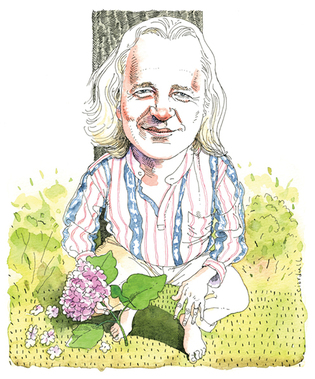
In a processing room of the Yale Divinity Library, several stacks of white boxes have handwritten labels that read SUFI, TIBETAN BUDDHISM, CHRISTIAN. A recent acquisition by Yale Special Collections, these boxes contain the papers of Lex Hixon ’63, a spiritual curator of the American counterculture. Hixon was best known as the host of In the Spirit, a two-hour WBAI weekly interview radio show in New York City that from 1971 until 1984 introduced listeners to prominent religious teachers such as Alan Watts, Tarthang Tulku, Rabbi Zalman Schachter, and Ram Dass. Like later broadcasters Jay Shetty, Krista Tippett, and Oprah Winfrey, Hixon’s success reflected his high-level communicative abilities and his wrestling with the spiritual questions he posed to others.
I learned about Lex Hixon first in 2003, when I was a doctoral student researching the 1893 World’s Parliament of Religions and found that he spoke at the centennial parliament in 1993. “A sacred tradition is an entire sacred world,” the proceedings record him saying. “Boundless in scope, inexhaustible in teaching and blessing.” Many years later, when I became the second Lex Hixon Professor at Yale, his name came back to me, now connected to a workplace honor. Sometimes a faculty member receives a chair named for a philanthropic family or a Yale teacher. The chair I occupy remembers a lifelong student of spirituality who died two years after he spoke at the 1993 World’s Parliament, when his life was cut short by cancer.
“I’ve been trying to open up a space of truth,” Lex Hixon repeated across many WBAI episodes. Opening a space of truth is something religions and universities say they do. Most early American colleges, including Yale, began as institutions for Christian leadership. The Hixon family hope that honoring Lex Hixon’s legacy ensures that the comparative study of religion, rather than the proselytization of a particular religion, be protected. Occupying the Hixon chair has made me think more about what kind of space of truth this opens.
A core experiment of Hixon’s life was his practice of what he described as “joint citizenship in parallel sacred worlds.” He rejected the idea that practice of one religion required the abandonment of another. Raised a noncommittal Episcopalian, Hixon described his high school interests at Hotchkiss as booze, poetry, and philosophy. When he came to Yale, his roommate Sam was the son of an Sioux Episcopal archdeacon, Vine Deloria Sr., the first Indigenous person named into a top executive position by a major Protestant denomination, and the grandfather of renowned historian and American studies scholar Philip J. Deloria ’94PhD. Hixon’s relationship with Vine Deloria Sr.—represented in the Hixon papers by a rich three-decade correspondence—changed his life. Driving around the South Dakota reservation, the two spoke extensively about Christianity, which led Hixon to rebaptize.
This was just one conversion that occurred during his time at Yale. In a comparative religions course, he encountered The Gospel of Sri Ramakrishna, a book that claims it is a stenographic record of the conversations of a nineteenth-century Indian saint. Ramakrishna taught that every religion is true. He also taught that God, or Ultimate Reality, should be addressed and experienced as Mother. Hixon describes finding this book as a sensory enchantment, manifest in the smell of incense he reported his copy carried and in the radical ideas it conveyed.
An ordained monk of the Ramakrishna order, Swami Nikhilananda (1895–1973), translated The Gospel of Sri Ramakrishna with help from Margaret Woodrow Wilson, daughter of President Woodrow Wilson. The younger Wilson was among the many American artists and intellectuals who studied at the Ramakrishna-Vivekananda Center on East 94th Street, a center founded by Nikhilananda in 1933. When Lex moved to New York in 1965 to study flamenco guitar with Carlos Montoya, he tracked the address for the Ramakrishna Center in his copy of The Gospel of Sri Ramakrishna and visited the center for a Sunday talk with the hope he could study yoga. Among the students there he found his spiritual and intellectual community, and Nikhilananda became the godfather of his four children.
Nikhilananda encouraged Hixon to advance his learning through doctoral research. As a result, Hixon spent ten years studying at Columbia University. His dissertation explored a seventh-century Indian philosophical commentary on dream states. This research deepened Hixon’s commitment to the Hindu tradition Nikhilananda taught, called Advaita Vedanta. Adherents to Vedanta understood the varieties of religions as different expressions of the same insight that the individual self is not separate from Ultimate Reality. Conflict among religions is, for Vedantists, an error deriving from ignorance and poor judgment. The religions of the world are many but the route to mental liberation is the same.
To prove this thesis to himself, Hixon practiced religion as a physical and mental adventure, using scholastic and social skills he evolved in elite New England education to understand vast metaphysical systems to a high degree of practical precision. He made the traditional Hajj to Saudi Arabia, he completed a full multiple year koan training, he made offerings at the Kalighat Kali Temple in Calcutta, India, and he audited classes at Saint Vladimir’s Orthodox Theological Seminary in Yonkers, New York. He published creative interpretations of Koranic verses, twelfth-century Sufi hadiths, eighteenth-century Bengalese tantric hymns, selections from the Prajnaparamita Sutra, and meditations on the Zen classic Transmission of the Light, and he revised commentary on The Gospel of Sri Ramakrishna. Whether engaging with Ramakrishna Vedanta, Vajrayana Buddhism, the Jerrahi Derivish order, or Eastern Orthodox Christianity, Hixon made religion something that occurred not only through revelation and ritual but also through experience, education, and translation.
In addition to being an initiate of Ramakrishna lineage, Hixon became a sheikh in the Halveti-Jarrahi Sufi Order and a member of the Eastern Orthodox Church, and he was honored posthumously as a Zen master. “Whoever receives even the most basic initiation in a sacred tradition, or citizenship in a sacred world, has the responsibility to uphold the dignity and sanctity of that tradition, to interpret it in the light of its own highest principles, to protect it against distortion, to maintain a critical view of its past and present manifestations,” Hixon wrote. He advocated that every human being learns from authentic teachers of sacred traditions through daily study of holy texts, thinking and writing about that work, and engaging in spirited dialogue with others. His 1978 memoir, Coming Home: The Experience of Enlightenment in Sacred Traditions, describes how he sought awakening among many traditions.
Scholarship in religious studies explains Hixon as a practitioner of liberal religion reflected in his spiritual advocacy of pluralism and asymmetrical social relationships drawn by class, race, gender, and national difference. Historians of US religion Matthew Hedstrom and Stephen Prothero have shown how central book publishing was to the advancement of liberal religion, bringing koan, meditations, and scriptures to large audiences of English-speaking Americans tied to the Protestant Christian tradition, who often identify explicitly as seekers. Scholars of Asian American religions like Thomas Tweed and Alexandra Kaloyanides ’15PhD have observed how various American Christian interpreters have translated Buddhism, working to correct for the erasure of Asian cultures, and of Asian and Asian American people, in mainstream American Buddhism. One feature of this erasure is how few of the Buddhist texts sold in American bookstores are by authors familiar with source languages. Whether the 1892 collection The Gospel of Buddha by Paul Carus or Ursula Le Guin’s reinterpretation of the Tao Te Ching published in 1997, English-language readers have learned about Asian religions from English-speaking authors, rendering invisible the specific cultural origins for these religious ideas. Hixon ranged widely in his religious study, reflecting in these undaunted efforts what he learned in comparative religious studies at Yale and Columbia and his social identity as a religious explorer. Among the papers donated to Yale are scores of condolence letters from major religious organizations, laypersons, and readers, testifying to Hixon’s respect, knowledge, and infectious inquisitiveness.
Beginning in the late 1960s, Hixon, his wife and learning partner, Sheila, and their growing family spent summers with Swami Nikhilananda at the Ramakrishna-Vivekananda Center’s seasonal location on the St. Lawrence River. A place for classes and conversations about religion, the center sits on the footprint of a Methodist camp that existed for generations. Methodist campgrounds are major features of the religious built environment in the United States, known for their plain vernacular architecture, revival piety, and populist dialogues about different religions. Over a century earlier the same campground hosted Sri Ramakrishna’s disciple Swami Vivekananda, when he visited to deliver lectures there after his memorable presentation at the 1893 World’s Parliament of Religions in Chicago.
Convened by a Presbyterian minister and organized by a Swedenborgian judge, the World’s Parliament of Religions gathered Hindus, Buddhists, Jains, Jews, Protestants, Catholics, Unitarians, and adherents of Shinto and Zoroastrianism for a series of discussions that were equal parts diplomacy, education, missionization, and theater. I studied the Parliament as a paradigmatic event of US religious history because it was a Christian-designed event seeking to represent how strongly religious America was and how good religion is for the economic and democratic leadership of the United States. Its organizers said it united “all religion against irreligion.”
This effort for unification was explicitly missionary, with many speakers arguing that America’s unique role in history deserved special religious dispensation.
Historian of religion Lucia Hulsether ’20PhD demonstrates in her research how the Parliament was, by design, a promotional effort on behalf of expanding American territorial and economic power. Across his published writings, Hixon argued that people could reconcile any difference through consciousness. Such an argument served his and others’ adventurous pluralism and minimized the imperial power that supported it.
“There are, in this world, so many creations, so many beings of God, from whom we can learn,” said Guru Bawa Muhaiyaddeen in his 1973 radio interview with Hixon. “Whatever it is that we see, from all those things we can learn.” Listening to Hixon’s radio interviews, one hears over and over again how hard he works to learn from the wide range of religious thinkers he engages. As Hixon fundraised for In the Spirit, he emphasized how rare it was to create space for meaningful discussion between people holding different views. Donors offered what they could to encourage the ongoing circulation of such public conversations. Hixon and other public radio programs offered rare instances where religious ideas and information could be debated and accessed by a broad public.
“Our contribution to the future is to become responsible citizens, or initiates, of several sacred worlds, bearing them carefully and harmoniously within our own conscious and superconscious being,” Hixon said at the 1993 World’s Parliament of Religions. A committed public convert to religions whose practitioners experienced bigotry in the United States, Hixon sought to represent the ideas religions shared as a practice of countering the violence of wars and religiously informed hate.
Religions systematize worship, and Hixon pushed against systems that encouraged worshipping prejudice and power ahead of curiosity and vulnerability. “Sacredness cannot flourish as an intellectual abstraction, a romantic nostalgia, or a socially imposed norm,” he concluded in his talk at the World’s Parliament. “It springs only from free commitment and just community.” Future students will find in the papers of Lex Hixon a vivid account of how knowledge uplifts individual consciousness and can, through a deeply listening scholar, motivate others to awaken.
 loading

 1 comment
 Print
Print Email
Email
1 comment
-

Sam Brewster, 1:24pm February 09 2026 |  Flag as inappropriate
The comment period has expired.It would appear that all life emanates energy of a kind and form, and at some level, however subtle, it becomes sensed. The aura about Lex at times approached definition. Thank you, Kathryn, for the article and the Good Karma. Sam Brewster, high school classmate.