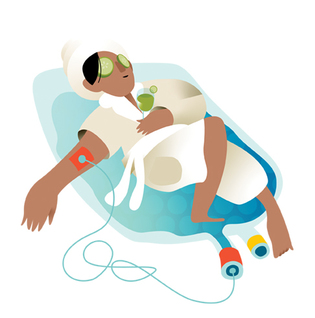
IV hydration spas claim that their treatments—injecting vitamins, minerals, and a variety of chemicals directly into the bloodstream—can do everything from relieving hangovers to boosting the immune system and combatting the effects of aging.
Don’t believe the hype, say Yale researchers. For a recent study, the team reviewed state regulatory policies related to IV hydration spas, examined websites for spas in every state and DC, and developed a “secret shopper” survey with an investigator posing as a consumer who queried 102 spas across the country.
They found that the spas operate with little oversight, offering costly procedures that are potentially risky, rarely administered or overseen by trained clinicians, and show little clinical evidence to support their claims. Their investigation, they say, provides insights into the need for more stringent oversight of industries that operate adjacent to the mainstream health care system.
Contrary to long-held notions about the intractability of focal treatment-resistant epilepsy (FTRE), an epidemiologic study by Yale and other researchers has found that patients can experience seizure relief.
Over three years, the team monitored seizure frequency and treatment regimens for 126 FTRE patients, all of whom had tried at least four drugs but still had at least two seizures per month. They found that about 68 percent experienced fewer seizures in the latter part of the study compared with the beginning, while some individuals remained totally seizure-free for periods ranging from three months to a year plus.
Researchers are still analyzing whether the improvements can be attributed to new or existing treatments or whether seizure frequency can wane on its own. Meanwhile, the documenting of these improvements in FTRE patients underscores the need for ongoing medical management and additional rigorous and controlled studies.
 loading


 1 comment
 Print
Print Email
Email
1 comment
-

Gail Falk, 8:09pm January 10 2026 |  Flag as inappropriate
The comment period has expired.This is not a comment but a question. Can you send me the citation for this study about IV hydration spas.