Manuscripts and Archives
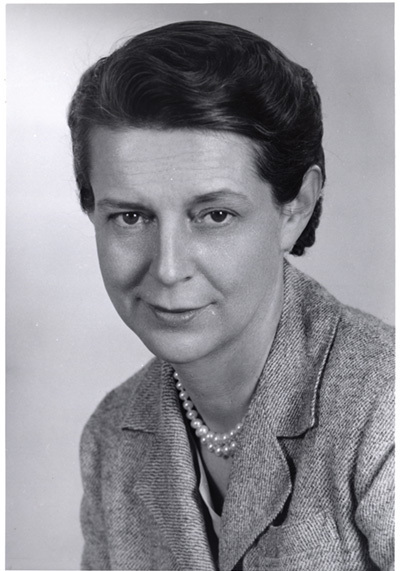
Mary Clabaugh Wright as a Yale professor.
View full image
Manuscripts and Archives
Mary Clabaugh Wright as a Yale professor.
View full image
Manuscripts and Archives
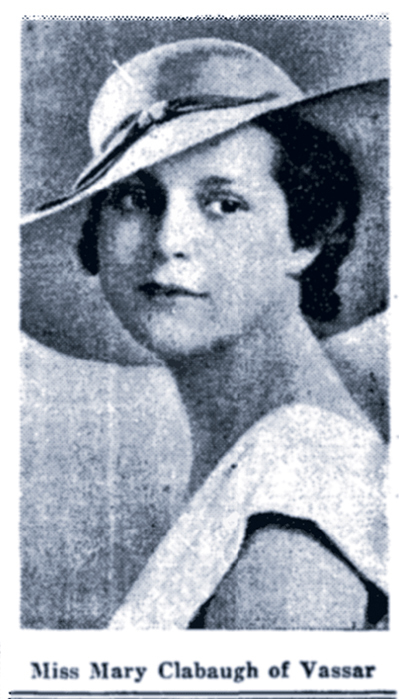
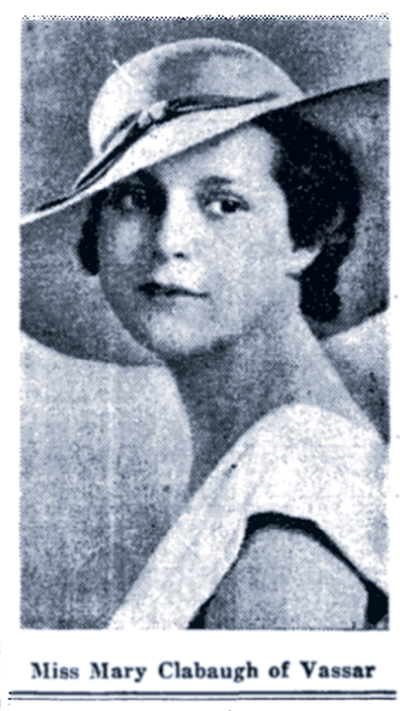
Mary Clabaugh as a student at Vassar.
View full image
Manuscripts and Archives
Mary Clabaugh as a student at Vassar.
View full image
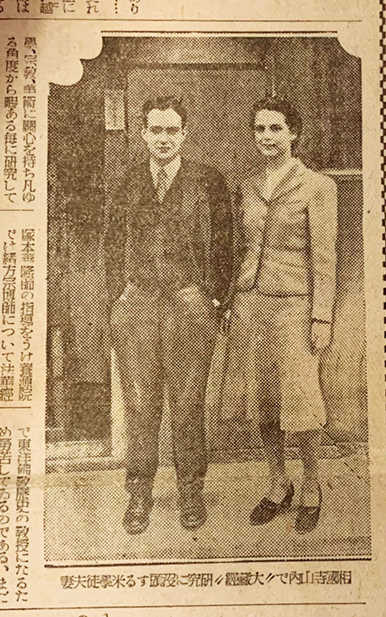
Manuscripts and Archives
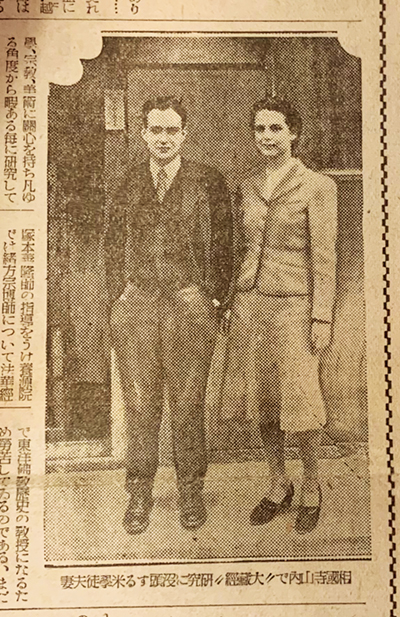
Arthur and Mary Clabaugh Wright in a Kyoto newspaper in 1941.
View full image
Manuscripts and Archives
Arthur and Mary Clabaugh Wright in a Kyoto newspaper in 1941.
View full image
Mary Clabaugh Wright may have been born and raised in Tuscaloosa, Alabama, but as her friend and faculty colleague George Wilson Pierson ’26 once said, you did not want to mistake her for a docile “Miss Magnolia from the South.” Wright, a historian of modern China who became the first woman appointed to a tenured position on Yale’s Faculty of Arts and Sciences, proved her toughness again and again: in the classroom, in the political arena, and even in an internment camp in China during World War II.
The New York Times and the Yale Daily News reported on the appointment of Wright and her husband Arthur Wright to the history faculty in 1959, but neither mentioned the glass ceiling she had broken. (Women had served for decades as tenured faculty in the School of Nursing and the education department, but not on the faculty that teaches in Yale College and the Graduate School.) The big news was that both Wrights were experts on China, recruited from Stanford to fill a gap in the history department at a time when the postwar international order demanded greater understanding of the world beyond American borders.
Mary Clabaugh began attracting notice as a student of the world while she was still an undergraduate at Vassar in 1937. As a delegate to the Model League of Nations—a forerunner of the Model United Nations—she represented the Soviet Union and was elected president of the body. Diplomat James G. McDonald, who spoke at the assembly, was impressed; the Vassar Miscellany News reported that “the ability that she showed in conducting the sessions inspired a dissertation by Mr. McDonald on the rise of women to intellectual equality with the male of the species.”
After graduating in 1938, Clabaugh went to Radcliffe for graduate school. Under the tutelage of the China scholar John King Fairbank, she decided to focus her historical research on China because it had not been picked over by scholars as much as Europe or the Americas. “You could take a whole century and just plunge in,” she later told the Yale Daily News. Fairbank later described her and journalist Theodore H. White as the brightest students he ever had.
Her choice of specialty also helped her find a life partner when she met Arthur Wright, who was a graduate student in Chinese history at Harvard. Mary and Arthur were married in 1940 and immediately set off for Kyoto and Beijing to do research for their dissertations—a risky move with the threat of war on the horizon. They were in Beijing when Pearl Harbor was bombed on December 7, 1941, and were unable to leave the country. They were kept under surveillance until March 1943, when they and other citizens of Allied countries were rounded up by the Japanese and put in the Weixang internment camp.
For the rest of the war, the Wrights’ families in America worked frantically to get them repatriated, but to no avail. Captives at Weixang were not mistreated; the Japanese authorities allowed the prisoners to govern themselves in a kind of commune. “Our handful of stupid executives and guards knows it could never run this place, so they leave it to us,” she wrote in a letter home. The Wrights were separated from their books and research materials for more than two years; still, Mary managed to find a way to educate herself, persuading some of the Russian prisoners to teach her their language.
When the camp was liberated in 1945, you might imagine the Wrights would have wanted nothing more than to go home. But the opportunity to make up for lost time on their dissertations and see the progress of the Communist revolution was irresistible: They traveled in China for two more years and met Communist leader Mao Zedong. Mary also collected publications for a Chinese collection at Stanford, where the two would land as faculty members in 1947.
While at Stanford, Mary completed her Radcliffe PhD, wrote a well-regarded book (The Last Stand of Chinese Conservatism), bore two sons, and earned tenure. She also spoke out on political issues, defending her fellow Asia scholar Owen Lattimore when he was targeted by Senator Joseph McCarthy.
When the Wrights were lured to Yale, undergraduates thought a course with the “lady professor” would surely be a gut. But as Pierson later recounted, she proved a tough grader. “Within a year or two hers was a privileged course,” he said. “Students cut or slighted their other courses to work for Mary Wright. They respected and loved her for what she demanded of them and for what she then gave.” Among her most devoted students was Jonathan Spence ’65PhD, who himself went on to become a Sterling Professor at Yale and a leading historian of China.
As the politics of the 1960s heated up, Mary spoke out frequently, especially on issues regarding Asia. She advocated US recognition of the People’s Republic of China and denounced the war in Vietnam, participating in the first nationwide “teach-in” on the war in Washington, DC, in 1965.
All this activity did not come without a cost. In a letter to family members in February 1966, Arthur wrote that Mary had been admitted to Silver Hill Hospital for “rest and a complete break from the tyranny of her habitual routine.” In December of the same year, he told family that she had been hospitalized at the Institute for Living in Hartford, where she was being treated for “deep depression.” She did not return to teaching until the spring of 1968. “Because the multiplicity of her talents was so great, she was pulled in many directions,” Spence later said at her memorial service. “Because the tensions generated by her fierce energy were so great, and the pressures she sensed so immediate, she lived under great strain.”
In 1969, Mary was diagnosed with inoperable lung cancer. She died in June 1970 at the age of 52, too young to have the impact as a teacher and scholar she might have had. But the students she did have did not forget the experience. One of them, Rick Fabian ’65, went on to be an Episcopal priest and a collector of Chinese art. In a condolence message to Arthur in 1970, he wrote, “She took academic life for real, and everyone knew it—so we began to take academic life for real, too.”
 loading

 6 comments
 Print
Print Email
Email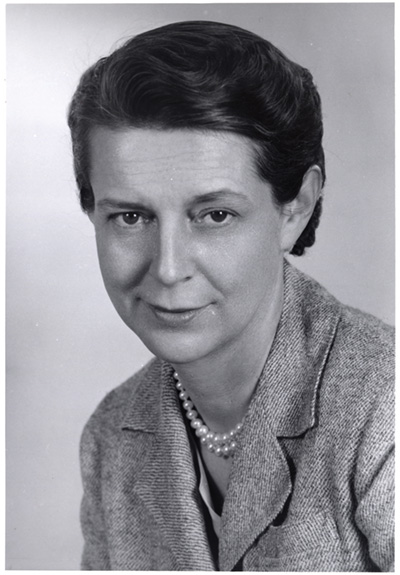
6 comments
-

Mark Shulman, 6:27pm February 23 2026 |  Flag as inappropriate
-

Jonathan Arthur Wright, 9:09pm March 10 2026 |  Flag as inappropriate
-

Meg Kelsey Wright, 9:37pm March 10 2026 |  Flag as inappropriate
-

Thomas Hong-chi LEE, 10:46am April 01 2026 |  Flag as inappropriate
-

Internet People, 6:45pm May 09 2026 |  Flag as inappropriate
-

Mark Branch, 11:37am May 11 2026 |  Flag as inappropriate
The comment period has expired.Thanks for sharing the story of Mary Wright's extraordinary life. Through her life's work and her students, her intellect continues to reverberate.
Greetings, friends, and I am grateful that this thoughtful and passionate tribute has found its way to me as one of her sons, and to a larger community. It has often seemed to me that her journey contains numberable opportuites for research, writing, and dissertations, and her family would encourage thoughtful students to consider these opprotunties. There are some modest factual nuances in the text,reminding me that access to this information is not easy. Difa Hamins was a Russian Jew and Chinese national who had just barely married Boris Hamins, of the same lineage but who had already attended Berkeley. This exposure meant that the Japanese took him prisoner, and Difa, 18 years old, elected to go to camp with her brand new husband. It was Difa who taught Mary Russian in the roll call lines over those two years, as over 2000 names were called out every morning. Russian nuns also helped. Just an anecdote. The camp location is now an historic site, honoring the internees and the American government who liberated China from Japanese dominion. Best wishers, and thank you!
How extraordinary to read this article about Mary Clabaugh Wright, who would have been my Mother in Law had she lived. I have heard her stories for the past 46+ years, as my Partner in life is her son, Jonathan Wright. I was fortunate to know and visit Jonathan's godfather John King Fairbank and his wife Wilma Fairbank at their home on Winthrop Street in Cambridge, MA, where Arthur and Mary Wright first met. And we spent quite a few wonderful occasions with Jonathan Spence, who was a truly lovely person, a scholar of Chinese History, and a writer and professor at Yale. Thank-you for writing this article and for sharing this history of a remarkable Woman, scholar, writer, teacher and Mother of two fine sons.
How nice to read about Mary again, after so many years. I came from Taiwan to study with Arthur in 1969, and met Mary on the first day I went to see Arthur. She was amazingly kind to me, and even wrote me a card, telling me not to feel intimidated but rather to be confident in myself. She said that later in my life, I would realize how important it was that I came to Yale to study! This is one of the few things I particularly remember as the most encouraging experience of my life. I later met her a few more times and learned many things from her. Her untimely death was a great loss to me, as I was planning to take her course the following year. The picture you publish in the article used to hang at the entrance of the East Asian Center of the Hoover Institution at Stanford. It is not there since they relocated the Center. In 2010, when I visited Stanford, I even asked the library assistants where it was. I hope they have hung it back in the proper place. Yale should do the same, too, and hang it in the Hall of Graduate Studies.
(I am now retired in Wappingers Hall, New York.)
Interesting narrating: this article says she earned tenure at Stanford, and "the first woman appointed to a tenured position on Yale’s Faculty of Arts and Sciences". Naturally, one would think when she joined Yale FAS she was offered tenure. Right? However, in the preface of Yale's John Merriman's "History on the Margins: People and Places in the Emergence of Modern France", he wrote the following,
> The extremely distinguished historian of China, Mary Wright, who had passed away several years before my arrival in New Haven, only carried the title of lecturer in the History Department, whereas her husband, Arthur Wright, had been named a full professor. Happily, Nancy Cott joined the department in 1975 and things gradually began to change for the better.
Other than this article, Wikipedia apparently cites other Yale sources that imply that Mary Wright was tenured at Yale. Only one version of the accounts can be true, as tenuring or not has no ambiguity. I am extremely unwilling to assume that Merriman simply remembered it wrong - that paragraph was dedicated to the unjust at the time. In fact, I landed on this page because I was curious what would be Yale's narrative - and rewriting history is certain not my expectation.
@Internet People: Yale's Historical Register Online (https://yalehistoricalregister.library.yale.edu/) lists Mary Wright as an associate professor from 1959 to 1964 and as a professor from 1964 to 1970. A print version of the register published in 1969 also indicates she became an associate professor in 1959 and a professor in 1964. But you needn't take my word for it, or Yale's. The New York Times mentioned her position at Yale at least three times: in 1959, when she and Arthur first came to Yale and her title was reported as associate professor, in 1964 when she was promoted to full professor, and in her 1970 obituary, which referred to her as "the first woman to be named a full professor at Yale University." (By the way, while it is true that at Yale, not all faculty with the title associate professor are tenured, news stories refer to her being appounted to tenure in 1959.)