Peter Aaron/Otto
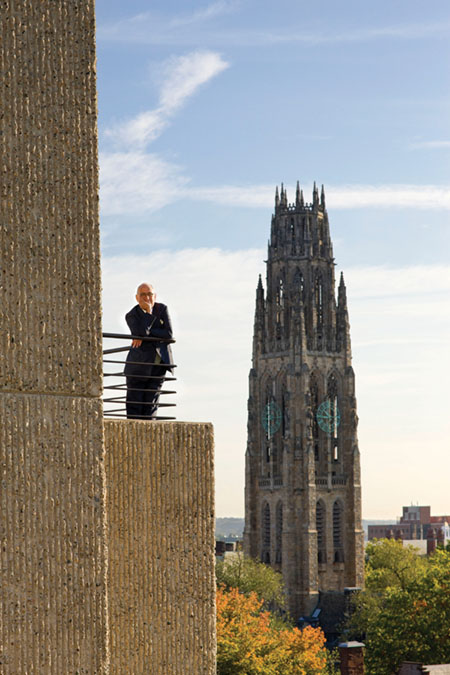
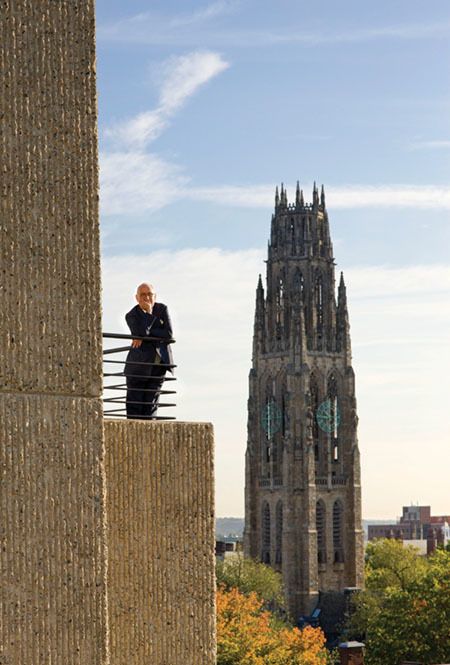
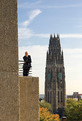
Robert A. M. Stern ’65MArch posed on a balcony of Paul Rudolph Hall--formerly the Art & Architecture Building--in 2008. As dean of the School of Architecture, he oversaw a renovation project that brought the building back to architect Paul Rudolph’s original vision.
View full image
Peter Aaron/Otto
Robert A. M. Stern ’65MArch posed on a balcony of Paul Rudolph Hall--formerly the Art & Architecture Building--in 2008. As dean of the School of Architecture, he oversaw a renovation project that brought the building back to architect Paul Rudolph’s original vision.
View full image
Peter Aaron/Otto
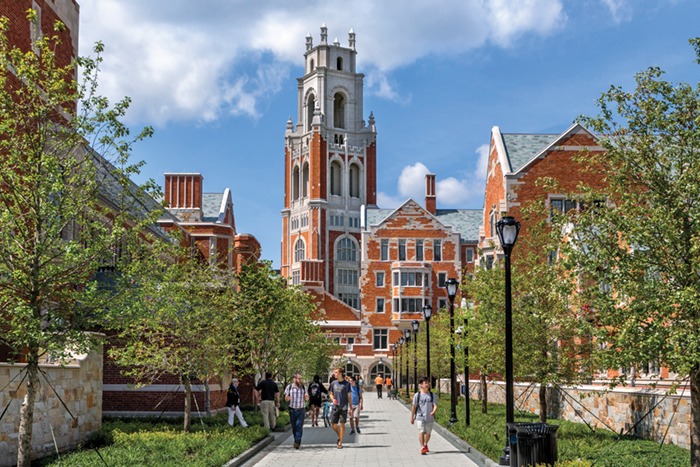
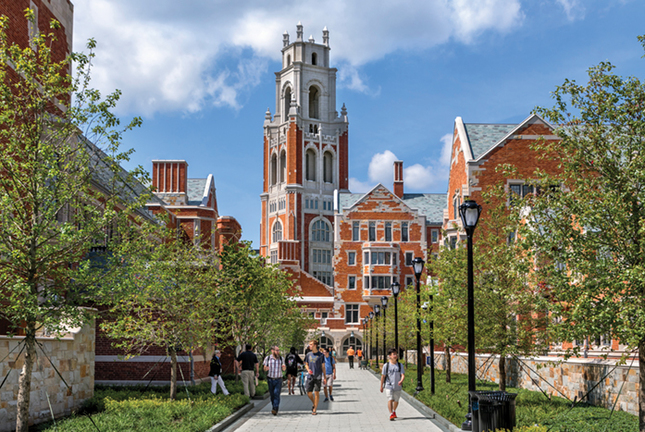
Stern’s design for Benjamin Franklin and Pauli Murray Colleges, completed in 2017, adapted the aesthetic and spatial strategies of James Gamble Rogers’s Yale buildings to the twenty-first century.
View full image

Peter Aaron/Otto
Stern’s design for Benjamin Franklin and Pauli Murray Colleges, completed in 2017, adapted the aesthetic and spatial strategies of James Gamble Rogers’s Yale buildings to the twenty-first century.
View full image
Mark Alden Branch ’86
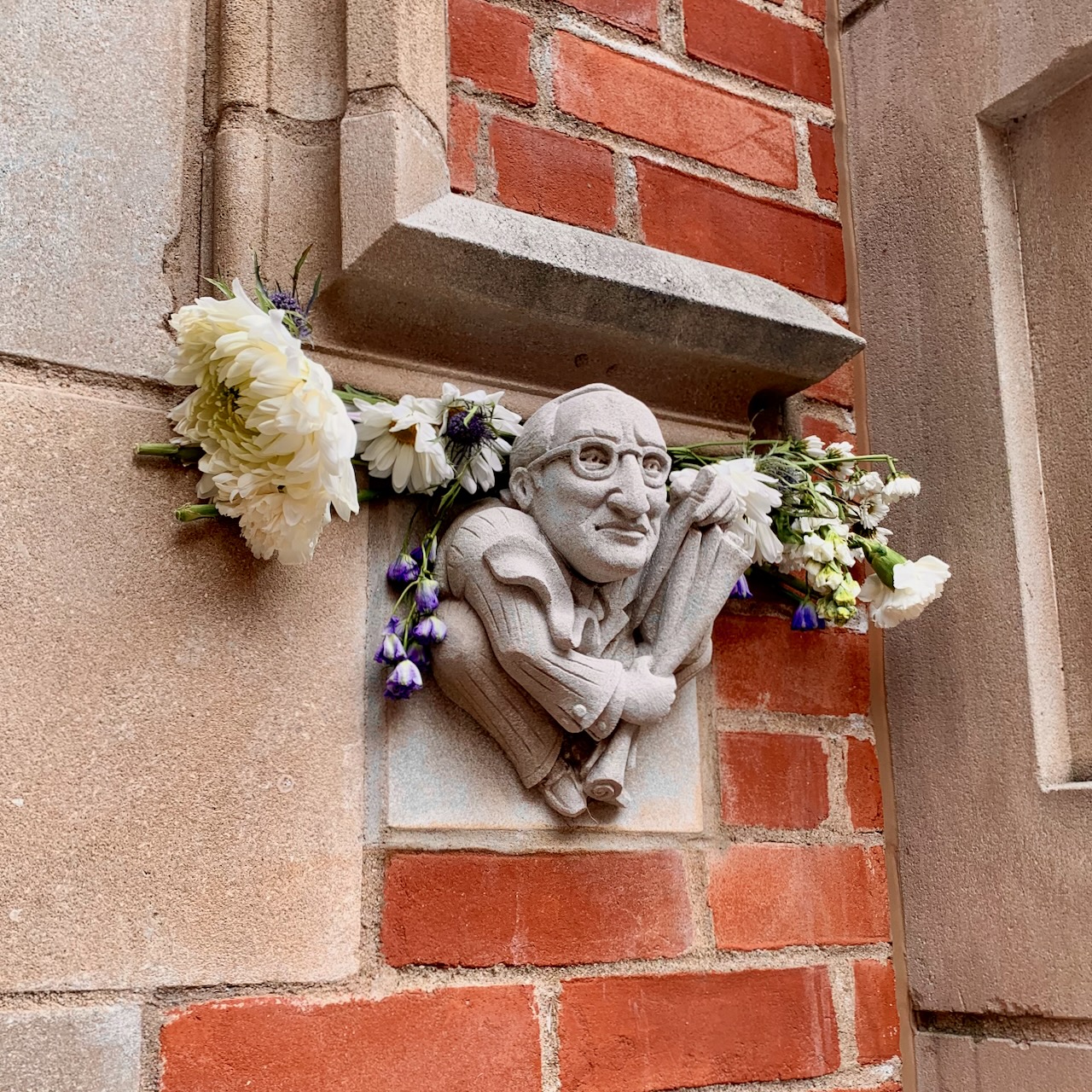
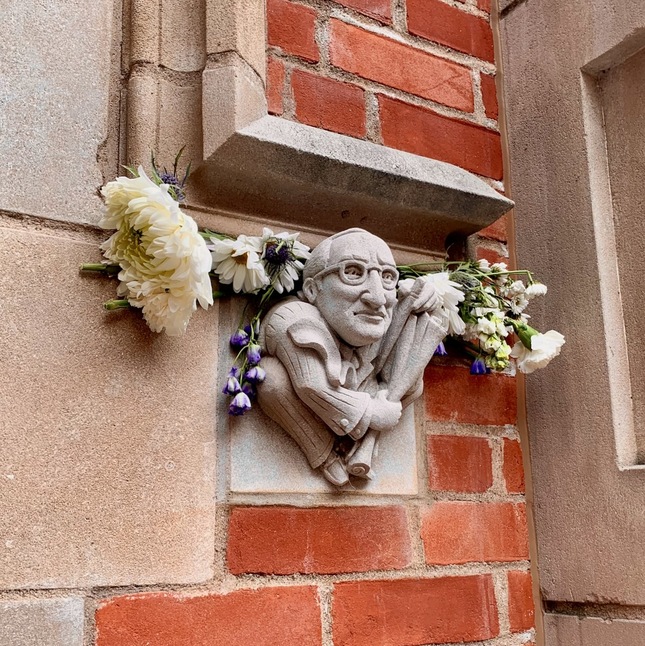
A stone likeness of Stern, embedded in the wall of Pauli Murray College, was adorned with flowers in the days after his death. It has become known as the "Bobgoyle."
View full image

Mark Alden Branch ’86
A stone likeness of Stern, embedded in the wall of Pauli Murray College, was adorned with flowers in the days after his death. It has become known as the "Bobgoyle."
View full image
When Robert A. M. Stern ’65MArch was growing up in Brooklyn, his parents took him to see Broadway shows and classic films of the 1930s, and he learned to play tunes from the Jazz Age on the piano. Stern grew up to be an architect, but show business never quite left him: He had an impresario’s instinct for making architecture—and architectural education—engaging and even delightful.
Stern, who led the School of Architecture as dean from 1998 to 2016, died on November 27 at age 86, ending a remarkably prolific career as a practicing architect, educator, and scholar. His influence on the discipline of architecture is undeniable: He was one of the leaders of a movement that overthrew the minimal modernism of the midcentury and brought premodern aesthetics and forms back into the built environment.
Stern’s influence on Yale, too, cannot be overstated. As the architecture school’s longest serving dean, as architect of two new residential colleges, and as an adviser to the administration on campus architecture, he helped shape the campus more than any single architect since James Gamble Rogers, Class of 1889.
A man of short stature and boundless energy, Stern held court in any room he entered. He dressed impeccably, from his chalk-striped suits to his yellow socks and Gucci loafers. He favored martinis, explaining that he had been told by the architectural historian Henry-Russell Hitchcock that they must be drunk standing up. “If you stand up,” he told Stern, “the martinis follow the law of gravity and drip straight down. You can have more of them in your body.”
A New Yorker for most of his life, Stern majored in history at Columbia before coming to the School of Architecture in 1960. He instantly made a friend of Paul Rudolph, the architecture department’s irascible chair, and he got to watch the construction of Rudolph’s Art & Architecture Building. He also served as a teaching assistant for art history professor Vincent Scully ’40, ’49PhD, an influential writer and lecturer on architecture.
Even as a student, Stern began making connections in the architecture world as editor of the school’s annual journal, Perspecta. His double issue of 1965 included an excerpt from Complexity and Contradiction in Architecture by Robert Venturi, a groundbreaking book that helped launch the rebellion against modernism and the rise of what would become postmodernism.
Aesthetically and philosophically, Stern aligned himself with Venturi and other young architects who—with Scully’s encouragement—were experimenting with subtle ways to bring allusions to historic architecture into their work. In 1973, Stern organized an article in Architectural Forum in which he and four of his fellow postmodernists critiqued the work of five modern architects known for spare, white, minimal buildings. Suddenly, there were two camps in architectural discourse: the “Whites” who wanted to purify modernism, and Stern’s camp, the “Grays,” who wanted to poke at modern orthodoxy by flirting playfully with historic forms.
As Stern started a practice and began to get commissions, mostly for private homes, he was still in what he later called “my period of angst-ridden postmodern experimentation.” Venturi (whose firm designed the Anlyan Center at the Yale School of Medicine) continued to approach history with ironic distance for the rest of his career. But over time, Stern moved toward what he called “modern traditionalism,” a straightforward embrace of historic architecture adapted for the needs of the present and based in close reading of buildings of the past.
This evolving stance cost him cool points in the architectural establishment, but it also made him and his firm very successful. Robert A. M. Stern Architects was soon designing high-rise apartments, high-profile college campus buildings, palatial country houses, and a series of projects for the Walt Disney Company, where Stern was on the board of directors.
At the same time, Stern continued to make a career as a public intellectual in architecture. He began producing a series of enormous, thoroughly researched books on New York City architecture, he starred in a 1986 PBS series on American architecture called Pride of Place, and he taught for nearly 30 years at Columbia’s Graduate School of Architecture, Planning, and Preservation.
By 1998, when Stern was at the peak of his career, Yale’s School of Architecture was looking for a new dean. The school was perceived as being in a slump, and President Richard Levin ’74PhD—urged on by Vincent Scully—thought Stern might be the man for the job. He mentioned Stern’s name to the search committee, but the members feared Stern would impose his own conservative design philosophy on the school.
The four finalists the committee chose were “plausible, good people,” Levin remembers. “But they just didn’t reach the level of eminence or distinction that Bob had as a scholar, as a teacher, and as an architect.” After meeting with Stern on his own, Levin came away convinced that the architect would not “try to run the school as a studio to promulgate his own views, but rather would use his connections in the profession to bring in the very best architects with all kinds of perspectives.” He offered Stern the job.
The decision was not universally celebrated. Many faculty and students were skeptical, and Architecture magazine editor Reed Kroloff ’82 declared Stern “a suede-loafered sultan of suburban retrotecture, a Disney party boy.” (As Stern noted with satisfaction in his autobiography, Kroloff changed his tune several years later, asserting that “Bob Stern may be the best school of architecture dean in the United States.”)
It quickly became apparent that—far from imposing a historicist orthodoxy on the school—Stern was going to encourage an aesthetic pluralism and raise the school’s profile by bringing in a Who’s Who of architecture representing everything from classicism to avant-garde modernism. Zaha Hadid, Frank Gehry, Peter Eisenman, Philip Johnson, Léon Krier, Deborah Berke, and Daniel Libeskind all taught at the school in Stern’s early years as dean.
Besides shoring up the school’s teaching, Stern saw to it that its building got a much-needed renovation. The Art & Architecture Building, largely restored to Rudolph’s original vision, reopened in 2008 and was renamed Paul Rudolph Hall. “He did exactly what he promised,” Levin says. “And a place that was probably not regarded as a top-three architecture school when he took over once again came back to that high level. He was an unarguably great dean.”
Stern’s remarkable energy served him well in a job that has often been challenging for a practicing architect. While he conceded after his appointment that “the days are long, and weekends have been canceled due to lack of time,” Stern had the advantage that, unlike previous deans who were in the earlier stages of their careers, he presided over a large firm in which much of the work was in the hands of his partners and associates. He had long been divorced by the time of his deanship, and his only child was grown.
“I think he’s the smartest architect I ever met,” Levin says. “He just raised the level of any conversation. That’s what made the school such a lively place. He could be sharp and critical, and that sometimes is off-putting for people, but he did it in the spirit of having a debate and talking it through.”
Levin’s confidence in Stern gave the architect a significant role in the development of the campus at a time when the university was putting billions into construction. Levin tapped Stern and former architecture deans Cesar Pelli and Thomas Beeby to serve as an architectural advisory board that would help choose architects for university projects and then review their designs. “Many projects at Yale benefited from their suggestions,” says Levin. “We got better quality work because they were subject to such rigorous review.”
Some of those commissions went to Stern’s own firm. Robert A. M. Stern Architects designed the Greenberg Conference Center on Prospect Hill (2009), the renovations of Commons and Memorial Hall to create the Schwarzman Center (2021), and most notably, Pauli Murray and Benjamin Franklin Colleges (2017).
The colleges were the full expression of Stern’s affinity for historic architecture—and for Yale. Just as James Gamble Rogers and his staff had done a deep dive into the architecture of Oxford, Cambridge, and medieval England to design the original residential colleges, Stern’s team studied Rogers’s work for its details, its patterns, and its strategies. The result is a complex arrangement of student rooms, common spaces, courtyards, and towers, rendered (like their antecedents) in gothic dress over modern steel-and-concrete frames.
Like the original colleges, the new ones have a wealth of ornamental stone carvings. One of them is a full-body likeness of Stern himself, holding a set of blueprints and wearing a suit and his trademark loafers. (See page 1 of this issue.) It has become known as the “Bobgoyle.”
Stern also put a little bit of his beloved Jazz Age into the colleges’ dining halls: two lyrics from his fellow Yalie Cole Porter. Carved into the woodwork in Murray is “Delightful,” “Delicious,” and “Delovely”; and, above the fireplace in Franklin, “It was just one of those things.”
The understatement of the latter quote seems a surprisingly apt epitaph for Stern, who for all his erudition avoided drawing grand conclusions about his own life (despite publishing a 500-page autobiography in 2022). Asked to assess his career by the architecture school’s student magazine Paprika! in 2016, Stern said simply, “I’ve done pretty well for myself. I don’t want to sound smug. Maybe I am a little. You know. I have good days and bad days, as anybody else. But no, it’s fine. I think I’ve been lucky.”
 loading


 Print
Print Email
Email