Yale Athletics
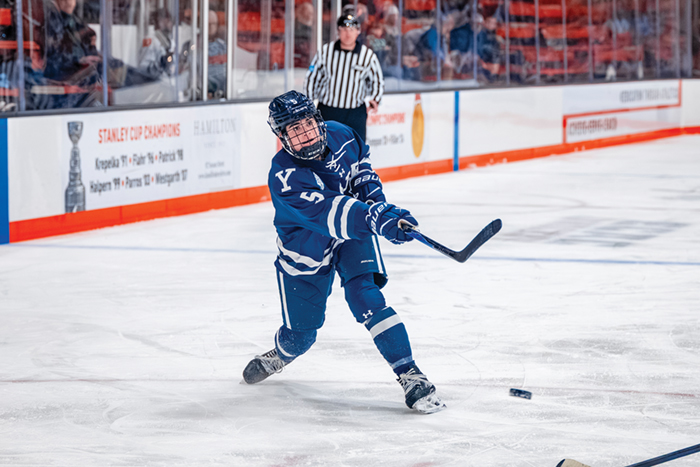
First-year defender Molly Boyle ’29 was a standout for the women’s ice hockey team.
View full image

Yale Athletics
First-year defender Molly Boyle ’29 was a standout for the women’s ice hockey team.
View full image
David Schamis ’95
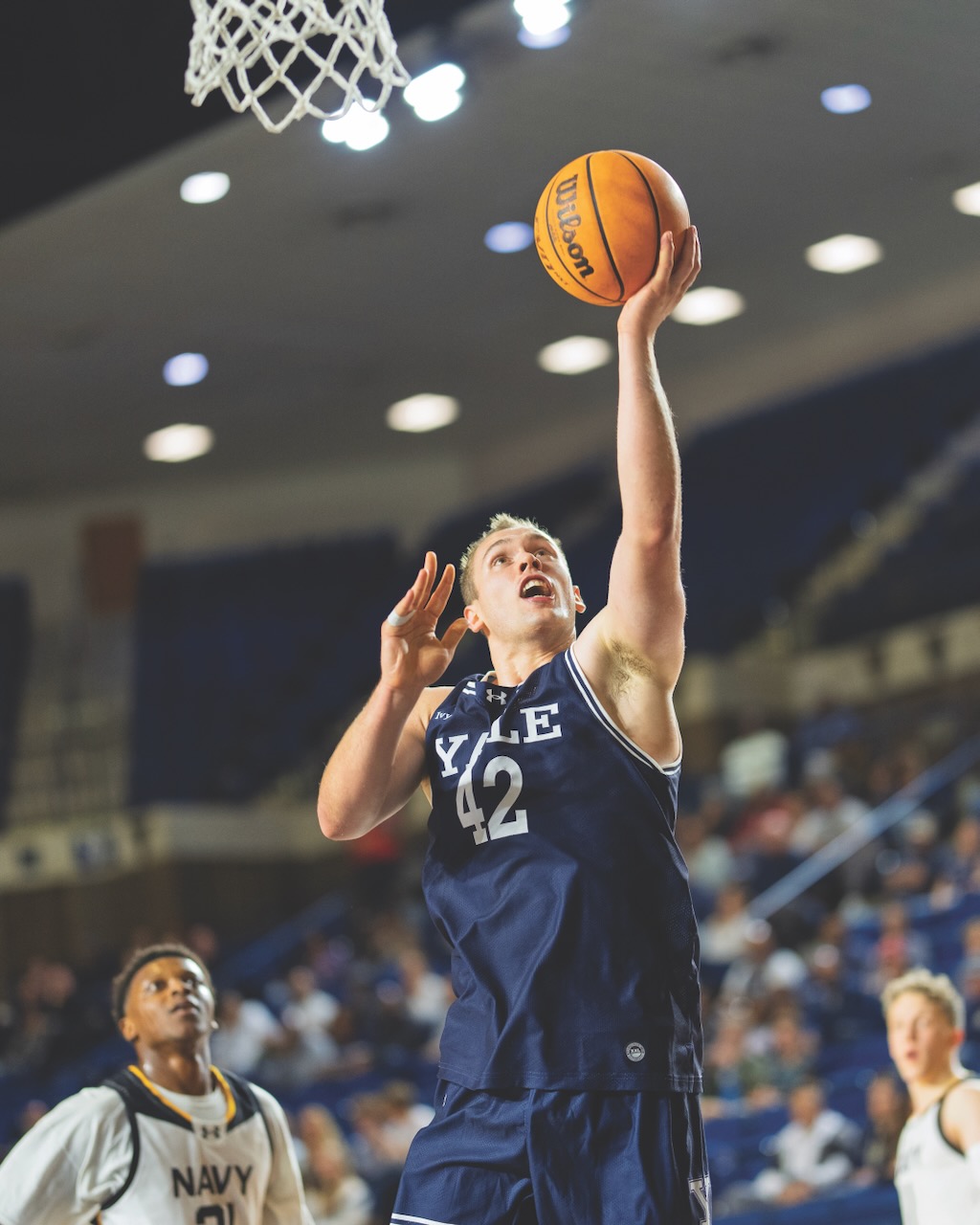
Nick Townsend ’26 was the Ivy player of the year.
View full image

David Schamis ’95
Nick Townsend ’26 was the Ivy player of the year.
View full image
Women’s ice hockey
After two seasons away from the NCAA Tournament, women’s ice hockey stormed back to the national stage this season—and this time, they were led by two first-years who immediately made an impact. Defender Molly Boyle ’29 tallied the most points ever by a Yale defender in a single season and was named a second-team All American. Meanwhile, Samson Frey ’29 took over the starting goalkeeper job in January and went 14–1 to close out the regular season.
“They both had time at the US national camps, and Molly was on the under-18 US team that won a gold medal,” says Susan Cavanagh Head Coach Mark Bolding. “Sometimes it takes a while for first-years to pop back up athletically, so it was great to see.”
In yet another multi-month winning streak, the Bulldogs won 14 straight games between December 7 and February 14, just one short of the previous record of 15 set in the 2022–23 season. On the final night of the season, despite an overtime loss to Quinnipiac, the Bulldogs clinched their second ECAC regular season title in program history. In the ECAC tournament, Yale, ranked a season-high seventh in the country, cruised through the early rounds to once again face their Hamden foes in the tourney final, falling 5–1 in a battle of two of the conference’s top teams.
The ECAC loss didn’t keep the women out of the 11-team NCAA field. It was just their third NCAA appearance, all of which have come in the last five seasons. In a first-round game versus Minnesota–Duluth, the first-year duo’s dominance was on full display. Frey turned away all 37 shot attempts from Duluth in a shutout, while Boyle notched the game’s only goal in a 1–0 victory. Their reward for advancing to the quarterfinals was a matchup against top-ranked Ohio State. The Bulldogs held tough in the first period, with Boyle responding to an early Buckeye goal by scoring a quick equalizer of her own. But Ohio State’s firepower proved to be too much, as the eventual national runners-up pulled away to win 6–1.
While the first-years stole the spotlight, the year was a reminder of the growing foundation of success for this program. Captain and senior Carina DiAntonio ’26, who joined the team just as it was making its rise, ended her career as the second-leading goal scorer in Yale history. Bolding, once again a national coach of the year finalist, has found a winning formula—and a first-year class likely to keep it going. “It’s just a great hockey town and a good school with a history of hockey. It’s everything I’d hoped,” he says. “Now, I get greedy. I want to win the ECAC championship. And I want to see our players continue this path to be a relevant team in the NCAAs.”
Men’s basketball
Even in his 26th season, Joel E. Smilow ’54 Head Coach James Jones is still finding a way to set records. This year’s graduating seniors, including Ivy player of the year Nick Townsend ’26 and defensive player of the year Casey Simmons ’26, finished their careers as the winningest class in men’s basketball history with 90 wins, eclipsing the record of 85 set last year.
In fact, the Bulldogs’ overall win total of 24 was its best in more than a century, when the 1906–07 team went 30–7–1. The team started hot, winning 11 of its first 12 games, and clinched another Ivy League regular season title with an 11–3 conference record. Headed into the Ivy League Tournament in Ithaca, Yale was a significant favorite to make its fourth March Madness appearance in five years.
In a semifinal against Cornell in Ithaca on March 14, Yale led the entire time and pulled away late to win 88–76. Yale had made its seventh Ivy championship game in just the eighth edition of the Ivy tournament—and Jones wanted to be sure to not mistake the success for luck. “This doesn’t just happen. We’re very fortunate to be in this position again, but it’s really hard,” said Jones after the win, smiling. “As I’m getting older, I think it’s getting harder year by year.”
All that stood in the way of Yale were the Penn Quakers, whom Yale had already bested twice during the regular season. This time, however, the Bulldogs ran into perhaps the greatest individual performance in the short history of the Ivy League Tournament. Penn’s TJ Power poured on 44 points, including two three-pointers in the final seven seconds of regulation, to send the game to overtime. After five extra minutes, Yale fell 88–84, booking Penn’s first NCAA trip since 2018 and leaving Yale out of the Big Dance. Power “had the game of his life,” said Jones afterward.
Yale’s surprising absence from the NCAA bracket gave it the opportunity to host a National Invitation Tournament (NIT) game at home in the John J. Lee Amphitheater. The Bulldogs were matched up against the University of North Carolina–Wilmington in a battle of broken hearts: the Seahawks had similarly taken the Coastal Athletic Association season crown before falling in their conference tourney. Yale led by as many as 14 before UNC Wilmington stormed back to take the lead in the final seconds and win 68–67, another painful loss to cap an otherwise historic year. “The message is that life is hard, and there’s going to be ups and downs. This won’t be the last down these young men have,” said a characteristically reflective Jones after the Ivy final. “If you coach long enough, you’re going to be on both ends of everything.”
 loading


 Print
Print Email
Email