Nathan Chellman
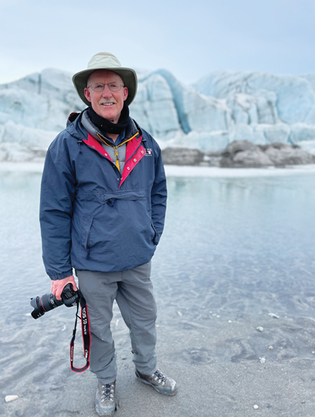
Climate and environmental scientist Joe McConnell ’82 has been studying ice from Greenland for more than 30 years, most recently to explore evidence of industrial pollution during the Roman Empire.
View full image
After more than 30 years studying ice from Greenland and the Russian Arctic, Joe McConnell ’82 helped uncover the potential health impacts of one of the earliest examples of industrial pollution in history, finding enough lead contamination from Roman silver smelters two thousand years ago to drop the average IQ of people in the Roman Empire by three points. McConnell, a climate and environmental scientist with the Desert Research Institute in Nevada, came to his work circuitously, working on an archeological dig while still in high school, running his own hydrology firm before college, and exploring the collapse of a melting section of Alaskan glacier after his junior year at Yale.
Tina Kelley: What was the coldest field work you ever endured?
Joe McConnell: It was in November in the South Pole. We were sitting in the galley having coffee, and we looked at the weather monitor. It showed –100 degrees [F] with windchill. We just said, “Let’s have another cup of coffee.” Everything freezes really quickly at that temperature. Your whole face has to be completely covered, and the main thing is to try to get out of the wind.
TK: How did you stay warm at night in Greenland when all you have is a tent?
JM: In the nighttime it’s 5 degrees. Even in –40-degree sleeping bags, people with my hairline have to put their head inside the bag. The colder the bag is rated, the more narrow it is. It’s like squeezing into a sock almost. When you roll over, the whole sleeping bag rolls over with you.
TK: Your studies often measure trends in the climate, reflected in ice cores. How is your work itself affected by climate change?
JM: In a manuscript my British colleagues and I are about to submit about the stability of the Greenland ice sheet, the bottom line is that while snowfall hasn’t changed appreciably in response to climate warming so far, melt rates around the edges have accelerated dramatically, leading to overall mass loss of the ice sheet and increasing sea levels. Mid- and low-latitude alpine glaciers, where some of our ice cores are collected, are in rapid retreat. The climate is very clearly warming even at the highest elevations in Europe.
TK: How does that affect your work?
JM: In higher elevation “accumulation zones” on glaciers and ice sheets, more snow falls each year than melts, so annual layers in the snowpack ice form sort of a layer cake of climate and environmental history. Warming makes these zones move to even higher elevations and, if extreme enough, can make them disappear entirely. This is a big concern for alpine glaciers, since their accumulation zones already are relatively small.
TK: Your interests in archaeology and polar ice came together in this recent paper. How did those stars align?
JM: A decade ago some ancient historians in Oxford heard through the grapevine that my lab could study atmospheric lead encapsulated in ice cores. They asked if we could do something in the Roman period. It was an interesting experience, because I’d had no idea that ancient historians were having this debate about whether the Roman economy was stronger under a republic or empire. We could help by looking at the annual rate of lead pollution, from ice in Greenland. Turns out it was more successful under an empire.
TK: Your first experience doing research on ice came from seeing a flyer in the geology building [at Yale] about an Alaskan glaciology program. A year later, you returned to Alaska to study a glacier that had stopped growing. What sent you in that new direction?
JM: While we were camping on the ice, all of a sudden it started cracking away. When we got up the next morning, something had changed. We could tell from looking at bathtub rings around the edges of the glacier that the surface had dropped about six meters overnight. Turns out water was backing up in the valley, with the glacier floating on top. When the ice dam holding back the water failed that night, the lake drained suddenly. It was serendipity, refocusing my whole undergraduate thesis.
TK: What’s the oldest ice you’ve studied?
JM: Six million years—it was just a little piece of ice from Antarctica I was asked to analyze by colleagues from Oregon State, to understand climate systems.
TK: What do really ancient ice cores look like?
JM: The top of the ice sheet is porous, as there’s snow that’s compressing. At 80 meters or so it compresses into ice. Air bubbles are the issue. Eventually, if the pressure is great enough, over enough time, the gas is absorbed into the ice itself. In Antarctica, when we worked with cores that were 60,000 years old, you could basically read a newspaper through it.
 loading


 Print
Print Email
Email