Marco Ventura
Marco Ventura
Marco Ventura
Marco Ventura
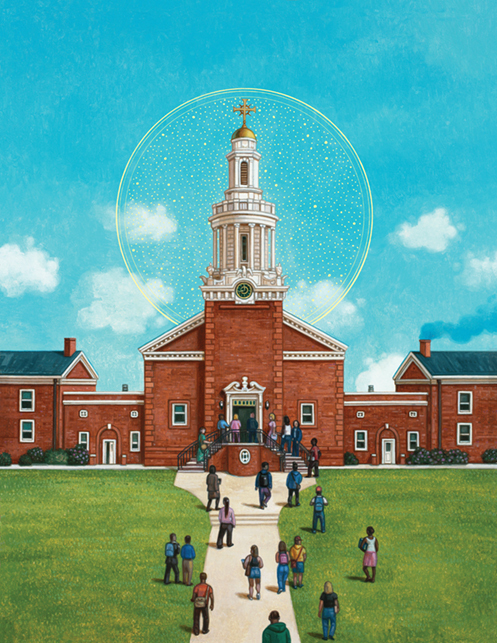
Atop Prospect Hill the faculty and students of Yale’s Divinity School (YDS) dwell on notions lofty, ethereal. The spire of Marquand Chapel rises in narrowing circles toward the heavens. People apply to the school and attend it because “they want to ask the big questions in life,” says Dean Greg Sterling. “So we give them space to ask these big questions. We give them room to explore and change their minds.”
Earthly matters intrude. Fundraising, enrollment, tuition, class size, acceptance rates. There is no way to ignore the mundane, even as it operates in service to the sublime. And the mundane possesses a particular weight these days; Christianity is navigating a fraught moment. Gallup found in 2020 that, for the first time in eight decades of measurement, church membership in the US dropped below 50 percent, down to 47 percent. In 1999, this figure was 70 percent. Between 2021 and 2023, a greater percentage of Americans said they never attend religious services than said they attend every week. And in 2023–24, the share of people who considered themselves religiously unaffiliated—29 percent—was greater than those who identified as Catholics or evangelical Protestants.
Every system holds inertia. Though these trends of declining religiosity in the American public began last century, only now, a generation or two later, are the repercussions extending into seminaries and divinity schools.
“It’s like the old line Hemingway had about going bankrupt: first gradually, then suddenly,” says Sarah Birmingham Drummond ’93, the founding dean of Andover Newton Seminary at YDS. As religious membership started declining at churches around the country, those churches generally invested less in youth education and training—precisely the kinds of investments that put kids on track to ministerial education. “We in higher education are feeling the knock-on effects 50 years later.”
Drummond’s own story neatly demonstrates the predicament. Andover Newton Seminary, founded in 1807 and tied to the American Baptist Church and the United Church of Christ, is the oldest theological graduate school in the country, indeed the oldest graduate school of any kind. It established the blueprint for modern Protestant theological education. But its historical significance could not insulate it against modern trends. Enrollment fell from 450 in 2005 to half that 11 years later.
Over that same period, the school, with an operating budget of about $7 million, ran a deficit of $1 million or more every year. It deferred essential maintenance on campus. All of these challenges led to a conversation with YDS and, in July 2017, an agreement for Andover Newton’s formal affiliation with YDS and its eventual relocation to campus in New Haven.
This move primarily allowed Andover Newton to slash the kinds of expenses associated with operating a school, from health care and technology costs, which have risen significantly in recent years, to administrative staffing and campus upkeep. Andover Newton is now a partner within YDS; Yale is the degree-granting institution, while Andover Newton provides more focused tradition-specific education for those motivated to enter the ministry after graduation. This is the second partnership of its kind for YDS. In 1971, it formed an affiliation with the Berkeley Divinity School, which retained its mission of forming Episcopal and Anglican priests while Yale awarded degrees.
Mergers like this are increasingly necessary for many small seminaries that want to keep their doors open. About 20 percent of seminaries and schools that are accredited by the Association of Theological Schools were affiliated with larger, external institutions 30 years ago. The number as of 2024 is more than 40 percent, with a majority of those programs still experiencing declines in enrollment.
For YDS, these trends raise the simple but profound question of how a centuries-old institution rooted in even older traditions might need to evolve. What service is YDS trying to provide its students? What service is it trying to provide the world?
Engaging with society
These aren’t novel concerns for the church or the schools that feed into the church. Public religiosity ebbs and flows. Relevance is always a concern. YDS, founded in 1822, has over its history encountered other seismic shifts in the broader world to which it serves as shepherd. In the mid-1800s, widespread diffusion of the scientific method and the intellectual revolutions that spun out from publications like Charles Lyell’s Principles of Geology and Charles Darwin’s On the Origin of Species raised a host of existential questions for many traditional tenets of faith—notions about Earth’s creation and man’s descent. YDS professor George Park Fisher responded in 1872 by noting that Yale’s Calvinist heritage encouraged engagement with the world’s workings. “We rejoice in the progress of discovery and in the diffusion of knowledge, for we believe that the tendencies of knowledge, in the long run, are favorable to religion,” he said.
A half century later, in the early 1900s, YDS faced tremendous internal uncertainty. After the dean stepped down, five candidates in a row declined taking on the position. The number of students enrolled in the school’s ministerial track was dwindling, calling into question the need for a stand-alone divinity school. The situation became so dire that William Howard Taft, Class of 1878, a member of the Yale Corporation and sitting president of the United States, was called up from his office in the White House to discuss the fate of YDS.
The school responded by embracing an ecumenical approach to Christianity and retooling its curriculum in a way that, perhaps most importantly, fused the ethical teachings of the Christian faith with contemporary social concerns.
As an editorial in the Yale Alumni Weekly put it: “We are interested in our fellows, and their social health and well-being, today, where our ancestors were interested in their theology.”
Enrollment numbers rebounded.
Another reckoning took place in the 1990s, when a YDS review committee was appointed to examine the school’s role in a rapidly changing society—greater secularization, a rise in unaffiliated spirituality, a recognition of the importance of faith traditions besides Christianity. “YDS cannot continue its strategic leadership role in theological education without engaging this set of problems,” wrote then-dean Thomas Ogletree.
The point, as YDS associate dean of ministerial and social leadership Bill Goettler puts it, is that YDS has long been attuned to the tensions between the teaching of tradition and the dynamism of society at large. Yes, central to an education at YDS are the unchanging texts of the Hebrew Bible, the New Testament, and ancient theological tracts. And yes, YDS has also led the academy, and sometimes society at large, when wrestling with pressing contemporary social questions related to race, gender, nuclear disarmament, and the environment.
“It’s not like there is a bank of knowledge that was taught in 1890 that makes one a minister, and it was taught in 1990, and is still being taught in 2026,” Goettler says. “The study of theology and ethics and sacred texts and the history of all of these things tends to be very responsive to on-the-ground questions about what it means to be human, what it means to be a society that is trying to think about issues of economics and justice. What we do here is never unrelated to issues in society at the time. We’re always engaging with these things.”
All to say that today’s questions of waning religious affiliation may raise challenges that are novel in their particularities, but recognizable in the abstract.
The reputation of YDS, built over many decades, along with the solid footing given by its attachment to Yale University, has meant the school is by and large shielded from the patterns of the day. “We’ve of course been concerned about the trends,” says Dean Sterling. “But we’ve also had record numbers of applications over the past three years.” Admission is more competitive than it has ever been, especially now that the new endowment tax will shrink the size of the student body from 300 to 285. Numbers are solid. (It doesn’t hurt that the school raised enough money over the past 14 years to offer a tuition-free education to nearly every student who is admitted.)
At the same time, YDS is not untouched by the world beyond its quadrangle. For the first time in the school’s history, those enrolled in the master of arts in religion (MAR) track—a two-year degree for those who typically do not plan to enter ministry or chaplaincy—outnumber those enrolled in the master of divinity (MDiv), the three-year professional degree program around which the school was founded, which prepares students for ordination in whichever denomination they choose. (YDS itself, like most divinity schools, does not offer ordination in any particular denomination.)
The school also recently overhauled its MDiv curriculum, perhaps most importantly instituting a cohort model like those at the Schools of Medicine and Management. This was designed to help fill a growing educational gap. As Goettler described it, YDS students a generation or two ago would take what they’d been studying at school and discuss it with clergy friends or mentors. While YDS offered an intellectual foundation in Christian theology and ethics, students had the opportunity to understand the practical interpretations and applications of this information in their own communities.
Many students today enter YDS without any strong attachment to a childhood church or denomination. “The decline of a clear affiliation with denominations among many of our students has meant that this kind of support structure is less robust,” Goettler says. “We realized we need to help provide a bit of this processing with students.” Each cohort over the first half of their MDiv program sticks together for 50 percent of their classes. They also meet on a weekly basis with an assigned senior faculty member to step back from coursework and “see how the pieces fit together and how they don’t.”
YDS is also helping to reestablish the “docking mechanism” between seminary programs and churches, as Drummond puts it. The same fading attachment to religious communities that the cohorts are designed to replace once gave students interested in ministry a clear job pipeline from seminary to ministerial roles. In the absence of this attachment, Drummond is proactively trying to rebuild connections with local churches, asking them what they need from recent graduates and shaping coursework to suit these needs.
Beyond the mechanics of the MDiv, YDS has created certificate programs that allow students to concentrate in areas like public policy and educational leadership. It hired Alison Cunningham ’84MDiv to help students land summer internships not only in churches, but in nonprofits. And it has created joint degree programs with the School of the Environment, the Law School, and the School of Management, to name a few. Leadership has also embraced the moral imperative of planetary stewardship through the discipline of ecotheology, demonstrating this commitment by building the Living Village, a residential complex that follows some of the world’s most stringent sustainable building standards (“Communing With Creation,” July/August 2024). Most recently, YDS established a joint degree in social work with the University of Connecticut and Quinnipiac University.
“It’s not unusual for someone to come into the school thinking they’ll go into ministry and then maybe they change their minds,” says Sterling. “And the reverse happens, too: Someone arrives assuming the last thing they’ll do is become a minister or a priest and then they end up serving in that role. What we want is for these people to help change society in whatever capacity they serve.”
New forms of ministry
Despite declining public religiosity—or perhaps because of it—ministerial jobs are relatively easy for YDS graduates to find. “I can say with a clear conscience that our placement rate is beyond reproach,” says Andrew McGowan, the outgoing dean of Berkeley Divinity School at YDS.
But the work itself has changed across many denominations. Molly Baskette ’96MDiv, who has been an ordained minister in the United Church of Christ (UCC) for nearly 30 years, notes that besides being the leader of her church she is now expected to be a director of videography for holiday services and a director of marketing to recruit new churchgoers. She is a fundraiser, an event planner, a therapist, a social justice activist. During the pandemic, when her services went online, that final bastion of privacy—her home—was breached. It remains so today.
She is ever grateful for her calling and for the work she gets to do, but these changes present a recipe for burnout, she says. “It is hard to set careful boundaries. You end up being the personal chaplain to lots of folks with really challenging issues and you can’t just say after 30 minutes, that’s our time today; here’s the bill,” Baskette says. “So many churches are in slow decline, and those who lead them are always asked to do more with less.”
Given this landscape, alumni are finding other paths to satisfy their calling. In 2019, Chad Tanaka Pack ’10MDiv left his work at the Collegiate Churches of New York; a year later, he moved west and took a job at Inner City Law Center in LA’s Skid Row. There he worked as a project coordinator supporting attorneys and paralegals who served veterans experiencing or at risk of homelessness. During this time, Tanaka Pack “had a mystical encounter with a person who was thirsting,” he says. Tanaka Pack gave him a bottle of water and, through this experience, “saw that this was a deeply spiritual encounter, and that for none of us should our spirituality be limited to the church.” He began to view his work, though not formally within a church, as a form of ministry.
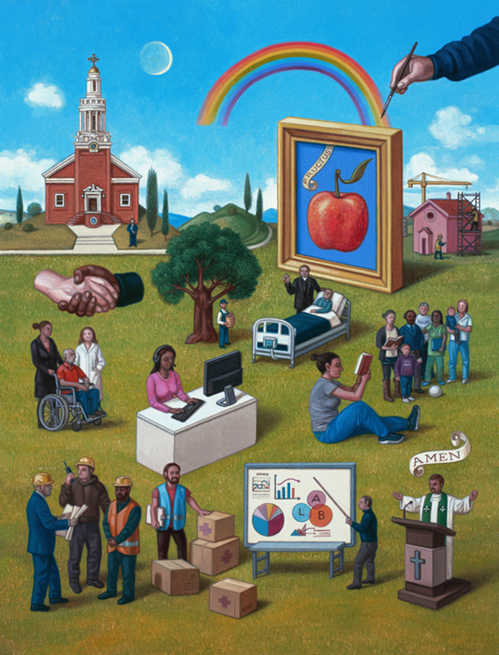
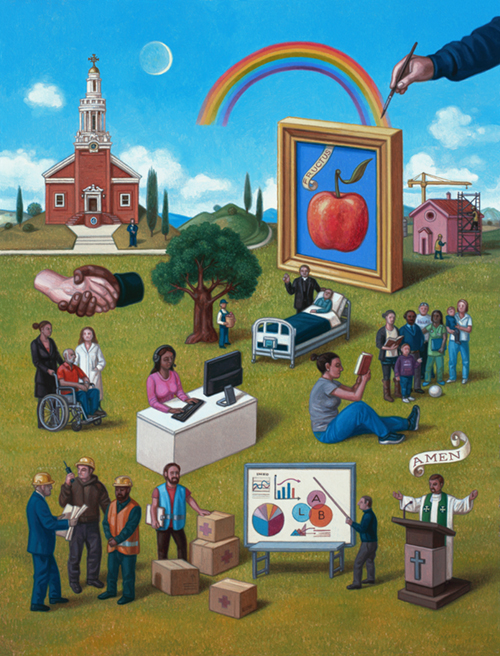
YDS has responded with its own quiet reevaluation of what it means to do ministry, says Tom Krattenmaker, the school’s director of communications. The vocational call need not apply simply to a traditional pastor in a church, though that remains a big part of what YDS does. People leading nonprofits or doing critical work to uplift their communities are practicing a form of ministry. Those in the arts can be practicing ministry. Even leaders in the business sector, he said, when working in service to others, might be performing a kind of ministry.
The main point is twofold: First, YDS was founded with a scholarly focus on Christian theology and it remains today the product of this doctrine. Second, what Christianity means in the world, how it is practiced, and the ends that it serves in many ways look different than they did in 1822, when YDS began, which means that the school itself is reexamining and repositioning—constantly—how the Christian doctrine is made manifest in the classroom, in curriculum, in a diploma to graduates who are often inspired by some grander purpose.
Drummond says she’s not a believer in the “decline narrative” of the church. “We shouldn’t compare the church of today with the 1950s and feel discouraged, as we’re no longer in an age of trusted institutions,” she says. “Something new is being born as something older is fading away. We don’t yet know what is being born. We might see glimmers, and these are encouraging, they are exciting, but they are also amorphous, ephemeral. We need not rush what comes next.”
What precisely the future holds—God knows.
 loading

 2 comments
 Print
Print Email
Email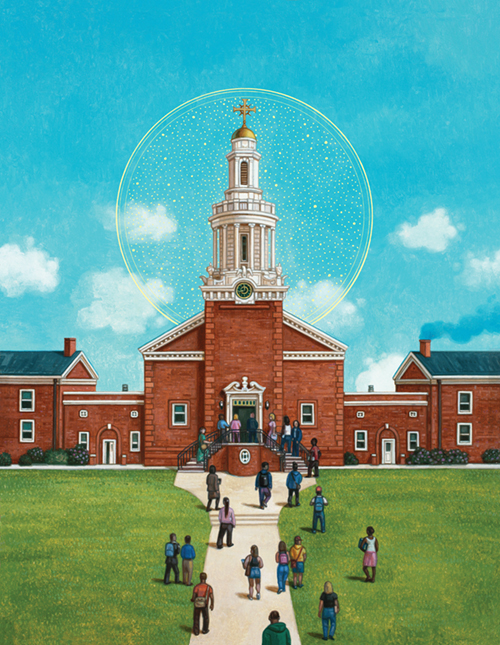
2 comments
-

David Smith, 6:51pm May 01 2026 |  Flag as inappropriate
-

Elaine Gaetani , 1:42pm May 03 2026 |  Flag as inappropriate
The comment period has expired.This is an amazing time and opportunity to lead the Church.
So grateful for the ever expanding understanding of ministry & mission. Surely God is doing a New Thing! Especially grateful for the Presence and influence of ANTS within the larger Yale Divinity School context.