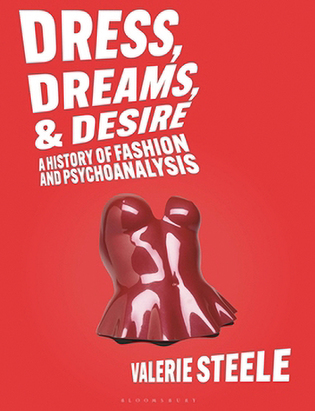
Dress, Dreams, and Desire: A History of Fashion and Psychoanalysis
Valerie Steele ’83PhD
Bloomsbury Visual Arts, $35
Reviewed by Rhonda Garelick ’83, ’91PhD
In Dress, Dreams, and Desire: A History of Fashion and Psychoanalysis, Valerie Steele, fashion historian and director of the museum at New York’s Fashion Institute of Technology, succeeds at a multilayered challenge: she elevates a subject too often trivialized (fashion), demonstrates its surprising connections to a complex and theoretical field (psychoanalysis), and manages to retain and illustrate the visual and sensual pleasures that undergird it all. This is a guide to understanding fashion’s gravitas through its long-standing relationship to Freud’s work, and that of his descendants.
A Yale-educated historian, Steele launched her career by training a serious gaze on a topic normally confined to what used to be called the “women’s pages” of newspapers. In this, her work is not only trailblazing in fashion studies, it’s feminism in action. For decades, Steele has set the standard for this field—in both her dozens of books and in her curatorial work. Dress, Dreams, and Desire was in fact also the subject of an acclaimed exhibition at FIT’s museum—one of more than 20 Steele has organized.
Fashion is a switching point, where the electric vectors of social status, desire, gender identity, art, power, and personality all intersect. As such, it has long fascinated psychoanalysts. Steele unpacks the aspects of Freud’s theories most relevant to fashion, such as the role of dream imagery, sexual exhibitionism, and fetishism. She then pans outward to consider thinkers such as Jacques Lacan, Joan Rivière, J. C. Flügel, and Didier Anzieu—who coined the concept of the “skin ego” (which treats bodily surfaces as a space for analytic interpretation)—and even fashion designer Bella Freud, great-granddaughter of the master himself, who now hosts a podcast called Fashion Neurosis.
Along the way, the ever-erudite Steele culls examples from literature, visual art, cinema, performance, and works by such luminary designers as Coco Chanel and Elsa Schiaparelli (whose Surrealist collaborations channeled Freudian imagery) through Rei Kawakubo, Alexander McQueen, Versace, and more. (There’s a great section interpreting the nearly-naked green Versace number famously worn by Jennifer Lopez at the 2000 Grammys.) Her section on gender-fluid fashion deserves special attention for its timely relevance.
Rhonda Garelick ’83, ’91PhD, directs Hofstra University’s Institute for Public Humanities and the Arts and writes the Face Forward column for the New York Times. Her most recent book, Why Fashion Matters, will be published by Yale University Press in fall 2027.
__________________________________________________________________
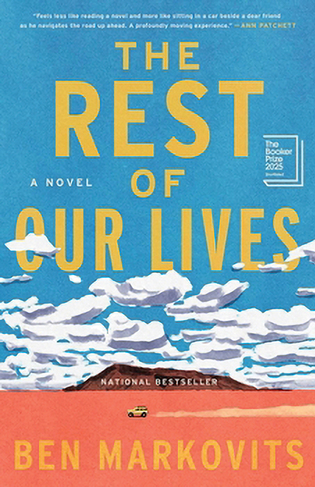
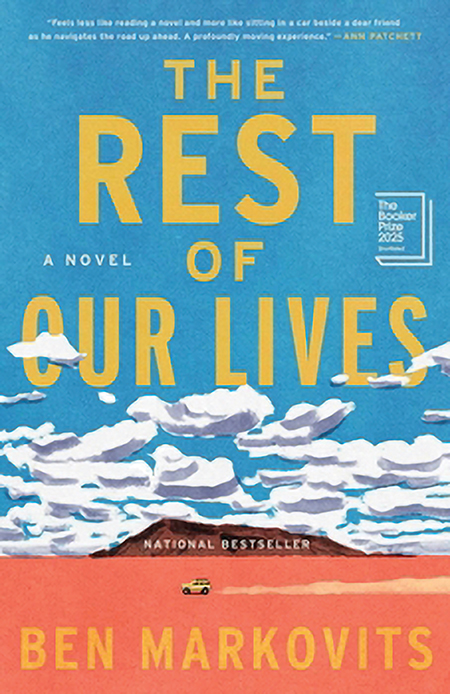
The Rest of Our Lives
Ben Markovits ’96
Summit Books, $28
Reviewed by Alex Beam ’75
This quick, successful novel departs from a simple premise: by way of payback for his wife’s brief affair, 55-year-old Tom Layward resolves to leave her after their youngest child goes off to college. One fall day, he drives their daughter Miriam from Scarsdale to her freshman dorm at Carnegie Mellon University and keeps on driving west.
The Rest of Our Lives is part road novel and part domestic satire, with a huge dollop of excellent storytelling commenting on adults’ illusions. It feels light, like the books British novelists such as Barbara Pym or Anthony Powell tossed off (seemingly) effortlessly in the second half of the twentieth century. It was short-listed for the 2025 Booker Prize, deservedly so.
This book has an insightful feel, as if Jack Kerouac and Anton Chekhov were piloting a used Nissan Sentra along Interstate 80, sampling questionable food along the way (a “bourbon burger” in Akron; then Cracker Barrel, TGI Friday’s, and a stint of “living off Pop’ettes and Fritos”). Maybe John Updike is in the back seat, tossing off advice. Layward was working on a PhD about Updike before he abandoned literary studies for law school. Like Updike’s famous Harry “Rabbit” Angstrom, Layward had a brush with youthful basketball stardom—he made varsity at Pomona College—and cherished the random pickup game. (Markovits played professional basketball in Germany.)
Unmoored from his wife and family, Layward’s westward progress takes him to the homes of his brother, his college girlfriend, and a former teammate who thinks his old buddy can assist on an anti-discrimination lawsuit against the NBA on behalf of white American basketball players. Layward finds the idea repellent. Instead, he deludes himself into thinking that he will write a book about pickup basketball. When he puts pen to paper, nothing happens.
If writing books was easy, everyone would do it. Writing books as smooth, clever, and digestible as The Rest of Our Lives is well near impossible. But you have only to read it, and you should.
Alex Beam ’75 is the author, most recently, of Broken Glass: Mies van der Rohe, Edith Farnsworth, and the Fight Over a Modernist Masterpiece.
__________________________________________________________________
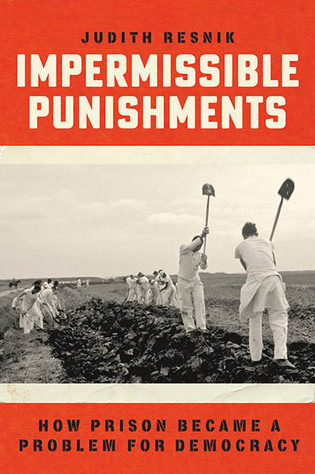
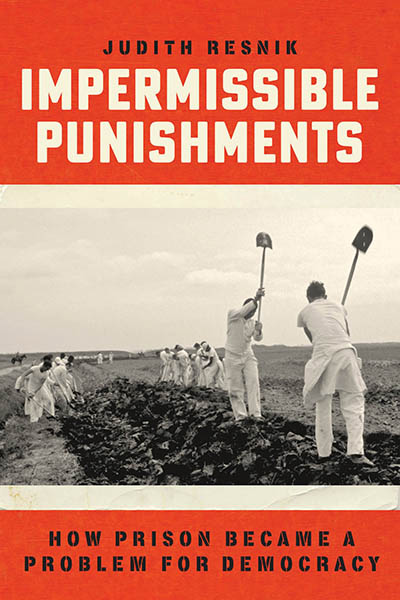
Impermissible Punishments: How Prison Became a Problem for Democracy
Judith Resnik
University of Chicago
Press, $45
Reviewed by Sam Rosen
In 1980, more than 30 states banded together in asking the Supreme Court to make a curious distinction: to prohibit in America’s prisons the infliction of “pain that hurts” but allow the causing of pain that leaves only “a dull ache.” This proposed delineation is one of many bewildering moments in Impermissible Punishments, in which Yale law professor Judith Resnik traces the long-standing and often surreal debate about what kinds of harm the government may impose upon the people held in its prisons.
Until the middle of the twentieth century, this question barely registered as one worth asking. With “few exceptions,” Resnik explains, the “people running prisons were oblivious to the status of prisoners as persons with rights.” This changed in the 1960s, when incarcerated litigants in Arkansas won a series of partial but groundbreaking victories, bringing challenges to the practice of whipping that forced courts to acknowledge that prisons were not Constitution-free zones. This period, Resnik argues, inaugurated the era of carceral punishment, “in which ‘rights’ and ‘prisons’ have shared space” uneasily.
If Resnik favors detail over narrative propulsion, the effect is to see how consistently our legal and political elites have championed brutal violence with no discernible shame. “If Arkansas can no longer whip prisoners,” Resnik asks, “why can governments cut off people from their families, subject them to isolation and to intense, close contact with strangers, and turn normal human movement and desires into in-prison crimes?” The judges and officials who populate Resnik’s book offer many answers but none of them are particularly convincing.
Sam Rosen is a journalist and civil rights lawyer.
 loading


 Print
Print Email
Email