Michael Ipsen
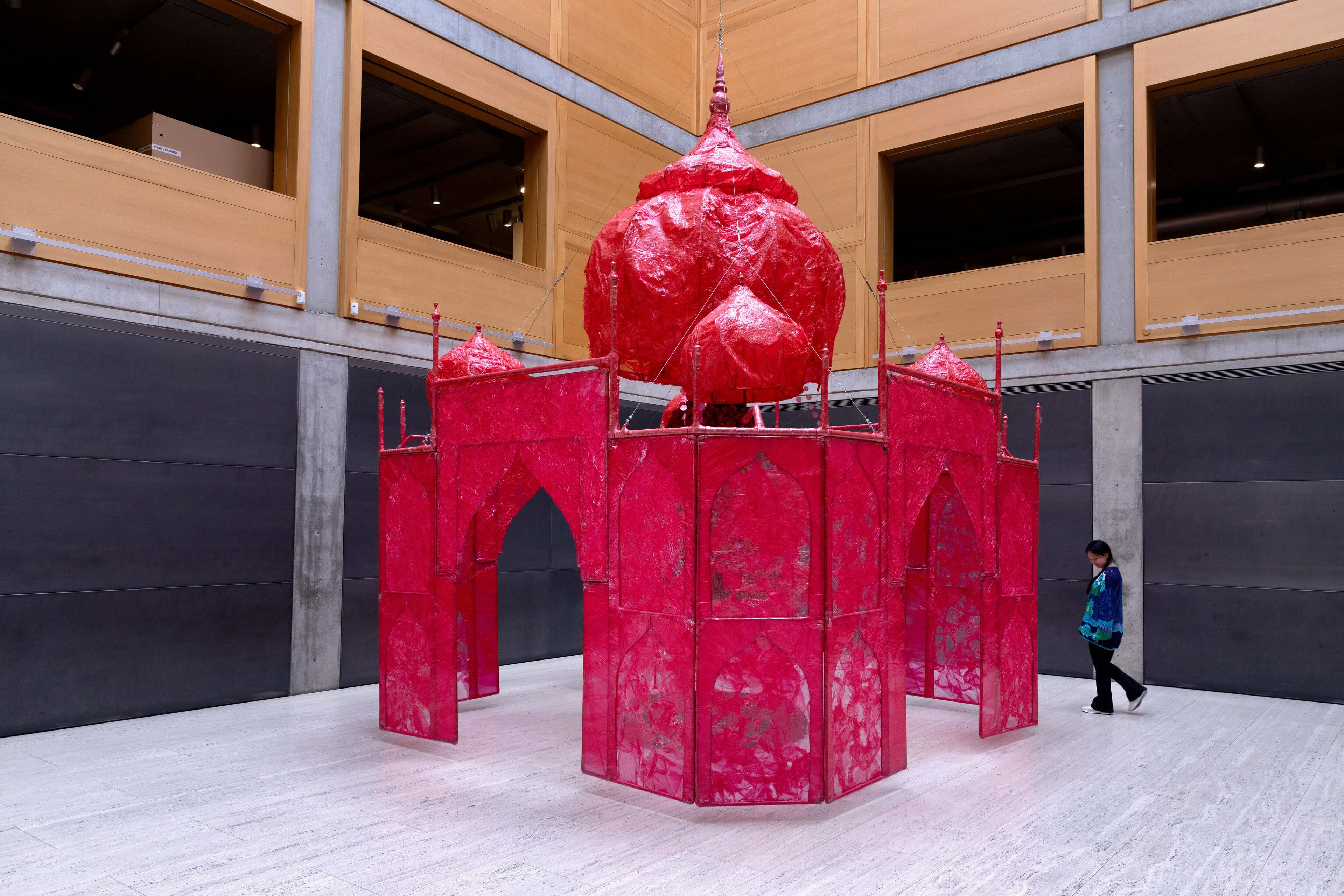
"Take me, take me, take me . . . to the Palace of love" is on view in the Yale Center for British Art atrium through September 13.
View full image

Michael Ipsen
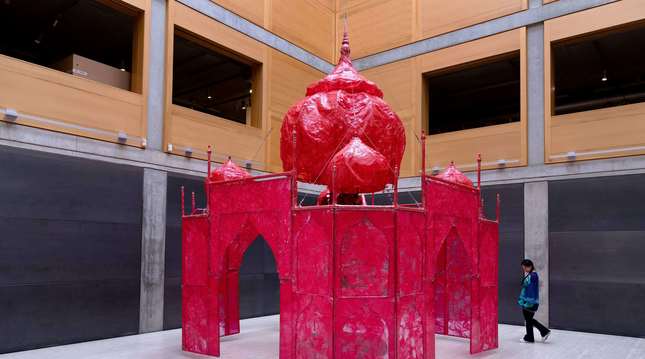
"Take me, take me, take me . . . to the Palace of love" is on view in the Yale Center for British Art atrium through September 13.
View full image
Richard Caspole

Richard Caspole
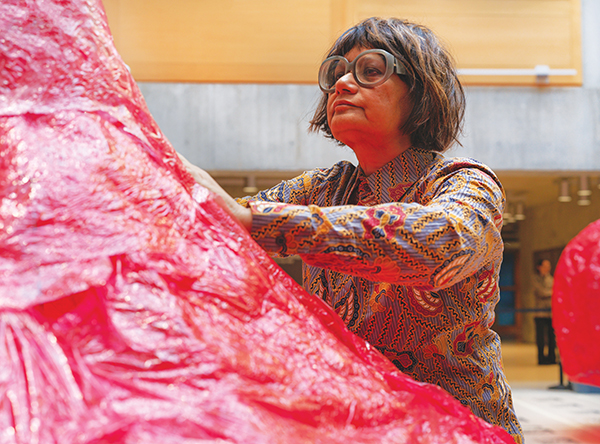
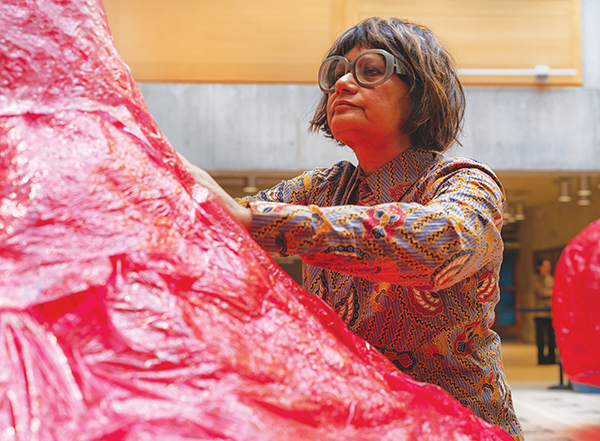
What if the Taj Mahal turned pink? Reimagining the Mughal tomb in her multimedia sculpture, Take me, take me, take me . . . to the Palace of love (2003), Rina Banerjee ’95MFA transforms its marble facade into a profusion of pink plastic wrap that hangs, balloon-like, from the ceiling. Stretched and folded over a copper and steel framework, a familiar kitchen staple is hand pressed into a translucent membrane that invokes the familiar contours of the Taj—but this is where the similarity with the famous mausoleum ends. Step inside the fragile cocoon and the visitor encounters a jumble of objects suspended over a globe positioned on the floor: an ornate Anglo-Indian armchair, floral picks, foam balls, cowrie shells, quilting pins, red colored moss, glass, synthetic fabric, shells, and fake birds found in markets in New York City spill down its center.
What, then, is this “palace of love”? And where might it “take” us? Like countless other images and even a LEGO model, Banerjee’s Taj evinces the desire to personalize a historic site—the impulse to turn architecture into memory also permeating traces of the Mughal monument scattered throughout Yale’s collections: William Hodges’s drawing recorded during a visit to the tomb in the 1780s; an Indian artist’s rendering from across the river Yamuna in the so-called Company style; a watercolor miniature painted on ivory that draws the Taj into the palm of a viewer’s hand; and postcard views collected by missionaries in the opening decades of the twentieth century. But in sharp contrast to these images, Banerjee’s Taj is a colorful simulacrum of the Mughal tomb whose impermanence shapes a fabled reality that is entirely the artist’s own. Verisimilitude is not the goal, nor is it the outcome. What we have before us is a memory so splintered from its site of origin that it has become a figment of the imagination.
Banerjee’s “palace” is an American rupture, emptied of Mughal materiality and meaning. Gone is the Makrana marble that was quarried in Rajasthan to build the famous tomb. Gone is the interplay of light and color evoking the concept of Nur Allah (divine light) in Islam. Instead, we have pink plastic wrap, a material Banerjee knows well: she earned a BS degree in polymer engineering at Case Western Reserve University before enrolling in the Yale School of Art. An American invention based on Dow Chemical laboratory worker Ralph Wiley’s 1933 discovery of a substance that was difficult to remove from glassware, cling film would be reengineered as a packaging material for machine guns shipped to American allies in Europe. Reintroduced in 1953 as a food wrap and incorporated some seven decades later into Banerjee’s Taj, its sticky pinkness would make visible the extraordinary confluence of art, science, and engineering envisioned by an immigrant artist.
Born in Calcutta (Kolkata) in 1963, Banerjee left India when she was still a child, living briefly in London and Manchester before settling down with her family in New York City. Like many diasporic Indians, she would make the Taj her own: picking up a miniature souvenir of the monument while visiting Agra, dining at an Indian restaurant named after it, or staying at a luxury hotel run by the Taj Hotel chain. But she would go a step further to reconceptualize it as a unique piece of American fiction detached from its marble authority—a pink, floating form visibly unmoored from a sense of place and time.
Banerjee’s “palace” belongs everywhere and yet nowhere, taking us back to India and to Queens where the artist grew up, surrounded by the flotsam and jetsam of American consumerism. Could it then be the quintessential American Taj?
Acquired by the Yale Center for British Art in 2023, Banerjee’s “palace” is on view for the first time in the center’s atrium through September 13.
 loading


 Print
Print Email
Email