Vestal McIntyre
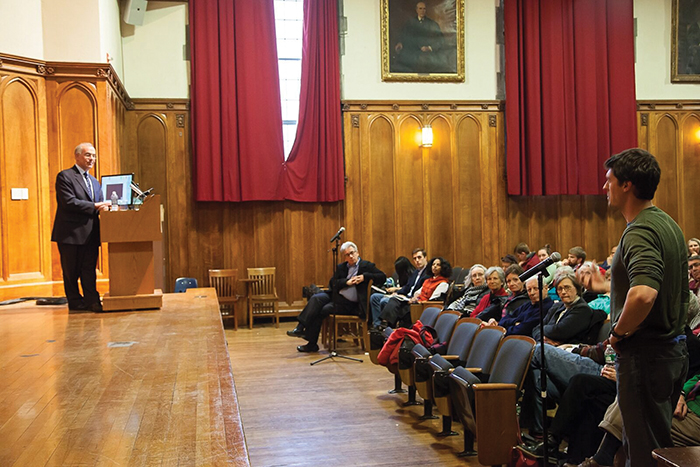
David Brooks takes questions during a lecture at Yale in 2013, long before his current appointment as Yale’s first Presidential Senior Fellow.
View full image
Haley Cohen Gilliland: You’ve taught here on and off since the 1990s. Why were you drawn to Yale?
David Brooks: I was drawn here—as opposed to all the places I could have gone without a five-hour train ride each way—because I thought it was the best college in America. I thought it was a little more intellectually alive than Harvard. I thought it was a little more argumentative than Princeton. I thought it was a little more worldly than Chicago, my alma mater, and a little less nice than Duke. When I first started teaching, the students were obviously brilliant, but also, they loved going at it with each other—more so than in more recent years.
HCG: I agree with everything you’ve said. And to draw on that last point, how have you seen Yale change?
DB: The students remain exceptional, and they justify the five-hour ride. I think the changes have hit every school of this sort. There are fewer students who come with a poetic frame of mind: “What can I do to be inspired?” More students come in a prosaic frame of mind. This is not a Yale problem. It’s a problem with the modern meritocracy at the elite level: the pressures have become greater. The odds of rejection have become greater. I spoke to a kid at Williams who told me, we’re the most rejected generation. He had to apply to 15 colleges to get into one. Once on campus, some of the student organizations accept only 8 percent of applicants. For internships, you’ve got to apply to 200. For jobs, you have to apply to hundreds. The students feel they’re just in an unforgiving environment. There’s a sense of relentlessness that wasn’t as strong 25 years ago.
HCG: That certainly resonates. My job is essentially to connect Yale students interested in becoming journalists with internships and jobs. The yield we often see is they have to apply to 50 internships to get one—it can be very disheartening. Yet you also mentioned that students might be less willing to disagree with each other in an intellectual way. Do you think that’s unique to Yale?
DB: Definitely not. When I helped out on the program called Grand Strategy, students had to present their policy suggestions to faculty as if we were the president’s cabinet. And we were ruthless. The idea was to rip their presentation to shreds so they could come back and do it better the second time. And this suggested a level of psychological safety that I don’t think a lot of students in this country—not just Yale—feel these days. There’s intense fear of judgment. I remember maybe around ten years ago, a student said to me—this was back when students were still using Facebook—if a moral passion goes through campus and you haven’t posted about it in six hours, people notice.
In 2023, I finally just told my students: you will argue. And if I gave them a command, they would do it. But I think things have improved since then—my perception is there’s more tolerance for diversity, more understanding that we need to have honest, open conversations with each other.
HCG: You became a presidential fellow in January. I’m curious how you see your goals for the role as being different or similar to your goals as a columnist for the New York Times. Is there something you hope to do in this role that you felt you couldn’t pursue as effectively from a newsroom?
DB: When you’re in the newspaper business, especially the column-writing business, your focus is largely political—what was Donald Trump doing yesterday? And I came to believe that the problems of the country, and especially the problems I wanted to think about, were pre-political. It’s reflected in the lack of connection across society. It’s reflected in the growing meanness of society. And I thought, well, if I want to really focus my thinking on the clash of ideas, that’s done better at a magazine like The Atlantic, where I can write an 8,000-word piece, and also at a place like Yale, where you can study and learn from the legacy of great figures like Robert Penn Warren, Allan Bloom, Paul Bloom, Harold Bloom. . . . Universities should be to modern culture what cathedrals were to medieval culture: centers of our national conversation, our spiritual and humanistic culture. I know people at Yale who are doing just that, and I was happy to be joining them.
HCG: Was it difficult to pick themes for your first lectures?
DB: There are a couple of lanes that I like to be part of that are actually growing on campuses across the country. The first is what you might call the moral formation lane: how to cultivate excellence in young people.
The second is how to do life. For some reason, we have not transmitted to younger generations basic rules like how to break up with someone without crushing their heart. How to sit with someone who’s depressed. How to ask somebody out on a date.
The third lane is what you might call civic thought. What are the big intellectual ideas shaping history?
And so those first four lectures were two in the how-to-do-life or moral lane, and two that were more about civic thought. The riskiest was the one I did most recently called “How to Fall in Love with Someone.” That was not my suggestion, and I was terrified because what the hell do I know? They live in a very different social world than I inhabited when I was 20. So I thought it would just be useful to say, I’m going to walk you through the phases, and I’ll give you the advice I’ve read on how to do each phase well. I was honored so many undergrads showed up at that one because it was late in the term near finals.
Afterward about 30 of them came back. We had a smaller conversation and it was very intense. They are really grappling with romantic issues—which is good, because the data show that the number of people in relationships in high school and college is way, way down. I got dumped when I was a sophomore in college and it was one of the most important educational experiences of my life. First, I learned how to be in a relationship with another human being. Second, I learned how to get over heartbreak. These are vital experiences.
HCG: Perhaps it’s because the meritocracy you mentioned has just gotten so intense and they feel they need to work all the time.
DB: That’s part of it. Students also tell me that social skills—particularly flirting—they’re just not there; they have not been transmitted.
HCG: I’m sure a lot of communication taking place on the internet and through social media has dulled our in-person skills. But back to goals. If we check back in four years, what outcomes would make you say, ok, that mattered?
DB: The lectures are part of gathering people for discussion and an attempt to get out into the wider world. A lot of Americans have no idea what goes on at a college campus, and as a result, they think it’s all a bunch of Maoist revolutionaries. Of the three talks we filmed, one had 829,000 views [Ed note: figure as of press time in early June]; the other two had more than 100,000. I regard that as pretty good.
But the real work will begin next term. By then we’ll have the staff for the podcast up and running, and I’m 80 percent sure it’s going to be called The Great Conversation. The idea is that all of us humans have been involved in a single, great conversation stretching back four or five thousand years about what justice is, about how to balance fitting in with standing out, achievement with equality.
How do you find your calling? I’m going to get to talk to the best teachers in America, at Yale and at other schools . . . Research faculty get a lot of press. Teaching faculty, the ones who are great in the classroom, they don’t get as much.
But they do some of the most valuable work on any college campus. I’m eager to talk with them, to have conversations that create a little puddle of humanity in our common culture and show people all the good that goes on at a college campus.
The rest will be with a spirit of experimentation. One idea I had was the one-hour sabbatical. Students are so phenomenally busy, but they relish time to take a step back and say “Am I happy with how I’m treating my college education? Am I happy with how I’m treating my friendship circle? With my values?” Another idea is micro-grants to people who serve their communities.
HCG: Sounds really fun.
DB: Yes. My wife keeps telling me how much happier I am.
HCG: You’ve mentioned the intellectual transformation you underwent between growing up in kind of a lefty household to finding conservatism. I’m wondering, is there a view that you’ve changed your mind about recently?
DB: I’ve probably shifted a little left on economics, because our problem now is inequality. But I’ve probably shifted a little right on social values. Over the last 50 or 60 years, we’ve lost a sense of a shared moral order such that Martin Luther King Jr. could rest assured in the knowledge that certain things—segregation, slavery, rape, murder—are eternally wrong. I think we’ve privatized morality over the last several decades until people have come up with their own values. Without a shared moral order, you can’t trust each other because you don’t agree on what people ought to do.
HCG: One criticism of Yale is that it’s one-note intellectually and politically. What are strategies you’ve cultivated for disagreeing productively and how have you shared them with students?
DB: For the first several years that I was teaching, I never brought my politics into the classroom, based on the idea that faculty should not do that—students should be paying attention to the reading, not to me. But over the last several years, I’ve shifted and tried to talk about my conservatism. I don’t want anybody to graduate from Yale without having met a conservative. If you watch Fox News, you may have an image of what a conservative is. But there are a million different varieties, and I want them to see my variety, which they may not have come in contact with. And I find that kind of conservatism actually has some followers on Yale’s campus. And if they disagree with me, that’s great, but at least they will have encountered a living person who really likes Edmund Burke.
HCG: How can Yale fight intellectual homogeneity?
DB: If you focus courses on moral formation, on civic thought, on how to lead a good life, you’ll get intellectual diversity through the back door. There are people here who teach subjects not fashionable in the progressive world—diplomatic history, military history—and believe in the great books, unashamedly. I’m fine with bringing in diverse speakers, but the real solution is to give people answers, or at least possible answers, to the most important humanistic conversations about justice and identity. Intellectual diversity will come through that.
HCG: In your talk on ambition, you describe “the gleam”—the luminous drive you’ve observed in everyone from Boys and Girls Club competition winners to Tina Turner. With the entry level job market one of the toughest in decades and the threat of AI looming over most industries, what can students do to nurture that gleam?
DB: I think people get really ambitious when they have a secure emotional base and when they find things to fall in love with. My one-sentence definition of a university: it should give young people new things to fall in love with. You want the frame of mind where I’m going into class saying, “What book am I going to love here?” And then I find that book and say, “To hell with the rest of my classes. For the next two weeks, I’m going to read this book.”
 loading


 Print
Print Email
Email