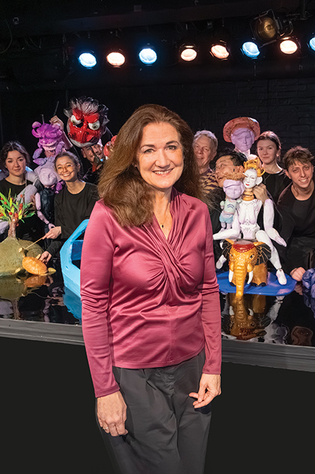
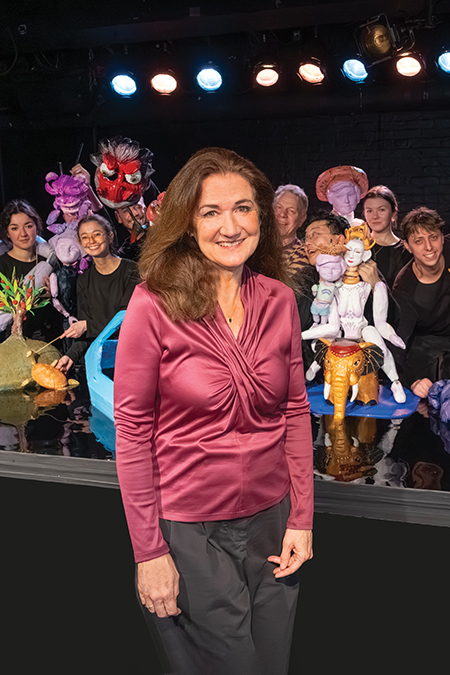
Cheryl Henson ’84, (with puppets and puppeteers from Tommy Nguyen’s “The Magnificent Ms. Pham” has been president of the Henson Foundation since 1992, continuing her parents’ support of the puppetry community.
View full image
Cheryl Henson ’84, daughter of Jim and Jane Henson, grew up in a world of puppets and puppeteers. She was surrounded by them as a child, exposed to the array of puppet arts at home and at puppet festivals around the country. Since 1992, she’s been president of the Jim Henson Foundation, continuing her parents’ focus on the work of other artists with grants to support live puppet theater, everything from shadow puppets to animatronic body parts to puppets who merge with puppeteer. Grants—ranging from $4,000 to $10,000— may not be enough to fund an entire project or production, but, says Henson, “because my father’s name is famous, a Henson grant has been a gold star to help get other funding.”
Debra Spark: I met you in a class about the Bloomsbury Group our senior year, but you were a history major back then, and you were headed to the Fashion Institute of Technology for a degree in textile design. Did you always know you’d go into puppetry?
Cheryl Henson: I was always subject to the gravitational pull of my father’s immense creative energy, and I built puppets before and after college. But it was his untimely death in 1990 that brought me and my four siblings back into the company. My father and I were planning a festival when he died. After, I worked with others who shared his passion to make that happen. We produced five International Festivals of Puppet Theater from 1992 to 2000. The festival put the Jim Henson Foundation on the map and it also put contemporary puppet theater on the map of New York culture.
DS: Just to clarify, you and others produced these festivals, but the foundation is primarily a grant-giving organization?
CH: Yes, the foundation was set up as a grant-making private family foundation to give grants to artists creating in their own unique style.
DS: The foundation has given more than 1,300 grants. Can you tell me about a recent recipient you’re particularly excited about?
CH: I’m excited about them all. But I think we should talk about Tommy Nguyen. His Magnificent Ms. Pham is in the photo, and he’s to the right of me. It’s the first Vietnamese-American water puppet show where he uses the traditional folk art to tell a contemporary story about his mother and her life in Vietnam before moving to Texas and raising four boys. That makes it very personal.
DS: Tell me about another grantee who makes the art form all their own.
CH: Basil Twist! He’s the creative director at Dream Music Puppetry at HERE Arts Center. He’s done so many spectacular productions, in which he gives life to abstract forms. Puppets don’t have to be humanoid. They don’t have to be animals. They can be shapes. They can be silk in water. He has a piece called Symphonie Fantastique that is all performed in a giant tank of water. He also did Rite of Spring with big geometric shapes, silk blowing in the wind.
DS: I watched a video of recent grant recipients on your website and was struck by how much dance seemed to be incorporated into what I was seeing.
CH: Movement and gesture is so important to puppetry and a number of people come from dance into puppetry.
DS: Why do people love puppets so much?
CH: It’s the playfulness of the puppets and the delight. And right now, a lot of young people are interested in puppetry because it’s analog. It’s materials-based. It’s collaborative to animate a puppet: to work together, to breathe together.
People also love to talk about the soul of the puppet. How can you transfer the sense of being alive through a performance that’s done with the human hand? It’s almost like a subconscious transferring of life through your hand. It’s different than if it’s robotic or computer-activated. I don’t think it’s easily definable, but you have a sense of life.
DS: I love that the foundation started with your father focusing not on his own work, but on that of others, and you clearly have the same outward focus. All the same, I hope you will forgive one throwback question. “What Muppet are you and why?”
CH: [looks confused]
DS: You must know that there’s this whole online quiz thing where people ask, “What Muppet are you?”
CH: Oh, no. Actually, I don’t, but I’d say Kira in The Dark Crystal. She’s the female Gelfling.
DS: And why are you her?
CH: Because I was never a Muppet. I was always a fantasy girl.
 loading


 1 comment
 Print
Print Email
Email
1 comment
-

Carol Sterling, 9:38pm July 06 2026 |  Flag as inappropriate
The comment period has expired.Great interview, Cheryl. The inspiration and implementation of your work on behalf of The Jim Henson Foundation is a testament to your character, heart and legacy and your caring, kind, gifted and generous parents, Jane and Jim Henson, who I had the honor of knowing. You are truly a crusader for the love of puppetry and the personification of generosity and integrity.