Alex Eben Meyer
More than half of Americans live in suburbs. While suburban living can be pleasant and comfortable, it also leads to increased greenhouse gas emissions. Most experts have focused on the fact that because suburbs are spread out and far from city centers, many suburban residents must drive to get almost anywhere they need to go.
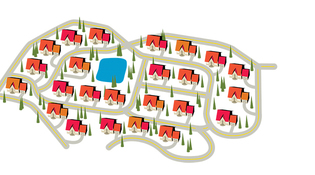
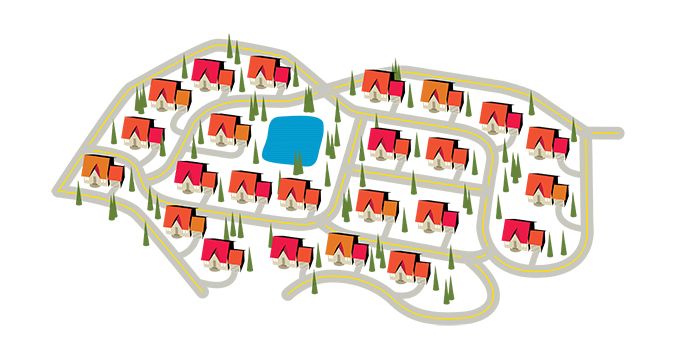
But a new study from a Yale urban planning researcher has identified another important way that suburbs contribute to higher emissions. For much of the 20th century, most suburbs were built according to the principles of garden city design (GCD), which emphasized irregular street layouts as a way to create a quasi-rural vibe. This approach also contributes to the overreliance on driving.
Arianna Salazar-Miranda, an assistant professor of urban planning and data science, decided to analyze the climate costs of suburban GCD. She used OpenStreetMap, a crowdsourced mapping platform that has street-level data for the entire country, to examine more than 60,000 US neighborhoods. She focused on four features that define GCD: how curvy the streets are, how many cul-de-sacs or dead-end streets there are, how irregular the blocks are, and to what extent small streets feed into larger ones.
Salazar-Miranda found that GCD accounts for 0.1 metric tons of greenhouse gas emissions per person per year, or about 40 percent of the total environmental costs of suburbs. Her paper, the first to look at the climate effects of suburban GCD, was published this spring in Nature Sustainability.
She notes that some GCD municipalities are now reconnecting dead-end streets or adding sidewalks and pedestrian paths. And some cities and towns are updating design standards, requiring connected street networks, mixed-use zoning, or shorter blocks. “The good news,” she says, “is that design is something we can change.”
 loading


 Print
Print Email
Email