Anthony Russo

Anthony Russo
Anne Ghory-Goodman ’71, ’73MFA

Anne Ghory-Goodman ’71, ’73MFA
To be in a room full of women at Yale in 1969, I had to learn to sing in Bulgarian.
I was among the 575 women who arrived at Yale that fall—the first women undergraduates officially enrolled—and it wasn’t easy connecting with each other in the sea of four thousand male classmates. Joining the newly formed, all-female Yale Slavic Chorus was the only way I could be in a room filled with Yale women.
There was no occasion during our time at Yale when we were all brought together.
Decades later, in 2009, I had the chance to ask coeducation architect Elga Wasserman ’76JD whether anyone had ever considered having an event at which those first women students could meet each other. No, she said, it hadn’t occurred to us.
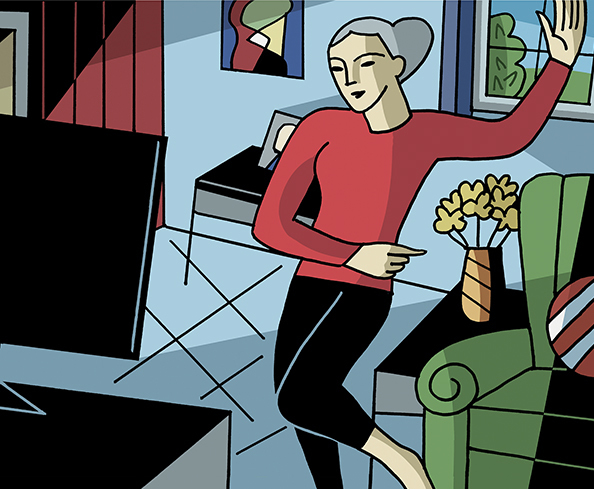
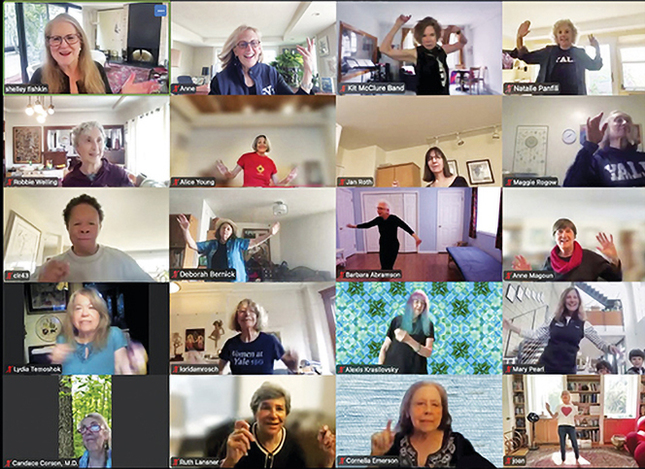
But now, every other Wednesday, a sizable group of women who arrived at Yale in 1969 dance together on Zoom. I call our dance sessions Zoomba (not to be confused with Zumba, the commercial exercise franchise). I curate lively, danceable playlists, and everyone moves as she wishes, with camera on or off. And after we dance for 55 minutes, we share insights and inspirations, celebrate each other’s achievements and milestones, and are present for each other in times of challenge and loss. The group has over 100 women in it, most of whom graduated in 1971, ’72, or ’73; about 20 of us show up at each session—a slightly different group each time, according to individuals’ schedules. We have been doing this for six years, and we are still going strong.
It started with Ato Quayson, a distinguished scholar originally from Ghana, who had joined Stanford’s English department (where I teach) in 2019 and wanted to create a sense of community. But then Covid hit. He suggested that members of the department should dance together on Zoom three times a week at 8 a.m. Most of my colleagues thought the idea insane. But I didn’t, and a group of us began doing just that, taking turns curating the playlist. At our first session, Ato quoted Chinua Achebe: “When we gather together in the moonlit village ground it is not because of the moon. Every man can see it in his own compound. We come together because it is good for kinsmen to do so.” Deborah Bernick ’72, a health policy analyst and Jewish communal services administrator, heard about our Stanford dance sessions and asked whether I might do this for the first Yale women. We began dancing together in the spring of 2020. Initially, it was to stay healthy during Covid. But after the pandemic, we kept dancing.
Our ranks include lawyers, doctors, musicians, journalists, teachers, artists, poets, businesswomen, therapists, activists, and community leaders. We have a behavior medicine researcher, a former university president, and multiple novelists. There are also award-winning filmmakers, authors or editors of hundreds of books, and proud mothers of feminists —feminist sons as well as daughters.
We Zoom in from Canada, France, the West Indies, and across the US. On Labor Day, we dance to songs about secretaries, chemical workers, farmers, musicians, writers, railroad workers, waitresses, coal miners, and babysitters. We dance to songs of freedom and liberation for Passover, and songs about fruits and vegetables for the harvest holiday of Sukkot. There are special playlists for people’s birthdays, Black History Month, and Women’s History Month. The eclectic playlists I curate are sometimes themed. When we started traveling again after Covid, we danced to songs about “Planes, Trains and Automobiles.” During the wildfires, we danced to songs about climate change. Every Memorial Day, we dance to songs by artists we lost the previous year. We dance to songs by “Artists We Heard Live at Yale” and recall Motown mogul Berry Gordy’s visit to Yale by dancing to “Midsummer Motown Madness.”
Reflecting our global travels and appreciation of world music, we dance to songs in English, Chinese, French, Hebrew, Hindi, Hungarian, Italian, Korean, Portuguese, Russian, Spanish, Slovenian, Thai, Turkish, Ukrainian, Vietnamese, Xhosa, Yiddish, and Yoruba. We dance to rock, jazz, pop, salsa, klezmer, folk music, and Broadway show tunes. A playlist of “Yale Women Musicians” includes songs written and performed by jazz saxophonist Kit McClure ’73 and singer-songwriter Sarah Heath ’73—both members of our group. Alexis Krasilovsky ’71, a prize-winning filmmaker, poet, and artist, wanted to be a ballerina at age five, but found she was too tall. “Who could have predicted I’d be dancing at 75?” she asks, “Especially after two hip replacements in my 60s, when I could barely walk.” Kay Hill ’72, a former school administrator, recently shared research noting that dancing three times a week can lower the likelihood of dementia by 76 percent. Many members have expressed their gratitude to Lydia Temoshok ’72, veteran of the World Health Organization, for tips she shared during Covid about vaccines, reputable treatments, and helpful research, and for her insights on how signs of heart attacks are different for women than for men. They are also grateful to Candace Corson ’73, ’76MD, a family physician who arrived at Yale in 1969, for insights she’s shared on plant-based healing. “As we get older, that’s news we can use!” writes Cornelia Emerson ’71, ’80PhD. Alexis Krasilovsky adds, “The discussions after dancing have most likely saved my life.” Kit McClure writes: “When I was diagnosed with breast cancer, our Zoomba group rallied to support me by sharing experiences, knowledge, and most important, love. I remember a time during the chemo when, bald-headed and weak, I could barely dance to one song. Yet I still wanted to tune in.”
When I had a mild hemorrhagic stroke four years ago and asked the group how to learn to “rest my mind,” Meg Custer ’72, president of Maharishi University of Enlightenment, introduced me to a local transcendental meditation teacher she knew; I’ve been meditating ever since. (Sadly, Custer passed away in July.) We often dance to songs that express our gratitude for our health and well-being—like Jennifer Hudson’s “Feeling Good” and the Barry Sisters’ “Abi Gezunt”—and then share tips about navigating the health challenges we all face as our bodies age.
Our “First Women at Yale Zoomba” dance sessions have yielded other practical benefits. Deborah Bernick writes that “the Zoomba group provided enormous comfort and emotional support when a close relative with a serious mental health condition went missing.” A member of our group who had contacts with a nonprofit that provides service for people experiencing homelessness in the region in which she had disappeared “actually helped our family locate my relative and ultimately bring her home. We are forever grateful.”
We also share ways of engaging with social and political issues about which we care. When our names were bizarrely removed from a book of narratives of our experiences as first Yale Women, we got hundreds of male as well as female classmates to sign a petition that succeeded in getting the “anonymized” version of the book pulped and getting a new version published with our names restored. We share our personal knowledge of organizations in which we’re involved that are fighting anti-Asian hate and assaults on reproductive health, and organizations working to preserve our democracy and our planet. I learned at one of our Zoombas about a powerful new film about lynchings, My Father’s Name, on which a key producer was Constance Royster ’72, a member of our group who is a leader in nonprofits addressing the needs of underserved communities. I showed it in my class at Stanford this spring, and Connie herself attended.
We take pleasure in celebrating milestones—professional awards, new books, new films, new concerts. And while it is wonderful to share our pride in our Yale sisters’ achievements, it has been equally meaningful to console each other during times of challenge and loss. Cai Emmons ’73, a brilliant novelist who was an active member of the group, had degenerative ALS and was about to choose death with dignity; days before her death, the group danced to a playlist of songs I cocurated with Cai of songs inspired by her novels. Cai swayed in rhythm with us throughout the gathering. Anne Ghory-Goodman ’71, ’73MFA, a professor, designer and photographer, recalls the “poignant moment when her husband helped her stand and dance” with us.
We share recommendations about films and TV series to watch, books to read, and exhibits to explore. Kay Hill writes: “I keep a notebook as we talk, after, and write down tips on what to watch, what to read. But for real learning I would say the lessons of Cai Emmons, dancing and engaging as she could, are the standout. What could be a bigger lesson than how to live with joy?”
 loading


 11 comments
 Print
Print Email
Email
11 comments
Hello,
How fabulous to meet this way… is it possible for 1976 graduates to join? Thanks, Terry Marsh
Women in '71, '72 and '73 may join the "First Women at Yale Zoomba" group that meets every other Wednesday, but i'd be delighted to welcome you to the Monday/Friday group that includes others around the US and the world as well as many First Yale Women. I need your email to add you to the list. Please email me privately rather than continuing this thread in the comments. I look forward to meeting you! sfishkin [at] Stanford.edu.
In Fall 1969 as a freshman at Yale the only women I met were in my entryway in Vanderbilt Hall on the Old Campus. We were in Davenport College and saw each other as residential college friends throughout our Yale years. It was not unusual to be the only woman in a class-- asked for the "woman's point of view" about an issue that was being discussed. I did not meet many other women. We were invited to return to campus to celebrate "50 years: Women in Yale College" in 2019, and that was the first time I met Yale women who had not been my roommates. Finally, I met my cohort! Through the "First Women at Yale Zoomba" group I met many Classmates who shared my experience of college and the turbulent years of the 1960's era. This has deepened my understanding of who I am and brings me great joy.
First Women in Yale College know how to create and sustain community. Our post-dancing discussion time also allows us to remain active and engaged with our alma mater.It gives us an opportunity to keep current with events at and issues concerning Yale. The Zoomba group compliments the Women of the Class of 1972 monthly Zoom calls. 1972 Women converted twice yearly in person lunches in NYC to monthly Zoom calls when the pandemic hit. We have subsequently reignited the in person lunches and kept the monthly Zoom calls vibrant.
How inspiring!
50 years later is not too late to get to know and learn from fellow First Women. It took me 30 years to go to a 1971 reunion, but I'm so grateful for the chances to connect and converse.
I am class of 1973. How do I join?
Class of 1975. Please me to the list!
Fabulous! What better way to connect than through music! As one of the Second Women at Yale (1970- 1974), I would love to participate in the Zoomba meeting mentioned in response to the comment by Terry Marsh. And I bet my dearest friends in the class that started Yale in 1970 would also be interested. I would be happy to pass this article along to them in case they don’t see it in the Alumni Mag.
I am grateful to all the alums who posted comments here, and am happy to add you to the appropriate Zoomba list, but I NEED YOUR EMAIL to do that. Please email me at sfishkin [at] stanford.edu and you will get the links to our dance sessions each week. (A number of you have already done that) I look forward to meeting you!
I'm not much of a dancer, but Shelley's Zoombas are the best! Inspiring old and new-to-me music, and stimulating discussions with classmates I only wish I'd known at Yale.