Chris Buck
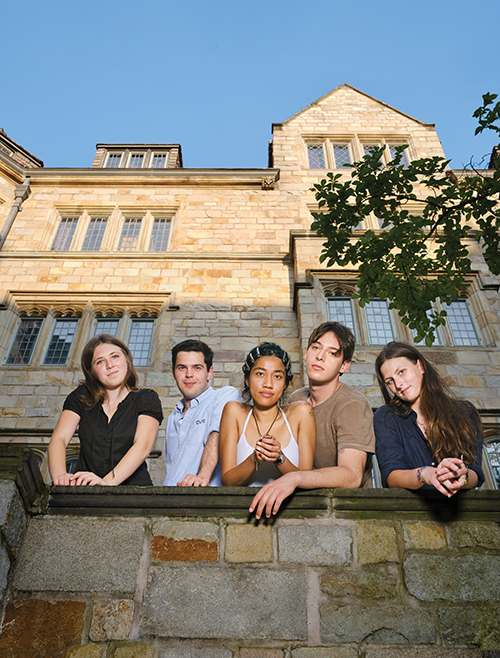
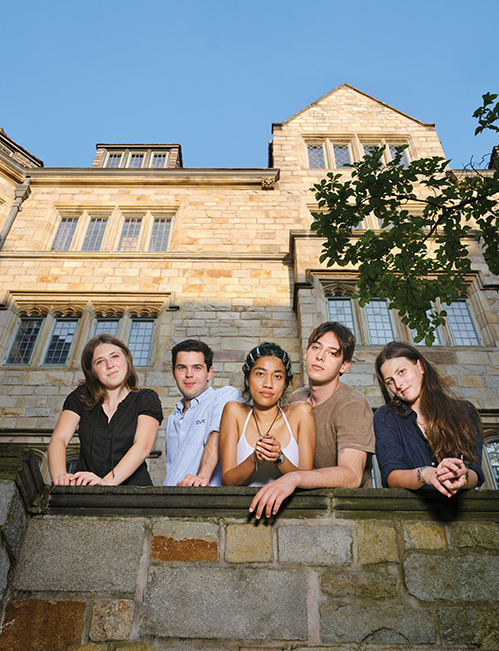
Off-campus students on campus, in Saybrook Court (left to right): Adele Haeg ’28, Carter Cashen ’27, Mercuri Lam ’28, Ali Otuzoglu ’27, Eloise Benchley ’28.
View full image

Chris Buck
Off-campus students on campus, in Saybrook Court (left to right): Adele Haeg ’28, Carter Cashen ’27, Mercuri Lam ’28, Ali Otuzoglu ’27, Eloise Benchley ’28.
View full image
Chris Buck
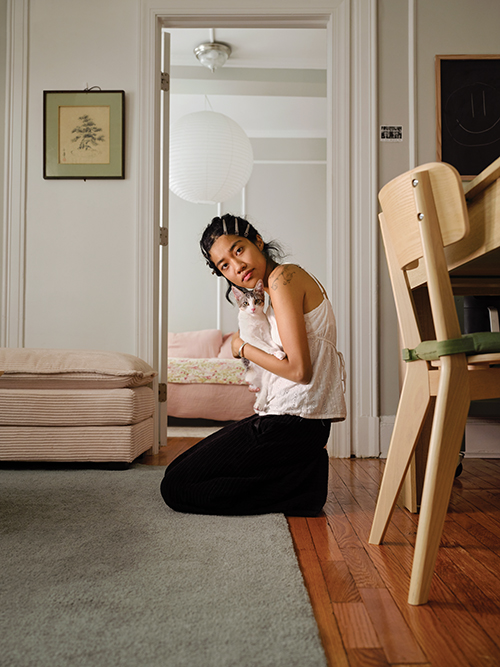
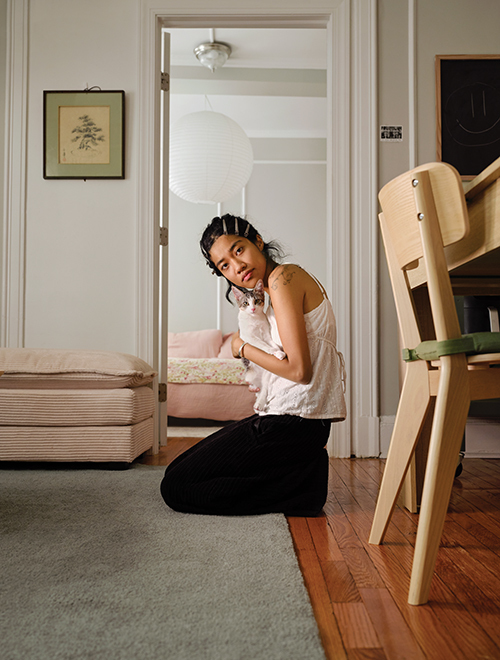
Poet Mercuri Lam ’28, an art history major also studying food, agriculture, and climate change, says there are two crucial things at her Chapel Street pad she could never have brought home to Benjamin Franklin: her four-month-old domestic shorthairs, Olive (pictured) and Oil.
View full image

Chris Buck
Poet Mercuri Lam ’28, an art history major also studying food, agriculture, and climate change, says there are two crucial things at her Chapel Street pad she could never have brought home to Benjamin Franklin: her four-month-old domestic shorthairs, Olive (pictured) and Oil.
View full image
Chris Buck
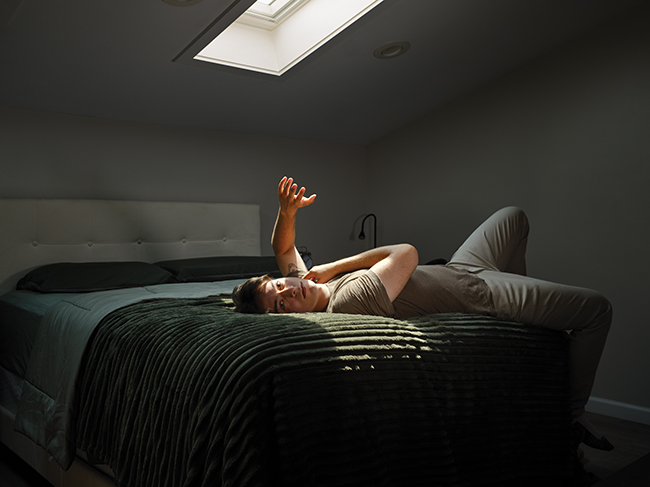
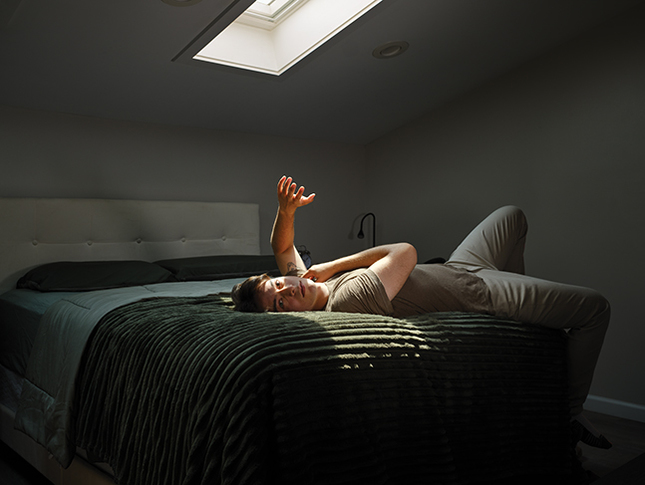
Turkish-born Ali Otuzoglu ’27 attended high school in Switzerland during Covid. By the time the double major—economics, statistics and data science—-and musician got to Silliman, he longed to personalize his space so much he started ordering furniture. “I will say that move-out day was a hassle,” he says of switching to a one-bedroom on Orange. “But I’ve been really enjoying exploring the city and making use of the space.”
View full image

Chris Buck
Turkish-born Ali Otuzoglu ’27 attended high school in Switzerland during Covid. By the time the double major—economics, statistics and data science—-and musician got to Silliman, he longed to personalize his space so much he started ordering furniture. “I will say that move-out day was a hassle,” he says of switching to a one-bedroom on Orange. “But I’ve been really enjoying exploring the city and making use of the space.”
View full image
Chris Buck
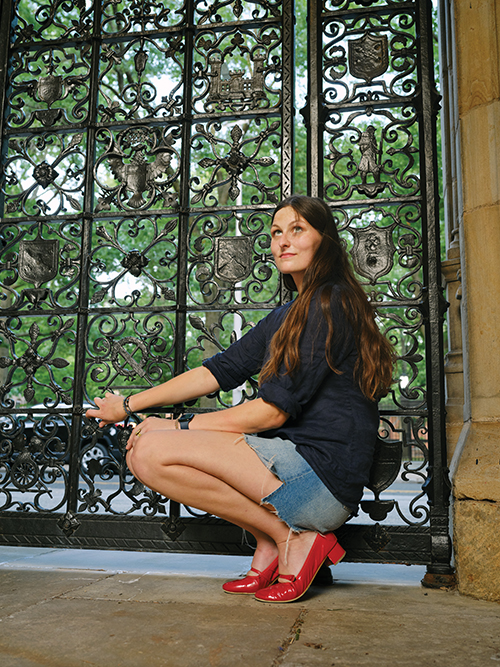
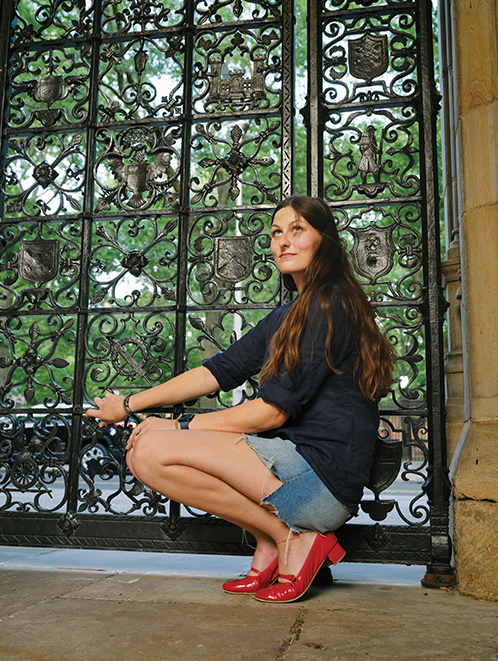
Physics major Eloise Benchley ’28 plans to live outside Berkeley both junior and senior years, despite being so involved she’s on the college council. She was tired of wearing flip-flops in the shower, wanted A/C and—-as a member of Y Pop-Up, Yale’s student-run “fine dining club”—her own kitchen.
View full image

Chris Buck
Physics major Eloise Benchley ’28 plans to live outside Berkeley both junior and senior years, despite being so involved she’s on the college council. She was tired of wearing flip-flops in the shower, wanted A/C and—-as a member of Y Pop-Up, Yale’s student-run “fine dining club”—her own kitchen.
View full image
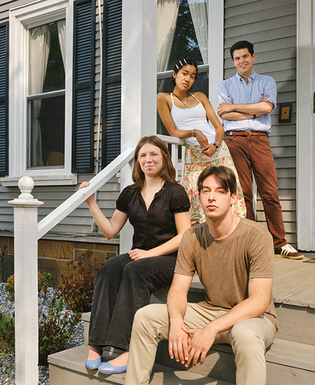
Chris Buck
Clockwise from top left: Mercuri Lam ’28, Carter Cashen ’27, Ali Otuzoglu ’27, and Adele Haeg ’28 on Otuzoglu’s front stoop.
View full image
Housing has always been contentious at Yale. And as with many contentious things, talking about it has, more often than not, been a way of talking about anything and everything other than the thing itself. Conversation inevitably turns to the fate of the residential colleges, the composition of the student body, the efficacy of the university administration, and the platonic ideal of the university itself. It’s a textbook case of “What We Talk About When We Talk About” fill-in-the-blank.
But the issue has never been more contentious than in recent years. The share of undergraduates living off campus surged during the Covid-19 pandemic and has yet to return to baseline. Nearly half of the senior class lived off campus in fall 2025, as did more than a third of juniors—around 1,400 students all told. The trend is unmistakable on the streets around campus, humming with electric scooters and loudspeakers.
No one’s quite on the same page about what it means for Yale. The colleges have always been a selling point, something that distinguishes Yale from its peers, even those with systems like it. They may help make an imposing university feel more manageable. And they hark back to the university’s beginnings at a parsonage in the woods of Killingworth, Connecticut. When the colleges were created, sitting provost Charles Seymour ’08 wrote in a 1933 issue of YAM that they helped extend that old legacy, “the principle of the small college, with its vivid esprit de corps,” into the 20th century. “There was need of some plan that would give cohesion to the undergraduate body and prevent it from becoming an amorphous mass in which the old values would disappear.” The echoes of that sentiment are still being felt. “It makes for a more pleasant place that may in turn make for happier alumni,” says Sam Chauncey ’57, who spent decades working in the Yale administration. But the colleges have often run into tension with larger forces at the university that are also a testament to its other strengths. Students don’t actually need the colleges to find friends; they can make them in academic departments, student organizations, cultural affinity groups, societies, fraternities, and teams. “I have very good memories of being in Davenport, but it was mainly because of good friends I had there, and I think we all have good friends in places,” says Chauncey.
There’s little ambiguity about when the question of the colleges’ future came into sharpest focus: the Covid-19 pandemic, when social distancing meant whole cohorts weren’t allowed into dorms for some of the 2020–21 school year. Some 1,400 students took leave or gap years that fall; another 1,300 or so lived off campus. The university created a staggered on-campus policy to ensure sophomores would not become “a cohort of students who have never lived in colleges,” as Marvin Chun, then-dean of Yale College, said at the time. And indeed, on-campus rates have since remained lower, perhaps because those students had learned to like living off campus; once a student moves off, says Yale College dean Pericles Lewis, they tend not to return. Tashroom Ahsan ’26, who lived off campus junior and senior years, said Yalies’ en-masse entry into the New Haven rental market “reaffirms the Yale student’s position as a spotted lantern fly,” the invasive pest that in recent years has come and gone in ever larger numbers.
The trend has been significant enough that the Yale Daily News this spring asked the question on the minds of many alums: “Is the residential college dead?” The answer, formulated in an 11-part series, was a nuanced “no, not quite,” but a YDN reader would have been hard-pressed not to conclude it’s on life support. It’s also become something of a flashpoint between alums and administrators. Last year, writing in the News, Sterling Professor of Law and Political Science Akhil Reed Amar ’80, ’84JD, and Jonathan Edwards College fellow Andrew Lipka ’78 coauthored an opinion piece lamenting the “ever-more-fragmented Yale” portended by the off-campus trend. “To live outside the Colleges is a rejection of the College community; an abrogation, or at least a denial, of that ‘civic and moral responsibility’” that the colleges, per Yale’s brochures, inculcate through diversity, traditions, and common experiences. Amar and Lipka proposed a quick fix: Extend the mandate that keeps students on campus for a minimum of two years to three or even four. More than a year and a half later, Lipka stands by the idea. “The only way you’re going to stop it,” he says, “is by making it clear from the beginning that this is what it means to go to Yale.”
The administration isn’t quite ready to go that far. “If you live on Old Campus your first year, you live in your college your sophomore and junior years, and then you move off campus senior year, that seems reasonable. If about half the students do that they’ll still be pretty connected to their college,” Lewis told me. “What we didn’t like is having students move off junior year.” A blanket mandate, in fact, isn’t logistically feasible: Yale has approximately 5,500 beds for an undergraduate student body of around 6,600. It’s not a shortage so much as a gap that reflects deliberate planning. For 30 years, roughly 11 to 17 percent of undergraduates have chosen to live off campus, and the university has built its enrollment targets accordingly. Modest recent reforms include centralizing the housing draw in a single online portal and delegating the work of managing it to a single administrative team. In fall 2024, around 40 percent of juniors were living off campus. For the 2025–26 academic year, however, juniors got equal priority with seniors to entice them to stay in the colleges for at least their third year, when many assume leadership positions in campus organizations, and the figure crept slightly down to 35 percent. This spring, juniors got first choice in room selection. Senior off-campus rates, meanwhile, have remained stable—approximately half will be living on campus in the fall, much like last year. It is, Lewis notes, just the first year of a new process.
Even before the latest changes, getting annexed—allocated a room outside your college—or watching helplessly as a suite of friends got separated had been common enough scenarios, pitting panicked undergrads against inauspicious math. Last year, Derek Harrison ’27 entered the housing draw in Grace Hopper with four friends. They were in the running for one of the college’s five junior quintets; luck had it they were assigned one in Arnold Hall, an annex on Elm Street. Two decamped, a new plan was hatched to secure a vacant triple, and when it encountered resistance, Harrison “pulled out all the stops” and emailed Melanie Boyd ’90, the dean of students. In his appeal, he mentioned an important bit of context: He was the incoming copresident of the Hopper College Council. Boyd promptly signed off. When the dust of the housing draw for fall ’25 settled, the university had 436 vacancies, according to Yale College spokesperson Paul McKinley. Grace Hopper had 35 vacant rooms, out of a total of 232. Arnold Hall was almost half empty.
Faced with such stories, some students see the New Haven housing market as a safer option. “The housing draw has screwed over so many people,” Eloise Benchley ’28 told me. “I think some people decide they’ll have more control over the fact that, okay, I know I can pick the room I get because I’m looking at an apartment, I’m finding a lease, I can pick who I live with because we’re finding it together.” Benchley, now copresident of the Berkeley College Council, decided to move off campus her junior year. She’d spent six years, including boarding school, in dorms and was spending the summer in New Haven working in a physics lab. The move didn’t feel like a zero-sum trade. “I love the ResCo system,” she says. “It’s a forced way to make a community, and it’s kind of like family—you might not pick them, but you’re stuck with them, in a sweet way. But some people want to live with their best friend, who might be in another college.”
The data back that up. In a survey, Yalies who elected to move off campus last year mostly cited a desire to have their own kitchens, more space, and the ability to live with friends, including from other colleges. There’s also the sticker price. The cost of room and board on campus recently hit more than $21,000 (with a little more than $12,000 of that set aside for housing), but juniors and seniors can find off-campus places for far less. Daegan Cutter ’27 lives in a nine-room house behind Payne Whitney Gym that’s home to members of the varsity track team; he told me he pays $650 a month. And when they move off campus, students on financial aid—which now covers all expenses for families making less than $100,000 a year—receive a payment from the university that can be as much as the full cost of campus room and board, which can leave a substantial amount left over. That cost-saving often factors into students’ decision to brave the rental market, though off-campus Yalies still “are somewhat less likely to be receiving financial aid than average,” according to Lewis.
Today the university’s off-campus cohort is made up of a bunch of disparate blocs dispersed through downtown New Haven. There’s the trio of streets west of campus whose first letters together spell PhD—Park, Howe, and Dwight—forming an artsy enclave that at least one member of the Class of 2026 calls the “Bushwick of New Haven.” Students who met in campus music, comedy, and theater groups tend to congregate there, with more space in backyards and basements to host concerts and parties. There are the backstreets behind Payne Whitney Gym where sports teams and fraternities have long had houses. Increasingly, the streets around campus also contain luxury buildings, Yale-owned apartments, even a few more frat houses. The inevitable analogy: off-campus accommodations constitute a “15th residential college,” says Brunella Tipismana ’26, who lived in a Park Street apartment junior year. That was the case decades ago, too, says Ron Llewellyn ’94, who remembers Dwight’s reputation as the then-“13th residential college.”
What separates the pseudo-colleges from the real stuff, aside from geography and a lack of gargoyles, is how they’ve formed. Instead of Yale administrators artificially selecting a “microcosm” of the university, off-campus communities tend to form organically as like-minded Yalies move in together. They also tend to self-perpetuate.
On the corner where Dwight Street intersects Edgewood Avenue sits a house that’s been full of student musicians for the past few years, most of them affiliated with the campus folk group Tangled up in Blue, or TUIB (pronounced “twib”). Benny Seidman ’27 joined to play the mandolin a few weeks into his first year. He remembers walking ten minutes from campus—a little homesick still—and arriving at “a cute little house that has Cape Cod tiling, a little red door, a fire pit out back. It just felt so homey.” People were cooking pancakes and playing music inside. “And I knew kind of from that moment that I really wanted to be involved as much as possible in that community,” he says, “but also that I found a lot of meaning in that setting, and it was kind of a break from what is a really intense campus life.”
Nora Brown ’27 had a similar experience, coming to a series of talks at an off-campus gallery space where student artists presented their senior projects. “I was like, ‘Oh my gosh, these people are so cool,’” she says, “and I always saw them going into houses over here after a late night.” Brown moved into a house on Dwight junior year that played host to concerts put on by the student radio station and also rehearsals of the Yale Slavic Chorus, which she led. The garage where those concerts happened, says Jules Morris ’27—who also lived there—has become “like a palimpsest of everybody who’s had a party in there over the last ten years.” Like the colleges, Dwight Street has its traditions.
What all this means for the identity of the university is still being worked out. Yale’s presence has always been felt off campus in secret society tombs, frat houses, and social clubs, and as Yalies over the years have exited the awkward weeks of orientation and gotten their footing in organizations, coursework, and communities, they’ve also often balkanized. “Yale really is a community of communities,” says Basie Bales Gitlin ’10, who works in development for the Yale library system.
“There are so many clubs and societies, from the senior societies to more recently created student organizations, that enjoy people’s affinities and loyalties, and there’s a long history of those coexisting happily.”
The colleges themselves still have their ardent defenders, foremost among them the university’s administration. “We have invested a lot in the residential colleges in the past four years: expanding the role of the college dean as the student’s chief academic adviser, adding staffing to support mental health, supporting more social and intellectual events, and renovating,” says Lewis. “The residential colleges are thriving.”
Andrew Boanoh ’27, a philosophy major from Robbinsville, New Jersey, who has served as president of the Yale College Council and will spend all four years living on campus, agrees. “Being a suburban kid, walking back to Davenport after a long day feels like returning to a little cottage,” he says. “When I walk through the gates, my mind calms a little bit.” The FroCo (counselor for first-years) and former peer liaison for the Afro-American Cultural Center moved between graduation ceremonies last spring and noticed how the colleges’ hold on students becomes most visible precisely at the moment of leaving. “People don’t really cry at commencement or baccalaureate,” he says, “but when they get back to their ResCo and they’re in that courtyard for the last time, that’s when the tears start falling.” He is sanguine about friends who have moved off campus—he visits them often, and they visit him—and he sees the pull toward independent living less as a rejection of the colleges than as a feature of his cohort. “Our generation has a bent toward independence,” he says. “Maybe that has to do with the research on loneliness and social media. But I don’t think it’s a symptom of negative sentiment toward the residential colleges.” What he is certain of is their foundational role, even for students who move out before they have to: “Just by virtue of proximity and time, most of your friends will end up being in your residential college. Those relationships aren’t going to go away because you move two blocks up Edgewood.”
Meanwhile, many in the newest generation of Yalies—who missed the Covid disruptions—hope to stage a renaissance. “There’s definitely freshmen and sophomores who are really into trying to revive the hype around the residential college system,” says Vic Perry ’29. “I’m part of that camp.” It may be possible for two things to be true at once: Yalies learned to love living off campus because they had to, and they may love the colleges, too, because they want to.
 loading


 Print
Print Email
Email