Yale Center for British Art, Paul Mellon Fund
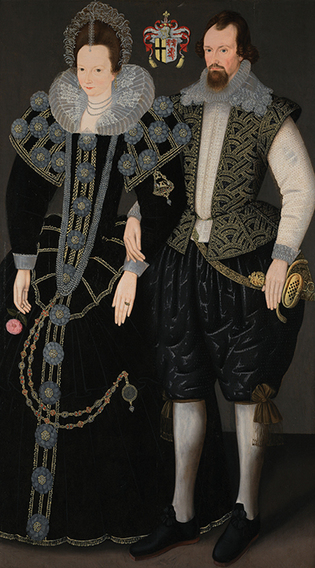
This double portrait of the newly married Mohuns, made around 1602, will be included in an exhibit of Elizabethan portraiture opening in fall 2027 at the Yale Center for British Art.
View full image
Made around 1602, this double portrait is one of the most striking images from the Tudor period. Large, bold, and with a powerful silhouette, the painting depicts Dorothy Chudleigh of Devon (c. 1586–1644) and Sir Reginald Mohun (b. c. 1565; d. 1639) of Boconnoc in Cornwall around the time of their marriage. This was Reginald’s third marriage, and the newly married Mohuns (pronounced moons) remained together for many years. Pendant portraits of the couple, still at the ancestral home at Boconnoc, were made around three decades after this painting.
Sir Reginald (who signed his name Reynold) was an important political figure in the southwest of England. Described by a contemporary as “one that by his courteous, just, and liberal course of life, maintaineth the reputation, and increaseth the love always borne his ancestors,” Mohun’s modern biographer points out that he also possessed a high-handed and arrogant streak. He set his servants upon his local adversaries, was challenged to a duel for breaking off an engagement, and falsified documents in a dispute with his own son, with whom he fought throughout his life.
Although his arm-in-arm embrace with his wife in the portrait is benign, even affectionate, some sense of his intensity as an individual comes across in his defiant gaze and stiff deportment.
A steely exterior was probably required for someone who served as deputy lieutenant, with responsibility for executing the monarch’s wishes in the region. This part of the country, situated a long distance from London, had a distinctive character. In the absence of an aristocratic presence in the locale, power was held by a network of gentry families, including the Mohuns, that was held together by bonds of kinship. In this painting, their combined coat of arms figures prominently between the couple, signaling to their peers their ancestry and long association with the Devon and Cornwall peninsula. This was England’s gateway to the Atlantic, and many of the famous figures from the period, such as Francis Drake, Walter Raleigh, and John Hawkins, hailed from this part of the country.
Recent scholarship has transformed our understanding of portrait-making in Elizabethan London, and this painting provides a rare opportunity to compare those practices with a workshop operating 200 miles away. There are several hallmark characteristics that make this workshop’s output immediately recognizable. The figures tend to be rigid in their poses, reflecting a stylized mode of representation that simplifies the contours of costume and renders details of jewelry and hair in a distinctive patterned shorthand. Their facial features are defined by a crisp linearity, and although the figures themselves are broadly convincing in proportion, they inhabit an implausibly shallow pictorial space, often standing on floors that recede at dramatic angles. The hands are repeatedly copied from the same stock patterns, in which the fingers are rendered as a single fused form, while the feet—when included—have the curious habit of all appearing to be left feet.
Another distinction of this studio is its consistent use of locally sourced English wood rather than the imported Baltic oak conventionally employed by metropolitan workshops. The latter was valued for its strong, straight grain and lack of knots, while this workshop’s use of local timber—whose distinctive grain is often visible through the paint surface—reflects both its regional identity and its practical adaptation to available materials. Technical analysis of paintings from this group, including the Mohuns, indicates that the workshop had access to the same range of pigments as London-based studios of the period. More costly materials, including red lake pigments, vermilion, and azurite, were used judiciously. For example, the expensive blue pigment was reserved for the whites of the sitters’ eyes, creating a lifelike animation.
The composition itself has considerable charm and several compelling details: The girdle (Dorothy’s jeweled chain belt), flower, ring, enameled jewel, the heraldic shield, and the elaborate clothing of both sitters all encourage close looking. The pose of the couple, while not unique, is unusual and provides insights into love and companionship in marital partnerships in the early modern period. Looking across the 70 or so portraits produced by this workshop, it becomes clear that family portraits—and in particular double portraits—were a specialism, and again this speaks to the importance of kinship ties in the close-knit gentry of the southwest of England.
 loading



 Print
 Email