Dan Renzetti
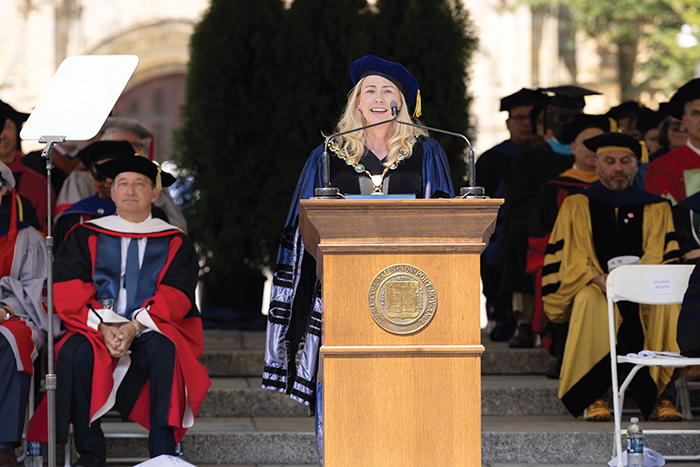
President Maurie McInnis ’96PhD welcomes incoming first-years, transfer students, and Eli Whitney students to Yale College with an address on Cross Campus.
View full image

Dan Renzetti
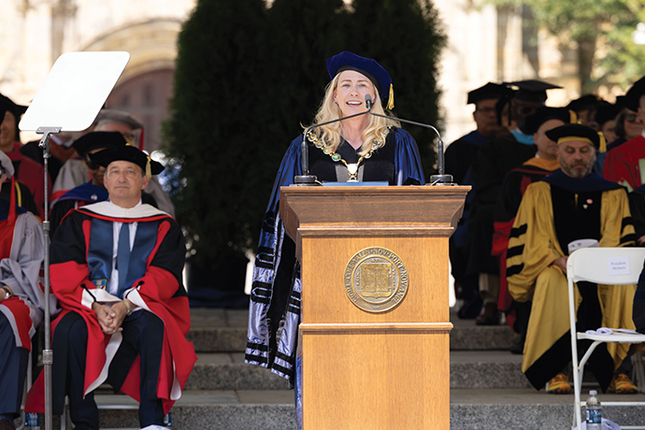
President Maurie McInnis ’96PhD welcomes incoming first-years, transfer students, and Eli Whitney students to Yale College with an address on Cross Campus.
View full image
© Ed Ruscha
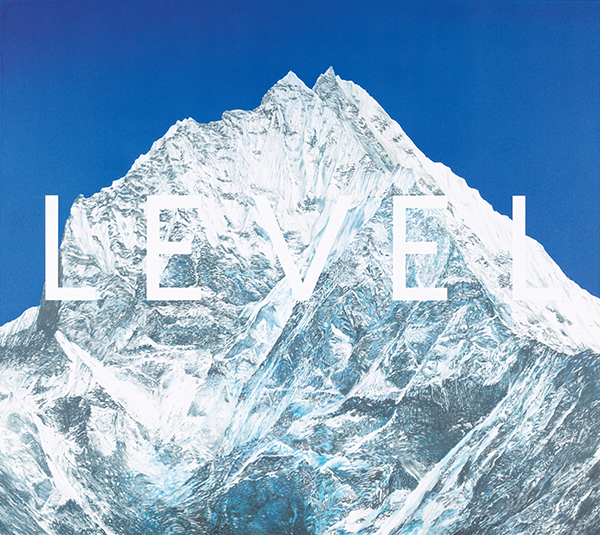
“Humans have long turned mountains into metaphors for our challenges and our accomplishments,” President McInnis told the recent arrivals and their guests, with artist Ed Ruscha’s "Level" projected behind her.
View full image

© Ed Ruscha
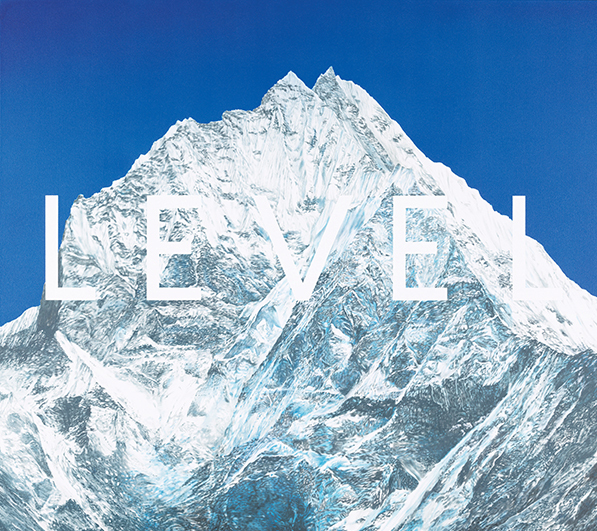
“Humans have long turned mountains into metaphors for our challenges and our accomplishments,” President McInnis told the recent arrivals and their guests, with artist Ed Ruscha’s "Level" projected behind her.
View full image
In her welcoming address on August 24, Yale President Maurie McInnis ’96PhD encouraged incoming first-years and transfer students to embrace uncertainty as they move forward, to stay open to an intellectual journey without a “predetermined ending.” Twenty-four hours after intermittent heavy downpours complicated move-in day, students and their guests sat under blue skies on Cross Campus for the Opening Assembly as McInnis spoke of uncertainty “not as a boundary but as a bond.” Her address follows.
_____________________________________________________________
Good morning, everyone. On behalf of Dean Lewis, Provost Strobel, and all of our colleagues, I’m so gratified to say to each and every one of you: Welcome to Yale.
Today is a beginning. And beginnings are grounds for celebration. But beginnings are also encounters with uncertainty.
Parents, I’ve gone through, with my own two children, this paradoxical ritual called “moving in.” Because “moving in” also means they’re “moving out.” Like you, I’ve climbed countless flights of stairs, hauling too many boxes of “do you really need this?” And like you, I’ve felt, all at once, pride in my children, bewilderment at how briskly time passes, and hope for their future. Hope that they will live their lives as only they can live them, in ways all their own, beyond even my most imaginative predictions for them.
This is the joyful indeterminacy of parenthood. Like parenthood, the most important endeavors tend to be undefined, without a fixed process or assured conclusion.
Students, you, too, are about to embark upon an undefined journey, one without a predetermined ending. Because what will define your Yale education is freedom. The freedom of intellectual exploration.
We want all of you to commit yourselves to a kind of egalitarian curiosity, one that embraces every variety of knowledge, and debates even the most agreeable assumptions. But a lack of constraints is also a lack of guarantees. And that can be disconcerting.
I came to Yale in 1989, also without any certainty about how my future would unfold, but knowing that I wanted to study art history among some of the world’s most original thinkers, and amid the nation’s best university art museums. Thirty-seven years later, those museums remain my favorite places on campus. And I hope, soon, they will be among your favorites also. Especially since, on the third floor of the Yale University Art Gallery, there’s a painting that might help you to welcome uncertainty.
You can see it projected behind me. And you can visit it later today, because the Gallery will be open from one to five. It’s by an artist named Ed Ruscha [1]. The canvas is dominated by a formidably jagged mountain, painted with almost hyper-realistic precision, in a palette of stony greys, glacial blues, and frigid whites, framed by a flat blue sky. But, seemingly floating above it all is—discordantly—a word. A most unexpected word: LEVEL. It runs across the middle of the mountain, in a font that Ruscha created and named “Boy Scout Utility Modern.” The word then also becomes the painting’s title.
So we have a word that not only denotes flatness but is also literally flat, superimposed over an image of chiseled and precipitous verticality. To most of us, this makes no sense. A natural human impulse is to try to make sense of the unknown, but Ruscha himself recommends a different approach. He said: “Art has to be something that makes you scratch your head.”
So what if, instead of lunging for an answer, we let ourselves scratch our heads? What if we gave ourselves the freedom to explore the contradiction? We could begin by considering our own personal associations. Humans have long turned mountains into metaphors for our challenges and our accomplishments. And for many of you, the peak on this canvas might remind you of your journey here.
It might call to mind all the mountainous cliches that you’ve traversed. You may have endured an uphill climb, you may feel that you’ve now reached the summit, you may be enjoying the view from the top, or you may be worried that what goes up must come down. And yet the blocky, two-dimensional script splashed across the summit speaks to other questions. Have I leveled off, or flattened out, or have I plateaued?
A head scratcher indeed.
Questions like these can’t be answered except by living through them, and you’ll encounter more than a few during your time here. I hope when you meet such paradoxes, you’ll remember that Yale admitted you for a reason. But I also hope that you’ll revel in your uncertainty. Because it’s a quintessential human emotion and a definitive part of the human condition.
Machines don’t feel uncertain, but humans do. And though humans can now ask machines for answers, no machine will ever replace human questioning. I hope, too, that you’ll find, in your uncertainty, inspiration and wonder and perhaps, sometimes, even a little fear. Those are the contradictory emotions that sit at the heart of awe.
Awe can be inspired by gazing up at a mountain tens of thousands of feet taller than you and tens of millions of years older than you. But awe can also be inspired by not knowing. By running into something that’s beyond you, something that exceeds explanation, like this painting; or exceeds prediction, like the four years ahead of you.
I hope you’ll allow whatever uncertainty you’re feeling right now to become this kind of awe. And I hope you’ll feel it again when you’re puzzling over a seemingly unsolvable problem set, or when you realize that two opposing ideas are both somehow valid, or when you aren’t sure what internship to pursue or what grad school to apply to.
But, of course, you can’t dwell in the awe of uncertainty forever. The deadline for the problem set drops upon you, or graduation somehow already looms. And you have to choose. So, when it comes time for you to make both minor and major decisions in the thick of doubt, there’s another mountain that I want you to remember. It’s the world’s second tallest mountain: K2.
In 1938, a group of American climbers traveled to Kashmir, to become the first people to summit what’s been called the “Savage Mountain,” and what’s considered an even more arduous climb than Mount Everest [2]. The expedition included a 25-year-old Yale alumnus named Bill House [’37MF].
He had been the president of the Yale Mountaineering Club. And his preferred collegiate pastime had been climbing on buildings around campus [3]. Presumably our gargoyles provided fine handholds. I’m obliged to clarify, though, that such climbing is against the rules. Three years after his graduation, he and his fellow mountaineers were beholding K2, all 28,251 feet of it. That’s as tall as Harkness Tower stacked on top of itself 130 times. He felt what he described as “an indefinable dread.”
I imagine the entire expedition was wondering: Would they make it to the top, or would they survive at all? Their preparations, though, had been comprehensive. They needed, for example, to ensure a reliable food supply, so they tested dozens of brands of biscuits. They dropped biscuits from high windows to gauge their durability. They left biscuits outside, all night, in a rainstorm, to see how they held up to moisture. And when they found the perfect biscuit, they bought 100 pounds of it. Once they were on the mountain, they followed, as far as they could, the route of a previous expedition.
They relied on the past. But, eventually, they reached a height where precedent could offer no further guidance. And they disagreed on the best approach. Debating in freezing weather, oxygen-deprived, exhausted after trekking back to camp through a snowstorm, they had plenty of excuses to foreclose discussion. But they nonetheless listened to each other for hours. Because they recognized that the questions you care about the most are precisely the ones on which you should invite the most disagreement.
Nor did they ever stop assuming they were friends. They played chess on a foldable board, they read to each other from The Pickwick Papers of Charles Dickens, they sang old folk ballads about the Klondike Gold Rush. They recognized that community doesn’t depend on agreement but on commitment, commitment to extend goodwill, and to assume good faith, on the way to a shared goal. And though they differed on how they should attack the mountain, once a plan was agreed upon, each of them did their part.
Bill House’s part included free-climbing a 100-foot crevice. This is considered one of the most challenging sections of the mountain, and it’s now called House’s Chimney. But not even bravery, skill, or teamwork guarantee accomplishment. When the expedition was less than half a mile below the peak, they had to turn back. But they had still gone higher than anyone before them. And they were able to do so because they had relied on one another, and prioritized the success of the entire expedition over individual achievement.
Sixteen years later, the course they mapped was used by the expedition that would become the very first to summit K2 [4]. And it remains the standard path today. Failing to fulfill an ambition isn’t necessarily the same as failing.
Students, though your climbing may be metaphorical, the lessons here apply just as well. Strenuous preparation, mindfulness of the past, the generosity of disagreement, the necessity of friendship and community, faith in the incomplete—these are the routes I hope you take up the mountain of uncertainty. And there’s one further hope I have for you, which is that you’ll remember you’re not alone in not knowing. Yalies have been learning through uncertainty for 325 years.
In 1701, at the first-ever meeting of Yale’s Board of Trustees, our founding Congregationalist ministers asserted: “There shall and hereby is erected and formed a Collegiate School, wherein shall be taught the liberal arts and languages.” [5] This formative declaration recalls the original derivation of the phrase “liberal arts.” “Liberal,” in this context, comes from the Latin for “free.” [6] And, though our university was originally envisioned as a sanctuary of Calvinist orthodoxy, freedom of thought has always prevailed at Yale.
In those first decades, our library housed quite a few Puritan texts. But it also included books on Galileo and Newton and Descartes, stoicism and idealism and empiricism, anatomy, medicine, world history, and all manner of doctrinal controversies. [7] Theologian John Calvin was studied alongside philosopher John Locke.
Both students and professors were often discomforted by this collision of ideas as apparently contradictory as a painting of a mountain interrupted by the word “LEVEL.” But even amid perennial demands for censorship, all of those bewildering books remained in the library. Yale is a place where you are free to be uncertain.
Where you are free to be uncertain alongside so many other courageous thinkers who want to step beyond what they already know.
Uncertainty isn’t something to fear.
Uncertainty is something to welcome.
Uncertainty propels the search for knowledge, because there would be no learning without uncertainty.
Uncertainty ties you to the generations of exceptional students who’ve preceded you here, who’ve scratched their heads over the same questions, though they may have offered different answers.
And uncertainty ties you to the students who’ll come after you, who will inherit your answers and ask their own questions.
This abiding lineage of knowing and not knowing should provoke awe. The awe of joining a community that spans centuries. Class of 2030, may the next four years teach you that uncertainty is not a boundary but a bond, not a cause for anxiety but a summons to partake in a collaboration that transcends you.
May you learn here how to be uncertain together.
Footnotes
[1] “Edward Ruscha.” Whitney Museum of American Art, whitney.org/artists/9343.
[2] Houston, Charles S., et al. Five Miles High. The Lyons Press, 1939.
[3] Jones, Chris. “Robert Underhill and Jack Durrance.” Climbing in North America, University of California Press, Berkeley and Los Angeles, CA, 1976, p. 200.
[4] “K2.” Encyclopedia Britannica, 26 July 2026, https://www.britannica.com/place/K2.
[5] Warch, Richard. “Liberty to Erect a Collegiate School.” School of the Prophets: Yale College, 1701–1740, The Colonial Press Inc., Clinton, MA, 1973, pp. 32–33.
[6] Sick, David H. “Etymologies of the Liberal Arts.” Zeal: A Journal for the Liberal Arts, vol. 3, no. 1, 2024, https://zeal.kings.edu/zeal/article/view/73/60.
[7] Clap, Thomas. A Catalogue of the Library of Yale-College in New-Haven. Timothy Green, 1743.
 loading


 Print
 Email