Tong Hsu ’24MArch and Brandon Lim ’24MArch
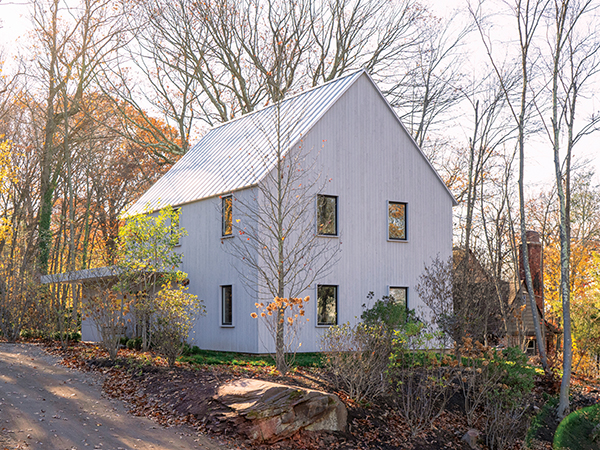
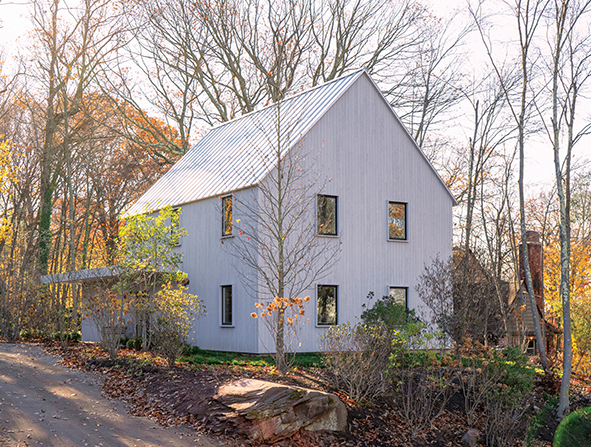
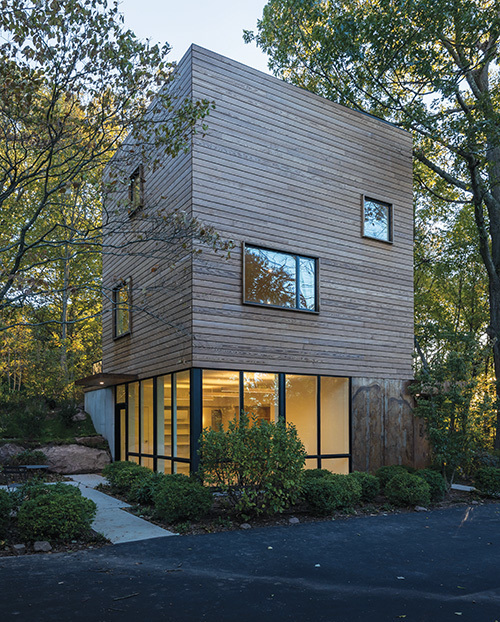
In 2023, architecture students built this house, the first of four for the Friends Center for Children. The only one of the houses that faces a public street, it has a more conventionally “houselike” form than the others.
View full image

Tong Hsu ’24MArch and Brandon Lim ’24MArch
In 2023, architecture students built this house, the first of four for the Friends Center for Children. The only one of the houses that faces a public street, it has a more conventionally “houselike” form than the others.
View full image

Yale School of Architecture
The site of the houses in Fair Haven Heights totals about two acres, but the west end (at top in plan) has a steep slope and is not practical for building. The original house already on the site (1) was joined by new student-built houses in 2023 (2), 2024 (3), 2025 (4) and 2026 (5). The houses loosely surround a green common space (6).
View full image
Logan Ali ’28MArch
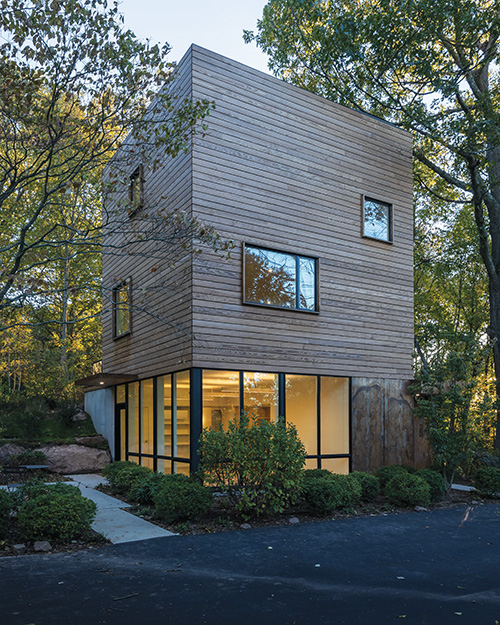
The third Yale-built house, from 2025, includes a community gathering space beneath the private living space. Unlike the other three, it is designed for one household.
View full image
Logan Ali ’28MArch
The third Yale-built house, from 2025, includes a community gathering space beneath the private living space. Unlike the other three, it is designed for one household.
View full image
Bohan Chen ’25MArch and Deming Haines ’25MArch
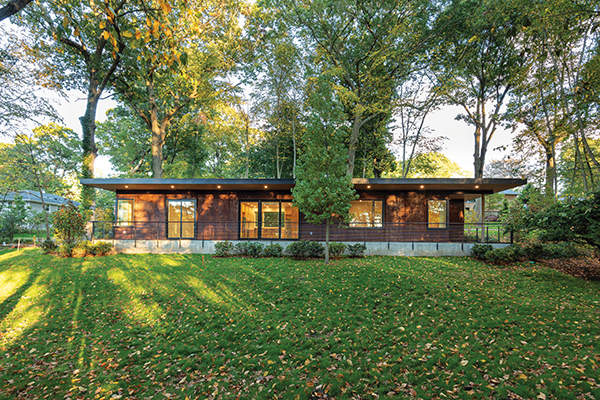
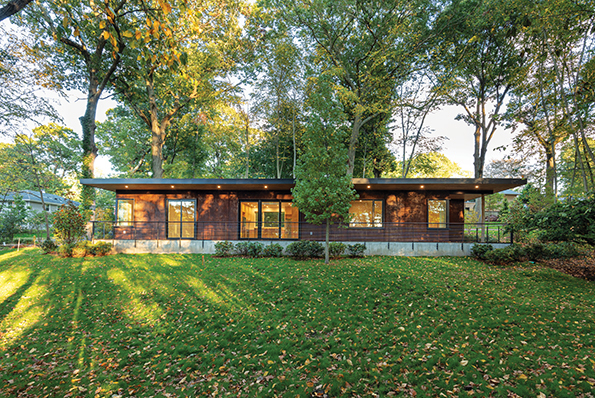
The second house, completed in 2024, was built on one level, in part to preserve the hilltop views of the neighbors to the east of the site. A covered porch faced the village’s common green space. All first-year architecture students participate in the first part of construction of the houses.
View full image
Benjamin Piascik
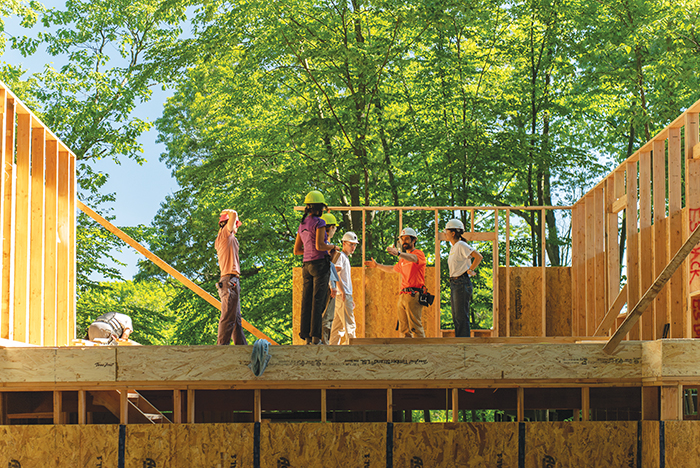
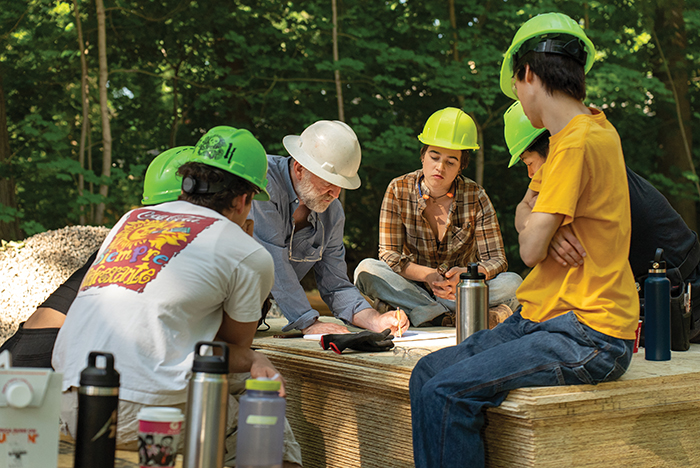
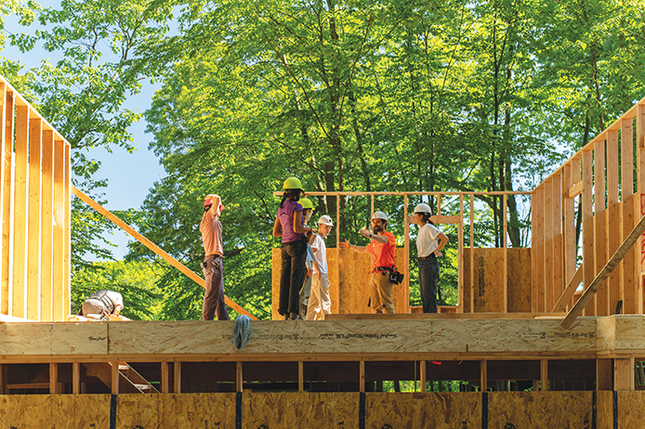
All students participate in framing and other early stages of construction.
View full image

Benjamin Piascik
All students participate in framing and other early stages of construction.
View full image
Logan Ali ’28MArch
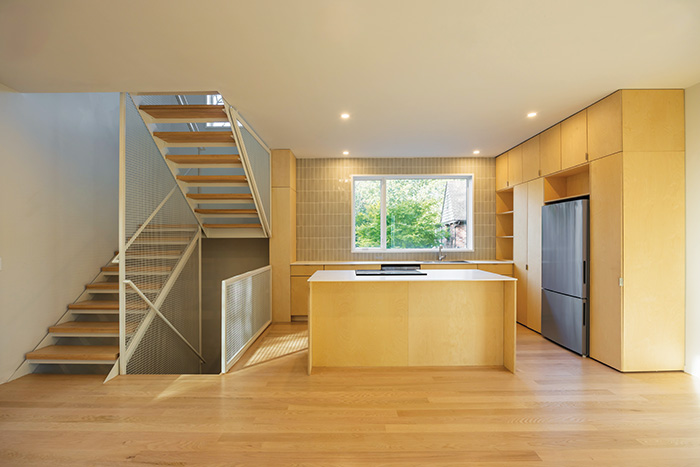
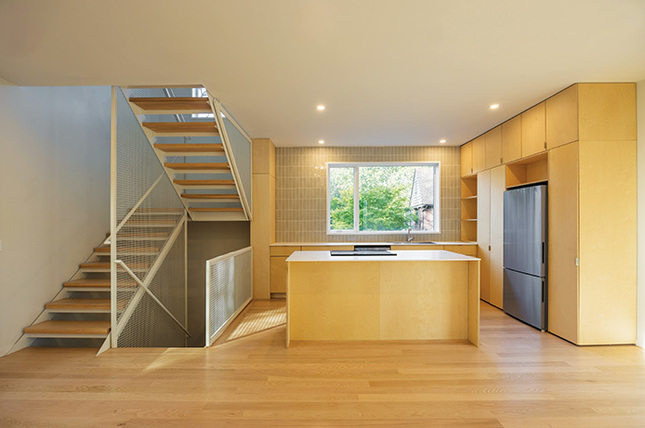
Students who stay on for the summer do some of the finer work like kitchen cabinetry, as seen here in the 2025 house.
View full image

Logan Ali ’28MArch
Students who stay on for the summer do some of the finer work like kitchen cabinetry, as seen here in the 2025 house.
View full image
Benjamin Piascik
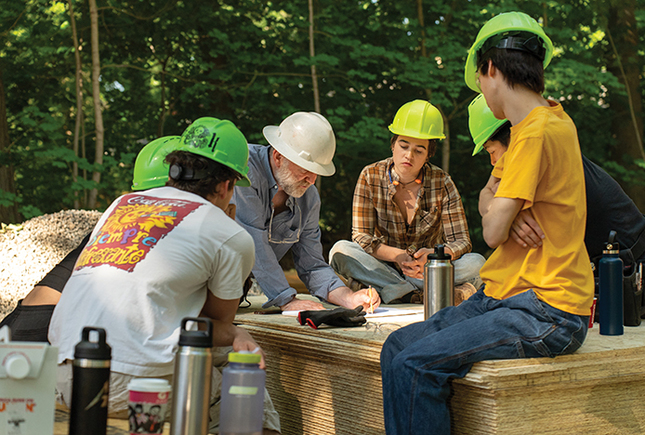
Contractor Carlos Zapf (in white hard hat) teaches students about construction as an instructor in the program.
View full image

Benjamin Piascik
Contractor Carlos Zapf (in white hard hat) teaches students about construction as an instructor in the program.
View full image
Benjamin Piascik
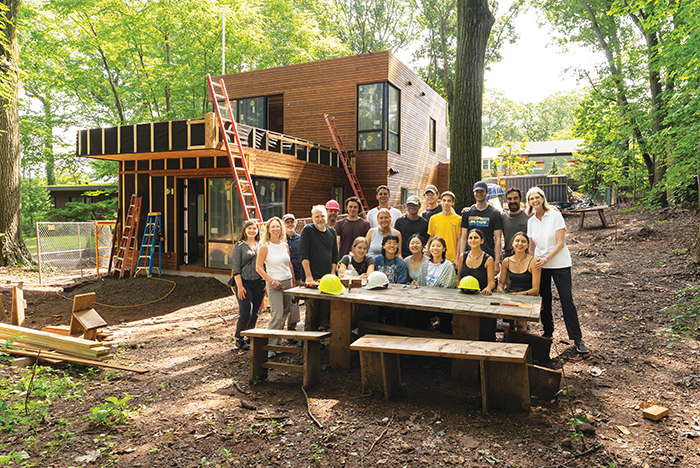
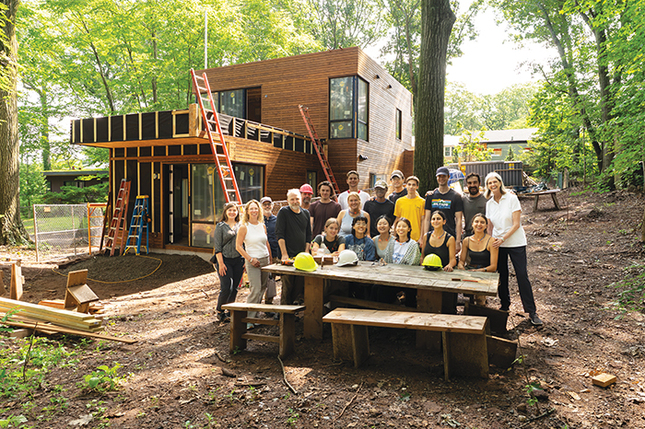
Students and faculty pose in front of this year's house, which separates the two households on different floors; the upper floor has a roof terrace (at left) and the lower one a deck.
View full image

Benjamin Piascik
Students and faculty pose in front of this year's house, which separates the two households on different floors; the upper floor has a roof terrace (at left) and the lower one a deck.
View full image
If what you know of New Haven is noisy streets and crowded sidewalks, these two acres don’t seem like New Haven at all. It is quiet, with lush plantings beneath the shade of a tall canopy of trees. A few small, humbly elegant modern houses are arranged informally around a central lawn.
If these houses were on the market, people would line up to rent or buy them. But there’s only one way you can live here: teach at the Friends Center for Children, a New Haven–based childcare and education provider for children ages three months to five years. The houses, designed and built by first-year students at the Yale School of Architecture, are part of the Friends Center’s effort to change the financial equation for underpaid early-childhood educators by providing free housing as part of their compensation.
This marriage of social consciousness, architecture, and construction is at the heart of the Jim Vlock First-Year Building Project, a 59-year-old program at the architecture school. Launched in 1967 by then–architecture chairman Charles Moore, the project—a requirement for all first-year students—takes students through all the stages of a building project, from initial discussions with the client to research, design, and construction.
It’s an essential part of a Yale School of Architecture education: a formative experience and a bonding ritual. And it’s a draw for prospective students, says Margaux Cooper ’28MArch. “It’s not an overestimation to say that the majority of people come to Yale to do this course specifically, to build something and design it and learn construction details.”
Over the decades, the nature of the projects has varied. The first were community centers in rural Appalachia. In the 1980s, public amenities like bandshells and picnic pavilions allowed students to experiment with form. Since 1989, the projects have all been houses for a succession of nonprofits in New Haven.
But the collaboration with the Friends Center is a first: a series of four projects on one site for the same client. “It’s so valuable to focus on a site over multiple years and to have the students benefit from the previous year’s work,” says Adam Hopfner ’99MArch, a senior critic at the school and director of the building project. “It’s just really broadening the perspective of what the building project is.”
The problem of childcare
The idea for this village of houses came out of the Friends Center’s effort to address what CEO Allyx Schiavone calls the “market failure” of early childhood care and education. Launched in 2007 by a Quaker congregation in New Haven’s Fair Haven Heights neighborhood, the center has quickly grown to serve children at four sites around the city.
Schiavone explains that because US child care costs more to provide than parents are able to pay, teachers are chronically underpaid—an average of $34,600 a year full-time in Connecticut. “The women in the early care and education sector—and it is 97 percent women—are subsidizing the work by low wages,” she says.
So the Friends Center started looking for ways they could improve their teachers’ financial situations, short of paying them more, which was not feasible. They hit on trying to reduce housing costs, the largest piece of most household budgets. If the center owned its own housing, they could provide a valuable benefit to teachers with the most need. They approached donors who bought some properties for the center, and the Teacher Housing Initiative was born.
But even with donors’ help, real estate is expensive to buy, especially in post-Covid New Haven. Eventually, the Friends and the building project got together to discuss a collaboration.
The Vlock project was just wrapping up a six-year building program with Columbus House, a nonprofit that serves people experiencing homelessness. Hopfner says the Friends Center’s agenda was attractive. “It felt like a lovely opportunity to work with an organization that is changing the way people perceive the value of early childhood education,” says Hopfner, “having this model whereby the housing becomes a stabilizing force in the lives of the teachers.”
A donor bought a house on two acres near the center’s school in Fair Haven Heights and gave it to the Friends, who made a plan with the Vlock project to build four more houses on the site. With the cost savings from student design and labor—not to mention the relationships the Vlock project has with suppliers who offer free or discounted materials—the Friends could build for less than half the market rate.
The area is zoned for single-family dwellings, so the site was divided into lots with one house apiece. While three of the houses are designed to accommodate two teachers and their families, they are technically single-family houses because they share one kitchen. (This offers a design challenge to the students: how to balance privacy with shared space.)
First impressions to finished product
For the first-year students who design and build the houses, the process starts at the beginning of the spring semester—not with design but with research. “We do a whole exercise called person and place,” says Hopfner. “Half the class does a really deep dive into an analysis of the site itself, and understands the migratory patterns of the birds and the geologic retreat of the glaciers, and the topography and the flora and fauna. The other half are talking with the teachers, learning about their concerns: the fact that it’s really hard to get out the door at 7:30 in the morning with a child in a car seat and a toddler that forgot her mittens. The architecture emerges out of an empathetic understanding of who we’re really building for.”
Next, the class of 67 students is divided into five or six-person teams, each of which comes up with a preliminary design. Over time, with feedback from faculty, guest critics, and the client, the designs are refined, and one of them is chosen.
Fernando Rojas Cervantes ’28MArch was on the team whose design was selected this year. He says they paid special attention to feedback from the teachers who lived in the houses designed in previous years, who said there was not always enough of a feeling of privacy between the two households. They put the two units on different floors (except for the shared kitchen) but not stacked directly above each other, which reduces noise transmission. “That was the key detail that made our design stand out,” he says.
Once the design is settled, the entire class goes to work to turn it into reality. For the first two months of the summer, everyone in the class is expected to spend time working on the site. Professionals are brought in for the licensed trades—plumbing, electrical, HVAC—but framing, carpentry, and other jobs are done by students, most of whom have no previous experience. “The first time is so scary,” says Rojas Cervantes. “Second time, you start getting the hang of it. Third, fourth, fifth time, you know what you’re doing.”
A smaller crew of around 13 students works to complete the house as paid interns. This summer, Margaux Cooper was one of them. “Over the eight weeks or so, the work required got more and more tight and precise, which was nice, because also our skills got more and more tight and precise as we went,” she says.
Hopfner says the experience of seeing the project come to fruition is what makes the building project so important. “To go from drawings and models to being able to walk through the space two months later gives them something that can’t be taught; it has to be experienced,” he says.
The benefits for teachers
With this set of houses complete, the Vlock project will begin a new village this spring on a new site near another of the Friends Center’s schools. By 2028, Schiavone says, the center will be able to offer housing to 24 of their 78 teachers.
Eric Gil is one of them. He teaches in an infant and toddler classroom at the Friends Center, and he lives with his brother in the second house built by the Vlock project. Before that, he had a 50-minute commute from Waterbury, where he lived with his uncle and his family—seven people in a three-room apartment. The time he gained has helped him work on his bachelor’s degree in early childhood education. (He’s not alone: Schiavone says 77 percent of the teachers in Friends housing have been able to go back to school.)
For Gil, another benefit is the sense of community among the teachers living around him. Those with cars give rides to those without them, and they watch each other’s children. “We hang out together,” he says. “And if they need help, we are there for them.”
For the Yale students, that community was motivating, Cooper says. “We thought about it every day, that we were working on this mission of housing teachers, and that this project was changing their quality of life and their financial security and the ability for them to look forward.” And in a profession where novelty and artistic expression are sometimes at odds with practicality, she says, “there was a real sense that we should remember who we’re doing this for. It’s really important, and it’s not about you at all.”
 loading



 Print
 Email