Chris Buck

Chris Buck

Chris Buck

Chris Buck
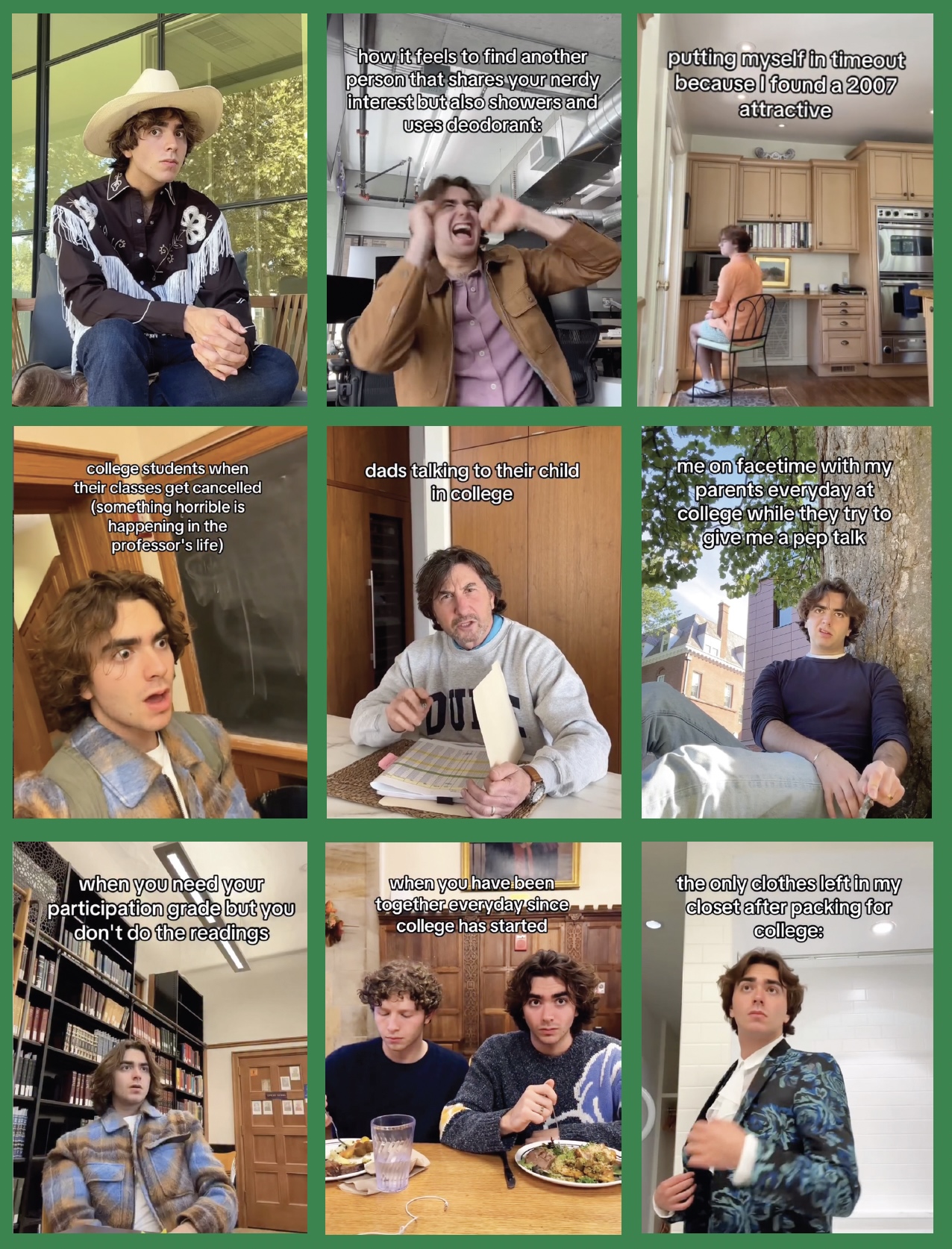
A sampling of Instagram posts chronicling the minute yet telling universalities of college life that have helped Arnow accrue more than a million followers.
View full image

A sampling of Instagram posts chronicling the minute yet telling universalities of college life that have helped Arnow accrue more than a million followers.
View full image

Chris Buck
Winding down in his room at Ezra Stiles. Why does he push himself to post every day? “My first year, I got mono. I was like a ghoul,” says Arnow. “I didn’t post for two days, and everyone in the comments was like, ‘Are you alive? We’re checking in on you.’ So now I do it for those comments.”
View full image
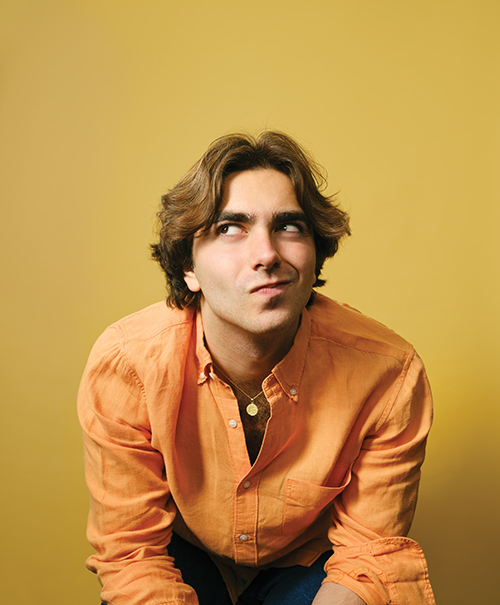
Crawford Arnow takes sure steps across the fourth floor of the San Francisco–based headquarters of Twitch, an interactive livestreaming platform giant where the rising senior is interning for the summer. Phone in hand, he’s showing me how he creates content for an odd 1.2 million followers scattered across Instagram, YouTube, and TikTok, the last of which he’s posted on daily since 2020.
In what feels like seconds, he’s filmed a video he says is meant to illustrate the way it feels to come across a smell from one’s past, a flashback to that era in time. Explaining the clip’s inspiration, he turns to me with raised brows and wide eyes. “Did you ever have, like, an ex where you smell their cologne again?” he asks. I answer. He shakes his head, brown hair flopping: “Horrifying.”
If his other content is any indication, the eight-second video Arnow filmed is likely to garner anywhere from 50,000 to a couple million views across platforms. In mere moments, he types up relevant key words at the bottom of the video to feed into the app’s search engine, places text where the viewer’s eyes will naturally land, and executes visual transitions that will keep the audience’s attention, 4.7 seconds in.
Arnow is part of the vast creator economy, a realm in which bite-sized videos posted across social media platforms play a massive role in generating an estimated $480 billion in revenue by 2027. These clips cover every surface of the human condition; in one minute, you can stumble upon an homage to a passed loved one, watch an AI-generated monstrosity of animation come to life, learn how to make bagels at home, and more, depending on your rate of scroll.
Or, you might catch one of Arnow’s posts. Aside from bringing both online notoriety and an impressive bit of pocket money (short-form content creators make anywhere from $50 to $300 per million views on YouTube alone, and brand deals for creators with Arnow’s reach can bring in $4,000 per post), his daily videos, which portray human moments that feel unique but skew universal, have resulted in social collaborations with names like Ralph Lauren, Apple, and Kodak.
“I used to be, ironically enough, very anti–social media,” shares Arnow over lunch in the Twitch office’s sprawling canteen. But as a theater-oriented teenager cooped up in his Texas home at the onset of the Covid-19 pandemic, Arnow downloaded TikTok—at first, to use as an editing app for a biology project. “Theater was kind of lost as a creative outlet . . . [but] then I started scrolling. I was like, ‘This is a great excuse to get out of pajamas.’ And so I kind of made it my mission. Every day, I had to post at least once. . . . I wanted to make people smile, and make myself joyful.” Arnow pauses, taking the first of few bites of his chicken and quinoa bowl.
Fellow interns wave at him from across the room, and he waves back with enough enthusiasm to shake the table.
Six years after his online debut, the spotlight aimed on his strong, often-cocked brow extends past Arnow’s front-facing camera. The psychology and theater double major has acted in 15 Yale productions so far, playing leading roles as Little Women’s Theodore Laurence and Alice By Heart’s White Rabbit/Alfred Hallam/March Hare before his second semester.
Most notably (at least according to the internet, where just one video of the then-junior playing the role garnered more than 10 million views), Arnow again took to the stage in the winter of 2026 to play Spring Awakening’s Hanschen, a cunning student in 19th-century Germany. “Just got told good job after g00ning on stage in front of an audience,” reads the main text in one of Arnow’s daily videos. Video-Arnow gazes, off-kilter, at himself in a mirror backstage, as he faces a flashback of a spotlight trained on his nightgown-clad form, passionately executing the juncture in the musical in which Hanschen portrays sexual awakening by masturbating to a postcard depicting Correggio’s Jupiter and Io. The audience, which includes Arnow’s peers, parents, and future undergraduate thesis adviser, claps feverishly.
Crawford Arnow wants to be famous, and has since he was six. And unlike so many others who have admitted that dream to another, Arnow’s earnestness cuts through any vanity, no matter how well-veiled.
“From an early, early age, he was going to go the direction of fame. . . . That’s what he’s comfortable doing,” says Arnow’s father, David. With a slow smile, the senior Arnow recalls the day he can most clearly remember understanding his son’s trajectory to stardom, at a work party 15 years ago. “Someone said, ‘Hey Crawford, you want to sing something?’ He grabs the mic, if there was a mic, and sings this Lady Gaga song. It was amazing.”
Arnow isn’t part of the most recent boom in micro- and mega-niche influencers plastering social media feeds. Far from it, he is of this scrolling digital world.
Starting his content-creator career at 15, Arnow doesn’t see his social media work as a tool he plans to wield to achieve his Broadway dreams; his online presence is just as important as stage acting, and both are equally defined as part of his practice. Arnow knows how his content creation crosses into his theater work (he started out making cosplaying videos), how it doesn’t (filming in public is very different than acting on stage; his audacity has skyrocketed, he says), and how it is important to pursue other opportunities as well: hence, the Twitch internship.
It’s because Arnow is so aware of the ways in which the real world and the people in it work that he’s able to excel in his craft, says Yale’s Chris Argyris Professor of Psychology Wendy Berry Mendes, for whom Arnow works as a research assistant.
“One of the things that we’re interested in studying is romantic couples,” says Mendes. “We needed to bring about really specific emotions for that couple when they’re in the lab, and this is a really artificial environment, right? It’s hard.”
Without giving too much away, because “My postdoc would kill me if it came out,” she continues, “Crawford had just this kind of exquisite insight into how to do it in such a way that we were all sort of blown away by his ability to think about how to create that emotion in the lab.”
Mendes says they’ve been running that study now for months, and its maintained success is, in part, due to Arnow’s contributions.
“Crawford is uniquely skilled at thinking about ways to bring about target or specific emotions,” she says. “He has a good sense of isolating various affective states to be better at identifying and then engendering it in the lab, and I think that is probably very much from his acting. . . . He understands that messages that are effective have to be simple.”
According to Arnow, effective messaging, and therefore successfully viral content, comes from thriving within the constraints of your medium. “You can’t capture who you are fully in a 15-second video,” he says. So, he advises anyone who’s looking to start their content creator journey to hone one of their characteristics, and run with it.
Vying for the attention of an online audience with an ever-shrinking attention span and a near-subconscious literacy in the most nuanced of digital language, Arnow chose, at the start of his social media career, to focus on what already stood out: his cheer, his “effervescence,” as Mendes phrased it, and his joy.
“On social media,” he says, “you are an aspect of yourself, amplified.”
Arnow’s practice doesn’t mean that any of his bright smiles or large gestures are phony; in fact, he says it’s harder to put on an act for his social media content than it is to perform on a stage. When there isn’t a character to play, like Berthe from Pippin or Bottom in A Midsummer Night’s Dream, the default character is himself.
And even the most average scroller can tell when someone isn’t comfortable.
“Implicitly, as humans, [so much] of communication is body language. Even if you’re trying to appear genuine, if it’s constructed, I almost think people can see through it,” he explains. As we descend from his office and amble towards Fisherman’s Wharf, he gestures at his own broad-shouldered frame. “Like right now, I was thinking, ‘My hands are in my pockets. Does that mean I’m more closed off?’”
In this line of work, Arnow doesn’t have any options other than to be himself. He must feel and present his emotions at great depth while simultaneously straining them through a fine sieve to form a crystallized version of them for social media—a skill increasingly necessary for a young person in today’s public eye.
“I think one way to make it as a celebrity now is when the audience almost feels like a sense of ownership. I think of Olivia Rodrigo, where we saw her from her first album, so it’s like we saw her genesis. . . . Or Sabrina Carpenter, where it’s like she’s our Disney girl. We feel this kinship because we’ve known her all our lives. That’s our bestie.”
Some of Arnow’s followers likely view him the same way. “You guys don’t know how much you really mean to me man. This is what kept me going all those years ago, thank you for making me stay,” reads one comment. Another particularly enthusiastic follower writes: “I hope you know that the first time you acknowledged me on the live [stream] that I screamed so loud and started crying so loud that I started getting texts asking if I was ok. I said no to every one of them.”
As entertainment evolves, so does the concept of celebrity. Just as the common folk—maybe even your neighbor; maybe even you!—have begun to dip their toes into the fame pool by becoming influencers, the larger-than-life facade that celebrities once maintained has faded as we see through their eyes on social media. They post vacations and get into fights in the comments, just like us.
Except, apparently, for Arnow.
He limits his replies to DMs—at most, just short thank-yous—and “I only heart with yellow hearts.” Yellow, Arnow explains as my eyes widen, takes the place of the default red, “so there’s no presumption you’re inviting anything.” My brain attempts to think back to all the things I’ve unwittingly “hearted” in red.
Fans of Arnow post screengrabs of his videos from five years ago in the comments to show their loyalty. They make “fan edits” of him, stitching together his content behind a song of their choosing to show their dedication. They write fanfiction about him, coupling him with other content creators. When asked how he would change internet fan culture in general, Arnow says he’d advocate for less aggression, and more respect. But when it comes to his own fan base, he shrugs, flustered.
“On social media, you are no one without your community,” he says. “You’re given these opportunities because of the people who support you.”
In a video from June, Crawford explains to his fan base that he’s about to be a senior in college. Viewers who’ve been watching him for years express astonishment at his upcoming graduation: “How are you already a senior?!” wrote one. Another, “Wait, what? What chapter did I miss??”
Musing on his trajectory, Arnow’s parents again trace back to his origins. “His favorite character was always Peter Pan,” said David. “He did not want to grow up,” Arnow’s mother, Debbie, cuts in. “I don’t think he still does.”
Arnow has changed since he first began acting, onstage and online. He stands taller, his hairstyle evolving from a trendy do that tumbles over his forehead to a timeless middle part à la John Bender. Years of experience in increasingly demanding stage roles have given him depth, run-ins with companies using his face online without permission have given him resolve, and thousands of supportive messages (with respectful dismissal of the unfavorable ones, after a bit of wallowing) have given him confidence. With graduation nearing, he’s kicked into a gear of adult stability, hoping to return to a company like Twitch to support himself as he continues to make content and send audition tapes wherever they’ll take them. But careful viewers will notice that the gleam in his eyes under the spotlight, in front of the camera—anywhere he can be himself, in whatever amplification—remains as keen as ever.
 loading



 Print
 Email