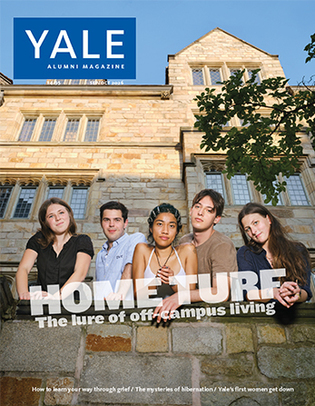
Chris Buck
A few months ago we asked you for eight minutes. We weren’t sure how many of you would answer.
Answer you did, and not just the box-checking kind, either—page after page of considered, sometimes contradictory, occasionally blistering opinion about what this magazine is for and whether it’s delivering. We asked how you read, what you value, what you’d change. You told us, so I wanted to share a first read on what we heard, and what happens next.
Several of you said the magazine has grown too soft—more promotion than journalism, more shine than substance. Others said we cover too much institutional friction and not enough of what makes Yale worth loving. There were calls to spend more time on Yale research, history, and impact on the world; less on sports. A couple of things came through loud and clear: You read in print, and you read to stay connected to Yale and its community, its alumni, its research and ideas and direction.
This kind of feedback is exactly what we were looking for. We are in the process of reading every word, and we’re not setting the hard parts aside, although this is also true: A magazine that reflects the actual range of a community this large is never going to please everyone. If it did, I’d worry we’d stopped trying to reflect you at all.
More about what you said: You span every decade back to the 1950s, every part of the world, and every shade of political conviction this country holds and beyond. (We didn’t ask about this last point, but it came through clearly in the comments.) Yet you all, somehow, read class notes—still your favorite section, followed by long-form feature journalism. That’s true even for more recent grads and those who lamented their class doesn’t write much; one called them an “opportunity to learn from older alumni I would never connect with otherwise.” This strikes me as an old-fashioned and increasingly rare thing: a shared room, a commons of sorts. This magazine still gives you a way to sit next to people you’d never have chosen to sit next to, and hear what they’re doing anyway. That feels worth defending in a world of increasingly disconnected bubbles.
So, from all of us, thank you. Whether you told us you read for “intellectual stim”; that you’d like more stories on other alums, including “those whose lives have not followed shining paths”; or that ways to contact each other online could be useful, especially if interactive, regional, and password-protected, this is information we can use. You said you look at the magazine “to track classmate survival,” for reunion prep, or that you mainly just “keep it on my coffee table to flex and occasionally read.” It’s all something we can’t manufacture ourselves: an honest read on where we stand.
Your answers will shape our plans for a redesign. With help from alumni and faculty, including the members of the YAM Editorial Advisory Board—find their names on page 2—our next move is to examine the print magazine, keeping what’s earned its place while making the magazine feel like it also belongs to the graduates of today. Depending on full results, we’ll consider our website and perhaps an email newsletter—likely the most affordable way to reach international readers, a group we deliberately went looking for in this survey, since they must take out a paid subscription to receive print.
I can’t give you hard numbers yet; at time of writing, the survey’s still live. One of print’s odd arithmetics, given the weeks between printer and mailbox, is that everything you’re reading was written more than a month earlier. That’s the print magazine trade-off: It can’t tell you the breaking news, only what’s true once the dust has settled, hopefully with plenty of the context and history a first read on any situation can’t contain. What we do know is that a shiny new website or striking magazine cover aren’t enough; what matters is what they contain. We strive to live up to the reason we were founded, and the thing that an alumni publication that tells its institution’s story fully and fairly is still well positioned to produce: storytelling that connects you honestly enough to Yale that you can decide for yourself what your relationship to this place should be.
One more thank-you: Roughly a third of survey respondents volunteered to join our new Council of Readers, an occasional (no more than quarterly) email panel we’ll turn to when testing a story idea, new platform, or who-knows-what. We’re grateful you’re game, and promise not to abuse the privilege.
 loading


 Print
 Email