Getty Images: Xpacifica
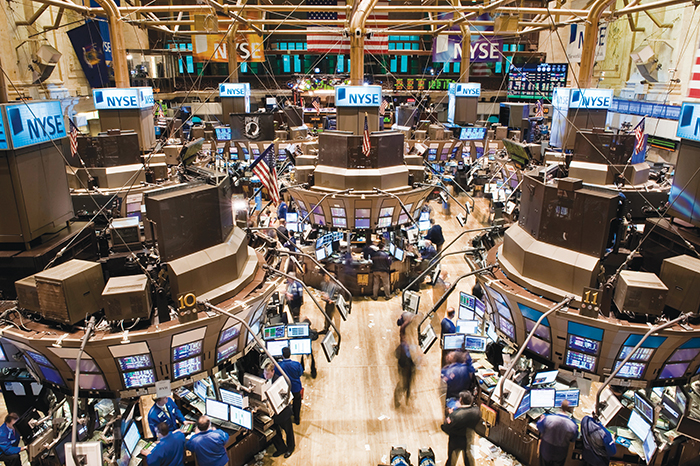
The trading floor of the New York Stock Exchange.
View full image
In an uncharacteristically meditative moment, Lucy Van Pelt of the Peanuts gang expresses a sense of discouragement to Charlie Brown. In turn, Charlie Brown reminds Lucy that life has its ups and downs. “But why can’t my life be all ‘ups’?” Lucy counters. “Why can’t I just move from one ‘up’ to another ‘up’? Why can’t I just go from an ‘up’ to an ‘upper-up’”?
If she really wants consistent “ups,” Lucy likely would do well to invest long-term in the US stock market.
The market has, of course, had its share of catastrophic events: the massive crash of October 1929 that heralded the Great Depression; the dot-com bubble of the late 1990s that eventually erased trillions in market value; the housing and financial crisis bubble of the early 2000s that caused a systemic banking crisis and the Great Recession; and, in early 2020, the crashing of global stock markets after instability generated by the Covid-19 pandemic.
While these events loom large in the public consciousness, the overall market is more likely to recover from crashes than to continue declining, says William Goetzmann ’78, ’86MBA, ’90PhD, Edwin J. Beinecke Professor of Finance and Management Studies. Although certain individual industries might prove more volatile than the market as a whole (e.g. the emerging technologies of a given time period such as radios, airplanes, the internet), true stock market bubbles—large booms followed by crashes that fully reverse prior gains—are extremely rare.
In a National Bureau of Economic Research working paper, Goetzmann and his team examined historical stock prices from 1792 to 2024, using data from the Cowles Commission for Research in Economics and other sources. The data show just ten “bubble” episodes in more than two centuries and suggest that the overall market is much more likely to recover from a crash than to continue falling. At every crash configuration, full recoveries vastly outnumbered further declines within five years.
Goetzmann notes that the human tendency to focus on negative events means that people are more likely to remember the few stock market bubbles than subsequent recoveries and continued market growth. “I worry that the memory of a crash or concern about a boom will keep people away from the market,” he says. “But all our evidence indicates that, over the longer term, keeping money in the stock market is a wise strategy.”
 loading



 Print
 Email