Yale Alumni Weekly
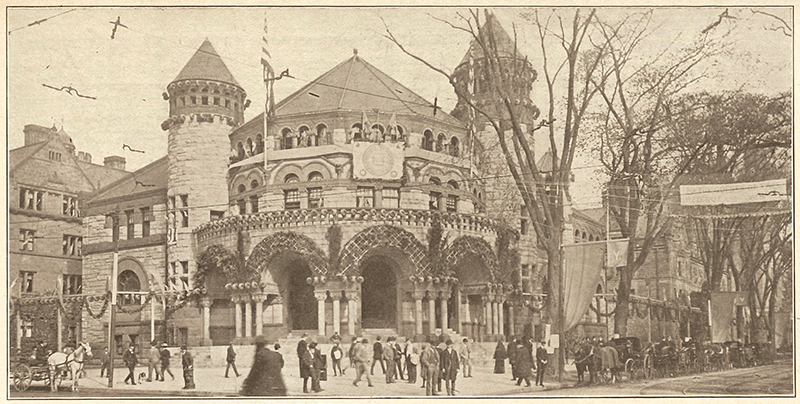
Osborn Hall, which stood at College and Chapel from 1896 to 1921, was among the buildings decorated for the bicentennial.
View full image

Yale Alumni Weekly
Osborn Hall, which stood at College and Chapel from 1896 to 1921, was among the buildings decorated for the bicentennial.
View full image
Manuscripts and Archives.
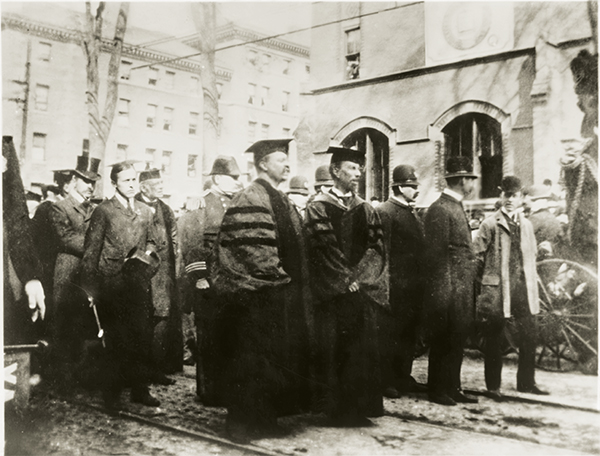
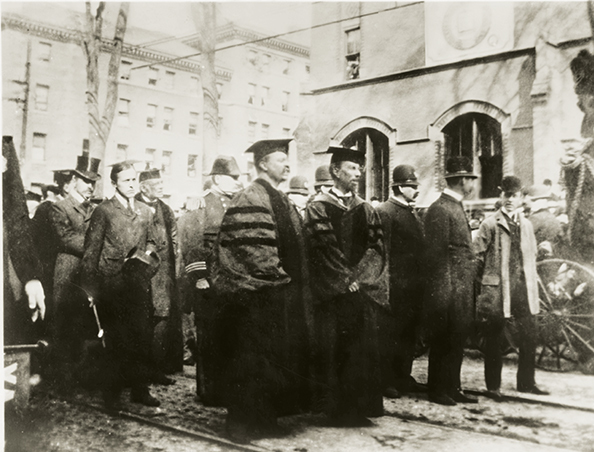
US president Theodore Roosevelt and Yale president Arthur Twining Hadley led the bicentennial academic procession.
View full image

Manuscripts and Archives.
US president Theodore Roosevelt and Yale president Arthur Twining Hadley led the bicentennial academic procession.
View full image
Yale Alumni Weekly
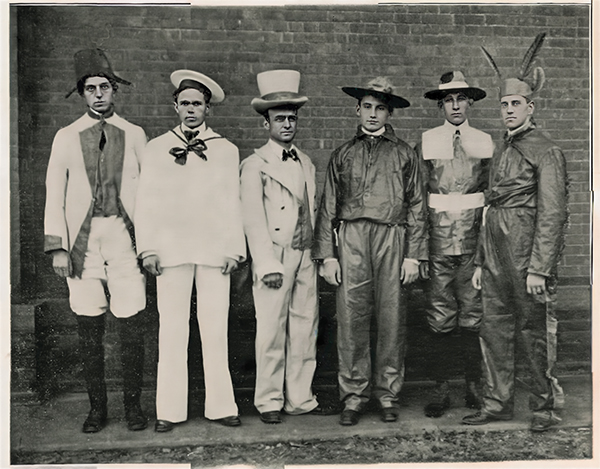
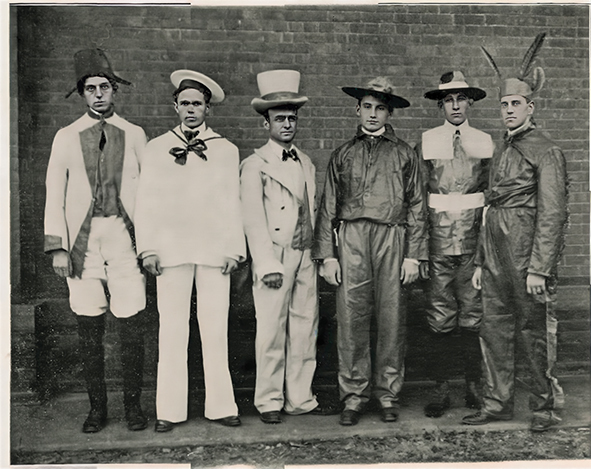
Students dressed in historical costumes were among 6,000 marchers in a torchlight parade around the campus.
View full image

Yale Alumni Weekly
Students dressed in historical costumes were among 6,000 marchers in a torchlight parade around the campus.
View full image
This fall, Yale politely nodded to its 325th anniversary, giving it about as much attention as a quasquitercentennial merits. Many alumni will remember a much bigger celebration for the university’s tercentennial in 2001, which featured a year’s worth of events capped by a star-studded evening in the Yale Bowl. But the university’s most elaborate birthday blowout came at its bicentennial in 1901, when the pomp of the Gilded Age and a growing sense of an imperial America aligned to produce a spectacle for the ages.
“We feel that the coming bicentennial celebration is an occasion that seldom presents itself to the university of asserting herself as a great institution of learning, of leadership in the country’s intellectual progress, and in the upbuilding of what is best in our national life and character,” wrote John Christopher Schwab, Class of 1886, the celebration’s chair, to an alumnus in 1898. A century later, a Yale historian saw it differently. Interviewed for this magazine in 1999, Gaddis Smith ’54, ’61PhD, called the bicentennial a “vacuous, backward-looking, and brainless” celebration that showed “how conservative the place was.”
An estimated 6,000 people took part in the four-day celebration, which included lectures about Yale’s influence in varied fields of endeavor; a torchlight parade featuring alumni and students costumed as Native Americans, Pilgrims, Revolutionary soldiers, Rough Riders, and more; a set of scenes from Yale history staged in a temporary Old Campus amphitheater by the Yale Dramat; and an academic procession and convocation with 62 honorary degree recipients and representatives of 146 colleges and universities.
The university hired the artist and designer Louis Comfort Tiffany to decorate the campus for the event. In a time when electric lights were not yet ubiquitous, Tiffany arranged for hundreds of orange Japanese lanterns to be hung from campus buildings. Every campus window was decorated with a blue “Y” flag, and a temporary colonnade with evergreen garlands and blue bunting was erected on College Street from Chapel to Grove.
The main event, on October 23, was the convocation, held at the Hyperion Theater across Chapel Street from the campus. The marquee guest was Theodore Roosevelt, who had accepted Yale’s invitation months earlier when he was vice president; he became president in September after William McKinley died from an assassin’s bullet. In his remarks after receiving his honorary doctorate, Roosevelt—a Harvard man—offered a testimonial that Yalies quoted far and wide for years after: “I have never yet worked at a task worth doing that I did not find myself working shoulder to shoulder with some son of Yale.”
Among the other 61 men chosen for honorary degrees were Chief Justice Melville Fuller of the US Supreme Court, Japanese prime minister Itō Hirobumi, Princeton professor and future US president Woodrow Wilson, authors Mark Twain and William Dean Howells, and secretary of state John Hay. The rest included several university presidents, professors, diplomats, journalists, scientists, and artists.
Missing from the list—and very nearly from the bicentennial as a whole—were women. The university had just a handful of women graduates at the time, and records show that bicentennial planners weren’t sure how to make room for those alumnae or for women in general. Women were admitted to the lectures in Battell Chapel through a separate entrance to a section of the balcony, and rooms were set aside in Osborn Hall so they could watch the torchlight parade from the windows at a safe distance.
Among the representatives of other colleges who attended the convocation, one of the most notable was Booker T. Washington, the Black educator who was then principal of Tuskegee Institute. Washington had been in the news just a week before when he dined with President Roosevelt and his family at the White House, causing a storm of disapproval from Southern white politicians. Washington, in fact, had been considered for an honorary degree—his name is on an early list of 129 possible honorees in the committee’s records—but he was not selected in the end.
The events of the bicentennial are just part of its legacy, though. The university also raised two million dollars to build the four Beaux-Arts Classical structures now known as the bicentennial buildings: Commons, Memorial Hall, Woolsey Hall, and Woodbridge Hall. (Ironically, Woolsey Hall wasn’t completed in time for the celebration, which is why the convocation took place at the Hyperion, the only venue nearby that could accommodate more than 2,000 people.) The buildings became the physical embodiment of Yale’s new status as a university, not just a college.
Like the swaggering bicentennial celebration itself, though, the monumental buildings soon started to seem a little over the top for Yale’s self-image. The university returned to a less pompous (though no less lavish) Gothic architecture for subsequent building projects, and the bicentennial buildings became an anomalous chapter in Yale’s story.
 loading



 Print
 Email