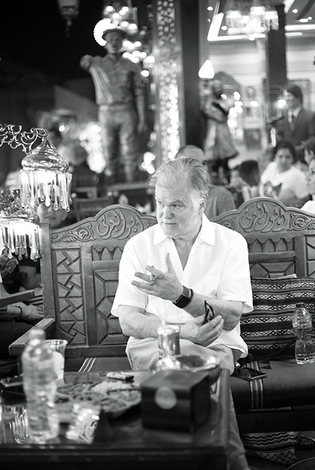
Jackson Greathouse Fall
Forty years after graduating from Yale, writer and television producer Rob Long ’87 is a full-time student at the Princeton Theological Seminary. “Princeton is super humbling,” says Long.
View full image
Rob Long ’87 still remembers the day when one of his Yale teachers suggested that he consider going to film school at UCLA after graduation. “I was so impressionable,” he says. “I’m glad she didn’t tell me to move to Budapest or something.” An English major, Long spent his free time writing plays and sketches with his friend Dan Staley ’85. Just over a year after Long moved west, an agent placed both him and Staley in an entry-level TV writing gig. The show? A little program called Cheers. Long spoke with Eric Olson ’11 about a long Hollywood career and his recent enrollment in the Princeton Theological Seminary, where he is studying to become an Episcopal priest.
Eric Olson: Tell me a bit about your Yale-era partnership with Dan Staley.
Rob Long: We met working on a play together. He was a junior and I was a freshman. And we just made each other laugh. We thought the theater was maybe a little too serious, so we did sketches that kind of made fun of that world. A partnership like that only works if you believe that, if your partner thinks something’s funny, then it’s funny. Starting my senior year, we wrote what are called “spec scripts” for big shows at the time, Murphy Brown and Newhart, to try and get agents. I talk to Yale undergrads all the time now, and their level of sophistication and craft is much higher than ours was. We didn’t even know what a real script looked like.
EO: After writing for Cheers, the two of you created a number of television shows, including George and Leo and Love & Money. From a creative perspective, what’s the most satisfying part of that process?
RL: The real gratification comes when you go to the stage, and you’ve been working on something all day, and the actors put on a little play for you that you wrote. A really good show is where everyone is working together. The final product is not like the first draft—great actors can add to a script. And part of being a writer is accepting that.
EO: Creating an entire show seems like a hectic job with thousands of moving parts. How do you delegate responsibility?
RL: That’s really what I wrote two books about [Conversations with My Agent (1997) and Set Up, Joke, Set Up, Joke (2005)]. It helps not to think of the ramifications of everything. Lots of things are flexible, and you’re constantly making adjustments. They don’t train writers to run a TV show, or to manage budgets, or to hire and fire people. The best thing and the worst thing about the TV business is that the writers are in charge.
EO: Do writers still have that sort of power today? Or has it changed over the past 30-odd years?
RL: Yeah, it’s changed depending on who you are. I think that’s one of the reasons comedies aren’t working right now. They’re over-supervised. The pilot table-read of a script is often the most stressful day of the project, because it’s the first time everyone’s gotten together to read. The studio and network are there, the investor stakeholders, and it already represents millions of dollars of investment. When we had that reading, there’d be the writers, the cast, and then 10 others. But the last one I went to, there were at least 70 others, all these constituent parts. And they all have notes for you.
EO: In addition to TV writing, you’ve published plenty of journalism, sometimes venturing into politics or other spheres that cross over with entertainment. How did you make that lateral move?
RL: If you write for a hit TV show, people suddenly think you know stuff. I’m a writer, and I’m constantly trying to make sense of the world and various ideas. I’m not as into politics now that it’s gotten so toxic and nasty. I still do my podcast on entertainment called Martini Shot. But I keep it at around ten minutes. I also write for Commentary magazine. And then I do what I call “word cartoons” for National Review. Usually it’s just something funny, a parody or speculation. I write for journals, but let’s put it this way: I do not deliver the news.
EO: Now you’ve made an even bigger jump. You’re back in school at the Princeton Theological Seminary. What steps led to this new journey?
RL: I’ve always been somewhat interested in it. I’ve spent time in Esalen in California, going to yoga, learning about Buddhism, traveling the world, and noticing how people are living. I was baptized Episcopalian, but I didn’t start going to church with intent until the early 2000s, when I moved back to New York and found this great church, St. James on 71st and Madison. I found that I really liked the people, and the clergy were super welcoming. The more I went, I thought, I’ve been writing my whole life. Maybe I should write about this. And before that, I should learn something about it. Princeton is super humbling. I’m usually the oldest person in the room, but my classmates have read everything, and some of them speak Hebrew and Greek. I’m like, ‘I write sitcoms.’
 loading



 Print
 Email