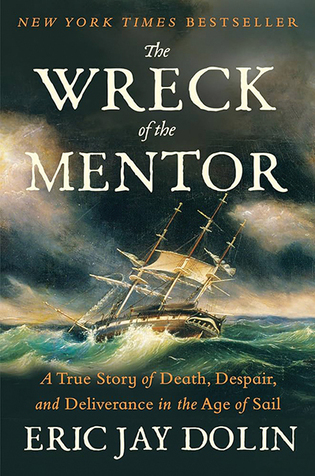
The Wreck of the Mentor: A True Story of Death, Despair and Deliverance in the Age of Sail
Eric Jay Dolin ’88MEM
Liveright, $27.99
Reviewed by Alex Beam ’75
Yes, this is the story of a ghastly shipwreck: The 84-foot-long US whaling vessel Mentor broke apart on a reef on the Pacific archipelago of Palau ten months after setting sail in 1831. But veteran maritime writer Eric Jay Dolin gives us so much more. The Wreck of the Mentor is a gorgeously illustrated, rip-roaring drama artfully enriched with subtle anthropological insights.
A best-selling book of 1788 called the exotically tattooed Palauan natives “benevolent children of nature,” but that failed to capture the islanders’ core diversity. In “first contacts” with Europeans, Palauans proved to be alternatively welcoming and peaceable or thieving and belligerent. Some of their paradisical islands were desperately poor, inimical to even subsistence farming and devoid of drinking water. The intruding Europeans are neither uniformly “civilized” nor uniformly exploitative.
The beleaguered American whalers land in a complicated political predicament. Disparate Palauan islands engage in more or less constant war, so when a European ship either visits or runs aground, the islanders try to recruit the well-armed (muskets, cannon) outlanders into their rival armies. Palauan war takes some getting used to. An attacking army announces its intentions three days before an assault, because, a local chief explains, who wants to be slaughtered in a surprise attack? “Regular and open warfare,” he observes, “might be the means of a speedy peace without barbarity.” A visiting American notes that “Christians might learn” from the Palauans’ example.
Before the whalers’ arrival, a visiting British warship had thrown its weight behind the enemies of one of the islands where the Americans alighted. This is bad news for the New Englanders, who need to convince their hosts that Americans and Britons are different peoples. With the common language and skin color, it’s a hard sell. “Peeter English is a thief, you are a thief, all Englishmen (are) thieves and liars,” they are informed at another Pacific island, told they’re destined to die there. Sadly, many do.
Of the 22 officers and crew who embarked in New Bedford, Massachusetts, eager to share the spoils of the whaling trade, only 7 survivors returned to the United States. The final stragglers had been away for four years. They lived through a gruesome ordeal, one we share with them in this vivid and engrossing story.
Journalist Alex Beam ’75 is the author, most recently, of Broken Glass: Mies van der Rohe, Edith Farnsworth, and the Fight Over a Modernist Masterpiece.
__________________________________________________________________

Seek Immediate Shelter
Vincent Yu ’13
Flatiron Books, $28.99
Reviewed by Debra Spark ’84
Vincent Yu’s fascinating debut novel is a work of fiction in the guise of a thought experiment. What would you do if you learned you were shortly to die? And what if you were subsequently spared?
Yu’s book opens with residents of western Massachusetts receiving a cell phone warning about an incoming ballistic missile. Eighteen minutes later, a false-alarm notice arrives. Yu uses this conceit in nine separate narratives, each with a different protagonist. (Most are Chinese-American.)
Yu lingers only briefly on what happens during the moments of panic. In one story, a high school girl waits with her teammates in a locker room, and Yu describes their hearts as “galloping nowhere, like a cartoon character whose blurry feet find no purchase past the edge of a cliff.” In others, a mother sends a cruel text to her daughter, a father abandons his family, and a nursing home employee is jolted into an act of self-redemption. Yu clearly cares most about the lives he wraps around the warning, and what the message activates. One story is about Nick Chen, a socially awkward musician, who falls under the sway of an older bluegrass musician. Another is about a widower, stymied by grief, who meets a woman whose son had made the catastrophic decision to drive drunk. Still another concerns the worker responsible for the false alarm.
“How long is a person supposed to live before he figures out which choices were the right ones?” asks a young waitress who once gave up a child for adoption. Whatever the answer to that question, Yu has made only good choices here, crafting a remarkable book that showcases his deep understanding of people of all ages and how they eventually arrive at insight.
Debra Spark ’84 is a professor of creative writing at Colby College. Her most recent novel is Discipline.
__________________________________________________________________
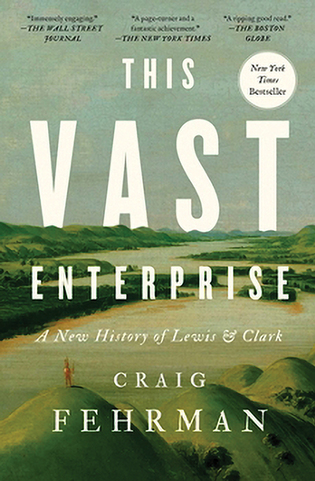
This Vast Enterprise: A New History of Lewis and Clark
Craig Fehrman ’13PHD
Simon & Schuster, $35
Reviewed by Richard Bradley ’86
Asking an author whether the world needs another book on their topic sends a shiv through the writerly heart. After years of lonely toil, the author, in an act of self-preservation, answers yes, but the question sows doubt. The dilemma presents itself to any new book about Lewis and Clark. Already the bookshelves of American history buckle under the weight of scholarly tomes, epic narratives, and short-but-sweet children’s books, multiplying like brooms in The Sorcerer’s Apprentice, all telling the tale of the explorers’ two-year odyssey from St. Louis to the Pacific and back.
So it’s wise that in his ambitious reinterpretation, This Vast Enterprise: A New History of Lewis and Clark, historian Craig Fehrman preempts the question. There are myths about Lewis and Clark, Fehrman explains, and they contain distortions. Fehrman aims to counter them. First, by going back to the land, emphasizing how the vast plains, jagged mountains, and beautiful but treacherous waters of the American West anchor this story. “Natives”—the term Fehrman uses—have a rightful claim to this land; Britain, France, Spain, and Russia lust for it; Thomas Jefferson thinks it essential to his vision of American democracy.
Questions of democracy past and present underlie Fehrman’s second proposition, which is to center the stories of the lesser-known players. Among them are York, the only Black man on the expedition, held in bondage by William Clark, and Native leaders such as Black Buffalo of the Lakota, struggling to craft a response to an intrusion whose implications he understands.
Little documented, these stories are hard to reconstruct, and Fehrman may go too far for some readers, detailing his characters’ thoughts and feelings in an almost novelistic manner. His writing is most vivid when the historical record is thinnest. Often Fehrman employs caveats—“surely,” “perhaps”—to acknowledge the impossibility of certitude. But not always. In the end, readers will be compelled to think deeply about the lives
of historical figures who lacked the ability to write their own stories.
Journalist Richard Bradley ’86 is completing a social history of Groton School, due out next year.
 loading




 Print
 Email