 loading
ObituariesIn Remembrance: Allan I. Ludwig ’64PhD, ’65MFA Died on November 2 2025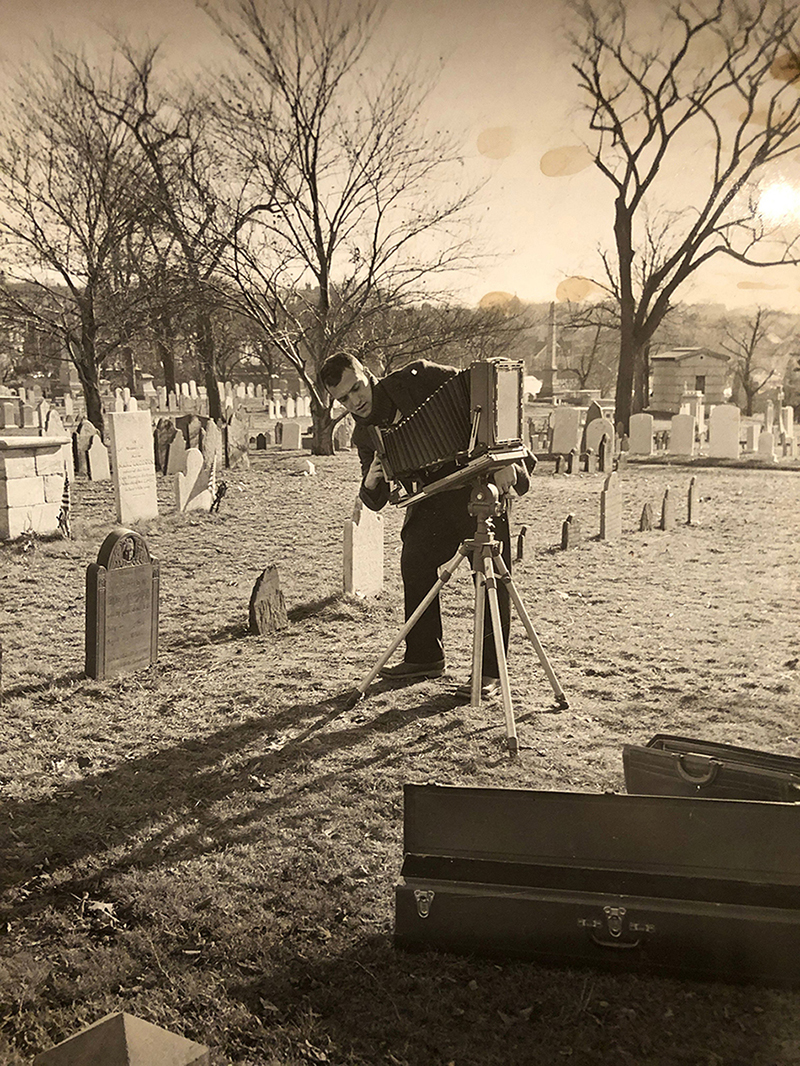 View full imageAllan I. Ludwig, author of Graven Images, a groundbreaking study in the field of American studies, and noted photographer, died in New York City on November 2, 2025. He was 92. Published in 1966, Graven Images: Stonecarving and its Symbols. 1650–1815 (Wesleyan University Press) established a new field in American art: the study of Puritan gravestones. The book demonstrated that the Puritan settlers of New England used religious imagery ubiquitously even if their iconophobic theology taught them to shun it. Ludwig’s work showed that Puritan tombstones abounded with meaningful and symbolic graven imagery. His study was illustrated with over 250 striking black-and-white plates, photographs that he took in New England cemeteries with a large-format view camera. At the time of its publication the book received widespread acclaim and was nominated for a Pulitzer Prize. A decade later, Greil Marcus, writing in Rolling Stone, noted that the book “is an extraordinary work. . . . To leaf through this book is to confront a vanished community trying to make sense of itself through art.” In print for almost 60 years, it has become the seminal field guide to early American gravestones for generations of scholars and enthusiasts. Ludwig returned full time to photography in later life, showing in solo and group exhibitions internationally and across the country and establishing his work in important photographic collections including those of the Metropolitan Museum of Art, the Smithsonian, and the National Gallery of Art. Beginning in the 1980s his collaboration with Gwen Akin resulted in the photographic partnership of Akin-Ludwig. Long before it was known as street art, Ludwig was also an early supporter and documentarian of graffiti. Allan I. Ludwig was born in 1933 in Yonkers, New York, but grew up primarily in New York City and New Rochelle, New York. He was the son of Saul Ludwig, a textile manufacturer, and Honey Ludwig (née Fuchs), a homemaker with an artist’s soul who instilled in her only child his love for the visual and performing arts. Allan took up photography at the age of 13 and was afterwards rarely seen without a camera around his neck or in hand. He graduated from Beverly Hills High School and on the strength of his photography portfolio he went to Yale University where received his BFA in 1956 and as an undergraduate founded the Yale Sportscar Club. He went on to receive his MA and PhD in art history, also at Yale. While there, he met his first wife, Janine Lowell, a writer and artist who had come east from Chicago to do an MFA at the Yale School of Art. They married in 1956 and soon had three children in three-year intervals: Katherine Ludwig Jansen, Pamela Ludwig Dreyfuss, and Adam Lowell Ludwig. A chance encounter with a group of seventeenth-century headstones in a cemetery in Litchfield, Connecticut, led to the idea for Graven Images, Ludwig’s doctoral thesis and subsequent book. The dissertation was encouraged and inspired by Prof. Erwin R. Goodenough, whose own ten-volume work, Jewish Symbols in the Greco-Roman Period, argued the case for pagan influence on Palestinian Judaism; though it was Charles Seymour Jr., a specialist in Renaissance art, who directed his thesis and helped secure funding from the Bollingen foundation necessary for its completion. Finished in 1964, the dissertation won Yale’s John Addison Porter Prize “for a written work of scholarship in any field in which it is possible, through original effort, to gather and relate facts and/or principles and to make the product of general human interest.” While pursuing his graduate studies, Ludwig taught in the Department of Photography at Rhode Island School of Design and after the completion of this doctorate he took up positions in the Departments of Art History at Dickinson College in Carlisle, Pennsylvania, and at Syracuse University, where his charismatic and unscripted lectures (sometimes in costume) never failed to engage the attention of undergraduates. As early as the 1950s, Edward Steichen, then director of the Department of Photography at the Museum of Modern Art, purchased a number of Ludwig’s black-and-white silver prints, advising him, “the most important thing a photographer can do is to take photographs.” It was a credo he followed throughout his life, amassing a huge archive of photographs both personal and professional. In the 1970s, in a second act, Ludwig returned to photography full time. He was able to build on those early foundations. Among the first series that he created in this period was a pioneering portfolio of images entitled the “Graffiti Series.” Beginning in the 1980s, working with Gwen Akin, the duo became well known for working in the platinum-palladium process, which gives an especially warm hue to the prints. Together they produced a wide body of work memorably exploring the theme of the grotesque, among many other topics. Akin and Ludwig married in 1992 and had two children, including Allan Jr. and Alison Ludwig. For the last four decades of his life, Ludwig lived in downtown Manhattan—in Nolita—and enjoyed being recognized as one of the neighborhood characters as he prowled the streets in his iconic newsboy cap and leather coat, camera always in hand, photographing the downtown street art scene. —Submitted by the family. |

|

 Print
Print Email
Email