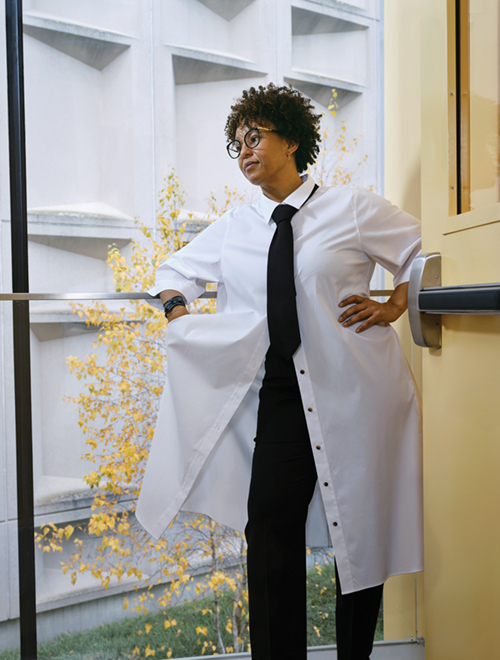
Chris Buck
Bioengineer Anjelica Gonzalez, seen here at Tsai CITY, works to understand “the environment that cells are in” and how outside pressures impact the way cells function.
View full image
Chris Buck
Bioengineer Anjelica Gonzalez, seen here at Tsai CITY, works to understand “the environment that cells are in” and how outside pressures impact the way cells function.
View full image

Chris Buck
Gonzalez, who created a low-cost medical device, uses her entrepreneurial chops to help students solve real-world problems as faculty director of the Tsai Center for Innovative Thinking.
View full image

Chris Buck
Gonzalez, who created a low-cost medical device, uses her entrepreneurial chops to help students solve real-world problems as faculty director of the Tsai Center for Innovative Thinking.
View full image
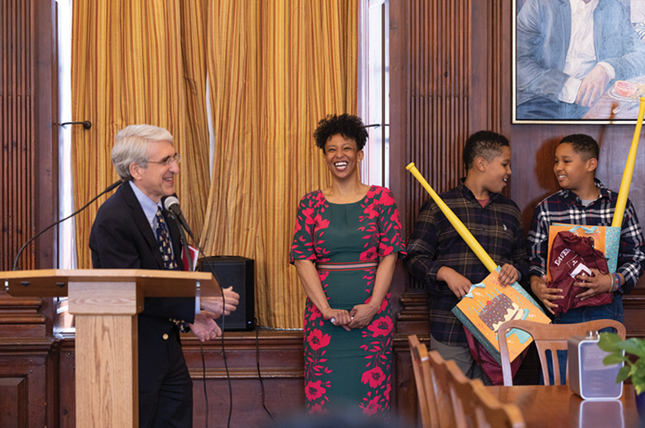
Dan Renzetti
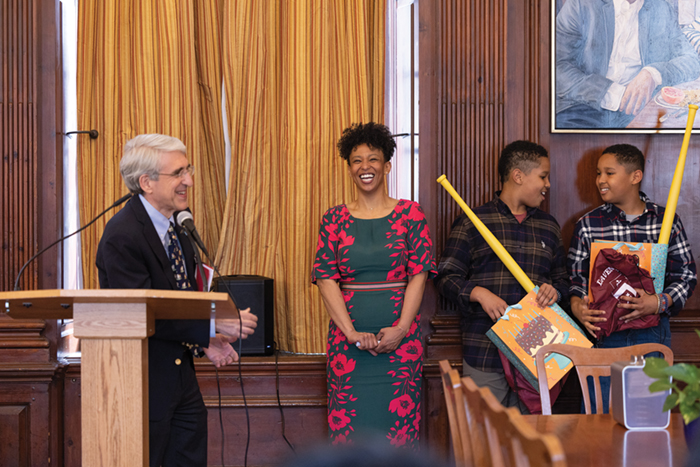
In 2022, then-President Peter Salovey ’86PhD (left), announced Gonzalez’s appointment as head of Davenport College, with her twins Alex (second from right) and Jackson (right) in attendance.
View full image

Dan Renzetti
In 2022, then-President Peter Salovey ’86PhD (left), announced Gonzalez’s appointment as head of Davenport College, with her twins Alex (second from right) and Jackson (right) in attendance.
View full image
The Davenport courtyard was bursting with activity, mostly from college students but also a few middle schoolers. The teenagers were there because the welcome-back picnic of 2023 coincided with head of college Anjelica Gonzalez’s twins’ birthday. On offer: food, music, Slip ’N Slides, and a range of other lawn games.
A bunch of party goers shoved themselves into human-sized inflatable spheres and bounced around like human beach balls bumping against each other. Powell Munro Holzner ’27, a Yale college sophomore at the time, crashed into Professor Gonzalez—who was also bubbled up—and sent her flying into the air and careening across the yard. “Eek, I’m 6'5" and knocked HOC G down!” Munro Holzner recalls thinking. (Gonzalez just laughed.)
The Slip ’N-Slides might have been for her students and the baseballs for her boys, but the enormous bubble bodysuits were fitting for Gonzalez, a professor of bioengineering who, among other things, investigates the impact of environmental collisions. In her scholarly endeavors, though, she examines forces on single cells, not hulking undergraduates crashing into teachers.
Gonzalez’s perspective is unique. Many scientists study the cell. As a bioengineer, she is intrigued by everything around the cell—and in particular, how those outside pressures impact the cell’s ability to do its job. Her focus is the immune system. “It’s not just about the biology and understanding the cells,” she says, “but understanding the environment that the cells are in. Part of that environment is the experience of the cells, which can be mechanical.” This is where her engineering expertise comes into play.
The ramifications are vast. Her basic science explores what drives immune cells to move faster or slower toward their targets. Already, her studies have solved mysteries about the body’s defense system that have dogged researchers for generations. Collaborations with other bioengineers, as well as physicists, biologists, pulmonologists, dermatologists, and immunologists, are paving a way to create new tools to treat a wide range of ailments, including stroke, lung disease, and cancer. If scientists understand the details of the immune response, they can devise ways to modify reactions that are too strong (autoimmune diseases), too weak (diseases that lead to impaired healing) or dysregulated (sepsis, which is massive and often deadly inflammation).
In addition to serving as head of college, professor of bioengineering, and mother of twin boys, Gonzalez is also faculty director of the Tsai Center for Innovative Thinking and the inventor of PremieBreathe, a low-cost mobile respiratory device for newborns in under-resourced countries. She credits her mother, a blackjack dealer, for instilling her with the math and people skills to forge ahead.
Gonzalez grew up in Nevada, the older of two children. Between her shifts at the casino, Gonzalez’s mother would sit at the kitchen table with a deck of cards in her hand and explain addition and probability to her grade-school daughter. “You have to know that there are fifty-two cards in a deck and you’re not going to see an eight of hearts in every hand, so what is the probability based on the whole that you will get a certain card?” she quizzed. She also explained the odds of getting to twenty-one depending on which cards you already saw. The upshot: Gonzalez learned that numbers mattered.
Casino lessons extended far beyond arithmetic and statistics. Gonzalez’s mother modeled how to work well with a wide range of people. Every now and then Gonzalez accompanied her mother to work and watched how her mother listened, charmed, and dealt with (and literally dealt to) difficult customers. “She could disarm people who were being sexist, or racist, or rude and demeaning by making them laugh, or making the other players at the table laugh at their offense,” says Gonzalez.
When Gonzalez turned eight, her parents divorced; she and her younger brother moved in with their grandfather, who lived about an hour outside the city in the sparsely populated farming community of Moapa Valley. Her mother soon joined and the three of them moved to a trailer nearby.
But with her mother commuting long distances to work, Gonzalez was often under the tutelage of her grandfather, who quickly became another motivating influence. “He told me your education is the one thing no one will ever take away from you,” says Gonzalez. Her grandfather, who had a third-grade education and eventually ran the irrigation system in the area, brought her into the fields and explained the mechanics that connected water to the desert farms. She saw firsthand that understanding engineering had immediate impacts on a community. Gonzalez also helped on the family farm. “When you go to the grocery store and see those onions bundled in rubber bands, I know there was a person doing that because at one point, I was that person,” she says. Her grandfather insisted that hard work, good grades, and a college scholarship were her ticket out of poverty.
Journalism? maybe. skin care? nope.
The first time Gonzalez earned money for college was in ninth grade when she entered a contest at her local newspaper, the Las Vegas Review Journal. The paper awarded $1,000 toward college tuition for a student whose article they published. In Gonzalez’s winning entry, she wrote that local minorities often made headlines for crimes committed, but rarely for their positive impacts on the community.
Though journalism seemed like an appealing career, by the time Gonzalez started college—she earned a full scholarship to Utah State University—she deemed engineering the most practical choice for earning a steady income. Gonzalez majored in biological and irrigational engineering with plans to return to Moapa Valley and devise an automatic water monitoring system. She had spent enough summers with her grandfather as he manually checked water levels in the brutal 100-plus-degree heat of the Nevada desert.
But the summer between her junior and senior year transformed her career trajectory. Gonzalez was accepted to the nine-week Baylor Medical College SMART (Summer Medical and Research Training) program for undergraduates. She worked in a laboratory that explored how the diaphragm impacts lung function in muscular dystrophy. “They appreciated my understanding of the mechanics and my engineering knowledge,” she remembers.
When she returned to college, she switched her focus to bioengineering instead of irrigation. Encouraged by mentors at Baylor, she applied and was accepted to a doctoral program in structural and computational biology and molecular biophysics, work that straddles engineering, biology, and physics.
Specifically, she explored neutrophil migration. The neutrophils, the most abundant white blood cell, are the first responders to injury or infection. But these mighty defense cells are shockingly short-lived, proliferating when needed and dying shortly thereafter. They are also hyper-fragile to any kind of mechanical insult, like brushing up against the blood vessel wall. That makes studying them a challenge. Gonzalez helped develop tools to track the movement of these elusive microscopic protectors in the lab.
As she was finishing her dissertation, she attended a lecture by a visiting scholar, Yale’s Mark Saltzman, now the Sterling Professor of Biomedical Engineering and a professor of chemical engineering and cellular and molecular physiology. She was too scared to ask a question during his talk but approached him afterward. He encouraged her to apply for a job at Yale.
In 2007, Gonzalez arrived at Yale as a research fellow and has been here ever since. (She chose Yale over a job working in the cosmetics industry, using her know-how to formulate collagen-boosting face creams.)
Since then, she has broadened her outlook to other immune cells. Immune cells, she explained, travel within blood vessels, yet at pivotal moments they leave the vessel to do their infection-fighting job. “As an engineer, my graduate work was on neutrophils and what they do once they are activated,” she says. At Yale, “I took a step back and said let’s build the vessel wall that they are flowing through.”
Her goal was to understand how the cell senses and responds to its ever-changing environment. What triggers these microscopic guardians to leave the vessel? Why do they exit at one particular spot and not another?
Of biomimicry and blood vessels
Of all the vessels in the body, Gonzalez’s fascination is not with the two main trunks (the large aorta that carries blood away from the heart and inferior vena cava that brings blood back), but with the tiniest twigs of the vascular tree. She eyes the microvessels that feed the skin, brain, and lungs—the ones that are so narrow, only one cell can pass through at a time. “That’s where we see the majority of high shear events,” she says, referring to the friction with the wall that can deform or destroy a cell.
Her team created a blood vessel in the Gonzalez Lab using multiple types of human cells. It was a huge engineering undertaking. That’s because a blood vessel wall is not simply a tube but has a complex lining of layers. The inner and outer layers of cells secrete material to make the inner cushy matrix. Think of the walls of your house, which aren’t single planks of wood, but two supportive layers with insulation in between. The innermost cell layer is made from endothelial cells; wrapped around them is another kind of cell, called the pericyte.
For years, most researchers studied the endothelial cells (the inner layer of blood vessels), epithelial cells (that form the outer surface of skin, airways, glands, and the stomach), and fibroblasts (that among other things make collagen).
But it was the pericyte, the ignored sibling of these cell types, that caught Gonzalez’s attention. “The pericyte,” she says, “is super important in stabilizing blood vessels and even more important to contributing to disease when the vessels fall apart.”
Gonzalez has been trying to understand how these cells perceive and then react to their environment. This process relies on integrins, an aptly named protein that integrates information from the outside of the cell with the inside. Or, as Gonzalez put it, integrins serve as the cell’s eyes and hands.
She studies how pericytes and other cells toggle from doing one thing to another depending on what they perceive around them. A cell that is in the middle of the blood vessel, for instance, makes one kind of collagen. Once it leaves the vessels and senses different surroundings, it makes a different kind.
“Some of the most exciting work is when we can say not only is the pericyte no longer depositing collagen IV, but it’s shifted its internal profile to be more collagen I,” says Gonzalez. These changes can be good or bad, helping to heal or contributing to disease. You need collagen to repair injury, but too much can cause dangerous scars. An appreciation of these precise signals can lead to a better grasp of restorative processes and of disease progression, and to better ways to prevent or treat a wide range of ailments.
A lifesaving breathing device
Like any good scientist, Gonzalez is driven by the unknowns. “Oh my gosh! We know so little, I get so excited about this,” she says. “I say this to my 15-year-old twins and I say this in my classroom. What we read in textbooks is just the beginning of the knowledge that we have. We know so much less about biological systems than you think. The reason you’re here in this class is to build a foundation to see where we’re at. Our job as students in the classroom, as researchers, as professors and teachers, is to build the critical knowledge to ask questions.”
She thrives in an interdisciplinary environment, thrilled to learn from and work with clinician-scientists including Dr. Erica Herzog, professor of medicine and pathology. Together and from their unique perspectives, they are seeking new treatments for a rare and deadly lung disorder called idiopathic pulmonary fibrosis. At the Tsai Center, where Gonzalez serves as faculty director, students come together from all parts of the campus to solve real world problems in areas such as entrepreneurship, civic engagement, and the arts.
PremieBreathe is an example of team cooperation, an idea that emerged from conversations between Gonzalez and clinicians at the Yale Institute for Global Health. The doctors explained that in under-resourced countries, health workers have to jury-rig breathing devices from whatever is available, often using one oxygen tank with a few tubes to treat several babies at once and moistening the air with old Coke bottles filled with water. These precarious devices, which can be life savers, are also prone to passing along deadly infections.
With a grant from the US Agency for International Development and further funding from the Blavatnik Fund for Innovation at Yale, Gonzalez worked with a team that included Yale undergraduates along with physicians from Yale and Ethiopia to create a low-cost device that delivered humidified air in a self-sterilizing piece of equipment. Unfortunately, the pandemic and funding cuts stalled implementation, but they are currently looking for ways to continue to fund the project. “This project brought all the things I love together,” says Gonzalez. “My undergraduate students working collaboratively with physicians here and abroad to bring out the best in their expertise and experiences to create something really cool.”
On top of everything she does at Davenport, in her laboratory on Science Hill, in her classrooms, and at Tsai CITY, Gonzalez says she always makes time for her boys. She served as Little League coach for her boys until they aged out of parent coaching. She was pleasantly shocked that parents were excited to have one of the few mom-coaches in a dad-dominated field—and she’s confident that served as an inspiration to the girls on the team.
How does she balance it all? She says balance sounds like you are doing everything equally all the time and that’s not how she operates: “I have to give my full attention to what is in front of me.” To do that, she relies on her “amazing” support staff, which includes administrators, doctoral students, teaching assistants, and fellow scientists.
She has come a long way from the graduate student afraid to raise her hand when Professor Saltzman gave a lecture. Nowadays, despite being a natural introvert, she tries to model behaviors that will encourage her children and her students to ask questions, to challenge themselves, and to discover.
“I’m a reticent public speaker,” says Gonzalez. “I think about my mom’s background, and how she allowed me to learn how to talk to anyone, how I am now able to work with renowned Yale professors.” She also taught Gonzalez “the value of being able to understand where someone else is coming from and to make sure I’m communicating my goals clearly.” The result? “As opposed to building opposition, you can engender more good.”
This attitude, with its implicit message to appreciate both others and yourself, is one of her key lessons in the classroom. “I tell my students that your lived experience is a value in every space you go into.”
 loading


 1 comment
 Print
Print Email
Email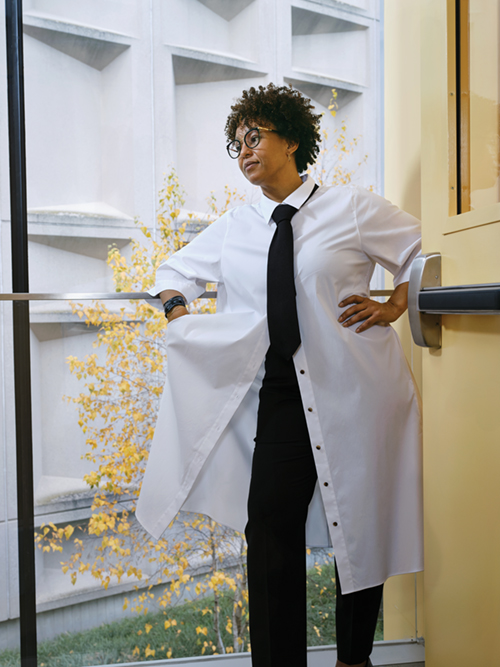

1 comment
-

Louis D Armmand, 10:39pm January 09 2026 |  Flag as inappropriate
The comment period has expired.Wow! what a great article and biography! Davenport is my home college at Yale. I would love to meet professor Gonzalez when I attend class reunion next spring. May I be connected?