Dan Renzetti
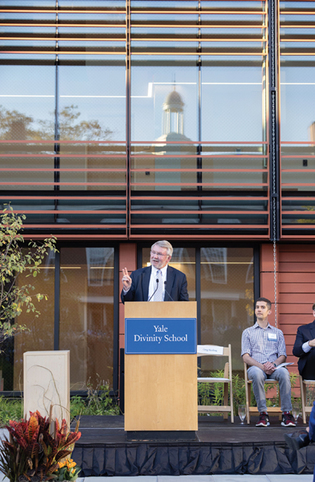
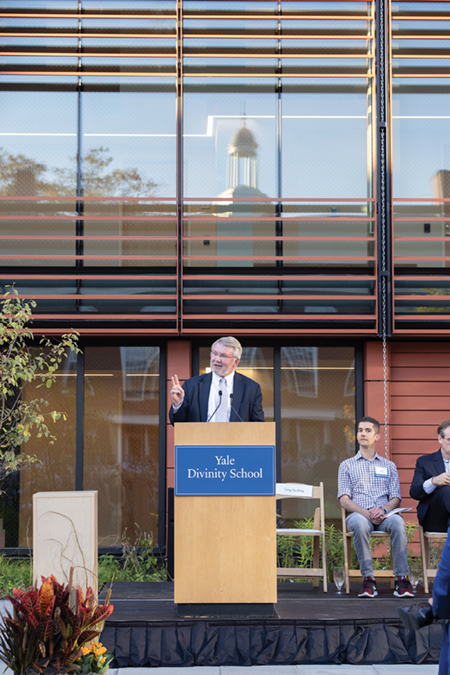
Dean Greg Sterling at the 2025 opening of the Divinity School’s Living Village. The pathbreaking building will contribute more power to Yale than it consumes.
View full image
It was sunny and unseasonably warm on the early January day I first visited Yale Divinity School, and the impression I came away with—of light, and beauty, and openness; of a tiny but bright city, shining on its hill—is now linked inextricably for me with the Reverend Robert A. Bryan ’54, ’57MDiv, despite the fact that Bob departed Yale for parts north and spent most of his life in Canada’s rugged northeast wilderness. I have Dan Strickler ’54 to thank for this; he’d called to discuss the remarkable contributions of his class to journalism as we were preparing this issue, and Bob, who died in 2018, was one of the names on Dan’s list.
Nicknamed the Flying Parson, Bob made hit comedy recordings called Bert and I, tall tales of Down East Maine that were recorded with fellow Yalie Marshall Dodge ’57, ’61MA, and foreshadowed the folksy storytelling of Garrison Keillor et al. He used the royalties to buy a series of bright yellow float planes from which he launched an aerial ministry, serving the remote fishing villages of the Quebec and Labrador coasts for five decades. A chaplain at the Choate School, he also served as an air ambulance pilot and started summer camps for children in remote hamlets, eventually founding the Quebec-Labrador Foundation, a model for community conservation. One Amazon reviewer describes his memoir, Robert Bryan: The Flying Parson of Labrador and the Real Story behind Bert and I (Down East Books, 2014), as “mechanical failures, human foibles, fearlessness and joy.”
It’s the same fearlessness and joy with which Jesus told his followers in the Sermon on the Mount, “You are the light of the world. A city set on a hill cannot be hidden.” That call to spread the light of faith and charity into the world is exactly what is still happening, every day, at Yale Divinity School, as you’ll read in our cover story.
Although declines in US religiousness have halted in recent years, modern ministry faces many challenges. Divinity School dean Greg Sterling put his finger on one of the biggest in a 2024 YDS Quadcast: “People haven’t lost interest in spirituality or religion,” he said. “They have lost interest in institutions.”
I’ve been thinking about this phenomenon since I joined Yale, one of the world’s great institutions and a place that fills me with wonder. Rather than turn away if our institutions are flawed, should we not be working to make them better? I see daily how people at Yale don’t just believe in the power of common action, but actually spend their time working to turn belief into concrete action. Why aren’t people here prey to the prevailing cynicism? What’s the secret sauce, and how can we export it?
The forward-looking, long-term thinking practiced at the Divinity School seems to me part of the answer, as does the school’s implicit acknowledgement that all people have moral convictions, whether or not they practice a religion, and these convictions can—must—be part of the public sphere. That seems right to me, and one possible answer to the fact that the US, a country that has long been a remarkably successful experiment in religious pluralism, is now turning away from pluralism of every kind, but especially political pluralism. This despite the fact that, as Lanny J. Davis ’67, ’70LLB, points out in his essay in this issue, most Americans agree on many big political questions. Sterling, in a 2024 reflection on political partisanship that could have predicted the polling data Davis quotes, said: “Many Americans agree on issues that are politically divisive; the divide is often more pronounced among the representatives whom we send to Washington, DC, than it is among us.”
Perhaps Sterling’s view from the Divinity School’s hill affords both a clearer view and a more joyful one. I invite you to join him there. After all, as he said in an April Afternoons with Alison video (see it at bit.ly/yaasterling), the standing of higher education has dropped dramatically; just 38 percent of Americans now think going to university could be a benefit for them, down 20 percent in just a few years. As a result, “the pact that Vannevar Bush and FDR made at the end of World War II, which became the basis for research in this country and has propelled the United States’s . . . economy worldwide, is under threat.” His prescription: Spread the light. “One thing that every alum can do, if you value your Yale education, is to talk to people. All you have to do is to tell your own story—what it means to you, and how it’s made a difference in your life.”
 loading

 Print
Print Email
Email