On campus or off?
I read with great disappointment the article entitled “The Fifteenth College” (September/October). Just before I left for Yale in 1963, my dad gave me what I considered a good piece of advice: “Don’t neglect your education for your studies.”
There are great and good professors at Yale, but the same is true for other universities and colleges, and many of those professors may have a Yale degree.
However, your education will be enhanced by the freedom and diversity of association and social intercourse you experience through the many hours of life lived among your fellow students in the dining halls, dorm rooms, and common areas of the campus facilities. Yale students come from all around the world with ideas and cultures that will enrich your life and your Yale experience just by exposure that you may not experience by living off campus.
I took a gap year that turned into four years during active duty in the US Air Force during the Vietnam War era. When I returned to Yale in 1969, the new dean of my college did his best to encourage me to live off campus, but I insisted on living in the dorms, and I am glad that I did. Not only did one of my roommates at Yale introduce me to the woman who was later to be my wife, but I was also able to socialize with students, both male and female, from all around the world and all around the country. Just hanging around the dining hall, I was able to have a nice conversation with Paul Newman, who casually dropped by one day, and one evening in the common room, I was able to listen to Woody Allen’s jazz combo.
Many years later at one of my reunions, I was pleasantly surprised when several of my classmates told me how happy they were that I lived among them. I feel the same way.
Bill Elliott ’72
Albuquerque, NM
The modern challenge to Yale’s residential college system actually began decades before Covid. In July 1984, President Reagan signed the National Minimum Drinking Age Act, effectively raising America’s drinking age from 18 to 21. The law drove students off campus to party and drink, increased alcohol-related car accidents in New Haven, gave rise to new fraternities and sororities, and weakened the camaraderie of the residential colleges. My father, Harold J. Morowitz, then master of Pierson, proposed that everyone would be best served if administrators turned a blind eye to underage drinking on campus. The Council of Masters rejected his motion, 11–1. Who shall history say was right?
Noah Morowitz ’83
Kensington, MD
I was disappointed by the lack of racial/ethnic diversity reflected in the cover photograph of the September/October issue. Appearances can be deceiving (as can so-called family names) as an indicator of racial and/or ethnic identity, but at face value it seems as though only one of the five students featured is a person of color.
Earlier this month, Yale’s Office of Undergraduate Admissions released a profile of the Class of 2030, one in which 56 percent self-identify as non-White by background: Asian American (33 percent), Hispanic/Latino (12 percent), African American (10 percent), and Native American (1 percent). YAM can and must do better in visually communicating the breadth of racial and ethnic diversity that distinguishes the student community of the Yale College of today.
Katherine S. Bryant ’06MDiv
Leesburg, VA
Chris Lloyd and the art of writing
Thanks very much to Christopher Lloyd ’82 for his brilliant, moving article “Lifelong Learning” in the September/October issue. If his highly successful career hadn’t already done so, this piece puts definitive proof to his father’s premonition of Lloyd becoming a writer of great skill.
Matt Eliot ’89
Washington, DC
As an Episcopal priest, I often meet with people confronting grief and loss, often complicated by difficult family relationships and unresolved conflicts. My counsel to them usually centers on finding a way of working through such sorrow that allows it to swirl around them without consuming them, finding outlets that indirectly encourage them to ponder and think and process.
I think I may now hand them a copy of Christopher Lloyd’s gorgeous piece on finding a way forward by taking Yale online classes. Not only is Lloyd’s writing sumptuous and witty, he hits on a strategy that he finds fulfilling while also making room for reckoning with family-of-origin complications as well as the death of a wife he cherished.
Thank you for publishing this piece, which can have such good effect on those walking a griever’s path. Lloyd’s tactic of overdosing on learning may not be for everyone, but it is a good lesson for all of us that no one grieves in the same way, and I am always looking for suggestions and tools to direct people to the road that works for them. This timely article did just that.
Elaine Ellis Thomas ’13MDiv
Killingworth, CT
Christopher Lloyd’s article on finding relief from the several tragedies in his life in online Yale courses shows why he is a master of prose. The story of his pitching the line “What is it about family that it can be so hard to like them, and impossible not to love them” is a prime example. But prose is not poetry, and the great 20th-century American poet William “Smokey” Robinson condensed that line into its essence in “You’ve Really Got a Hold on Me,” with its immortal opening, “I don’t like you, but I love you.”
Bob Bookman ’72JD
Los Angeles, CA
A community of women
Regarding Shelley Fisher Fishkin’s article about the Zoom dance sessions for Yale’s first women (“Let’s Dance,” September/October): In fall 1969 as a freshman at Yale, the only women I met were in my entryway in Vanderbilt Hall on the Old Campus. We were in Davenport College and saw each other as residential college friends throughout our Yale years. It was not unusual to be the only woman in a class—asked for the “woman’s point of view” about an issue that was being discussed. I did not meet many other women.
We were invited to return to campus to celebrate “50 years: Women in Yale College” in 2019, and that was the first time I met Yale women who had not been my roommates. Finally, I met my cohort! Through the First Women at Yale Zoomba group, I met many classmates who shared my experience of college and the turbulent years of the 1960s era. This has deepened my understanding of who I am and brings me great joy.
Joan Abrahamson ’73
Los Angeles, CA
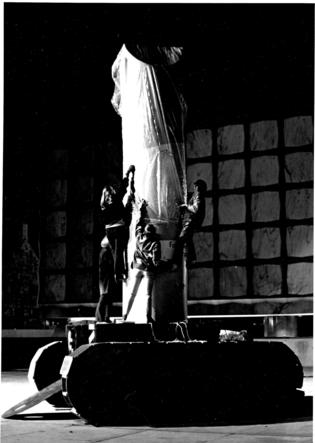
James Clark ’72
Protection
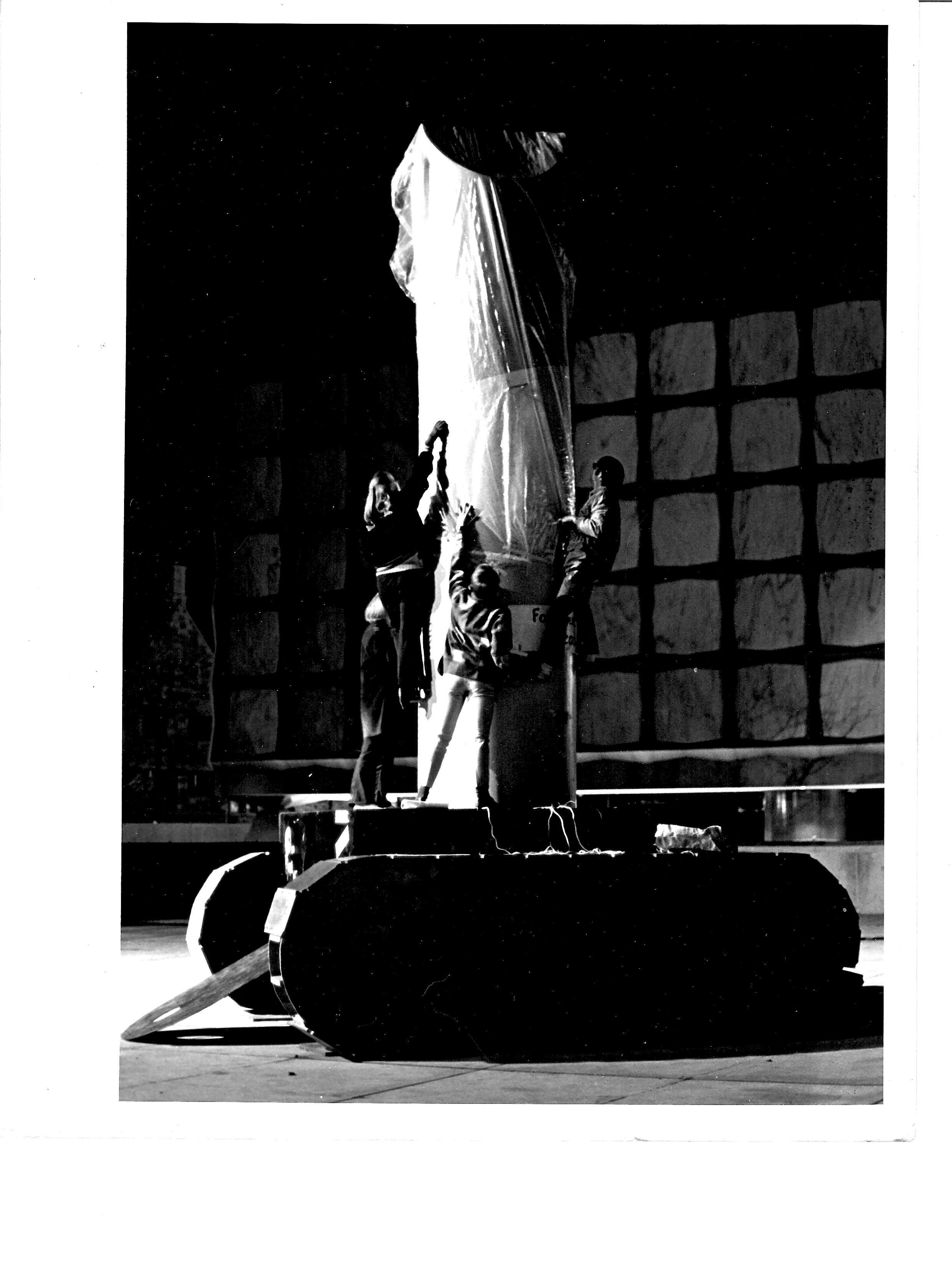
A follow-up to the recent article about the Oldenburg Lipstick being moved to the Art Gallery sculpture garden (“Lipstick Chronicles,” July/August): In the fall of 1969, shortly after the inflatable tip was replaced with steel, members of Zero Population Growth entered Beinecke Plaza sometime after midnight and placed a condom over the sculpture. I was there, and I took the attached photo (below). Thought you might be interested.
The woman standing highest is Diane Renshaw ’75FES, and the man with his arm outstretched in the center is William Clark ’71 (my brother). None of us can remember who the people at the far right and far left are.
The sign on the side of the sculpture says, “For Prevention of Disease Only??” Connecticut had some quaint ideas about reproductive matters back then.
James Clark ’72
Hillsdale, NJ
Fred Smith's “mediocre paper”
In her Baccalaureate Address (“Hang On to Every Memory,” July/August), President Maurie McInnis ’96PhD noted that “some famous alumni have found surprising guidance in their memories. One took a mediocre essay he wrote for an economics class, and turned its thesis into the largest express transportation company in the world.”
In 1983, undeterred by the “mediocre” grade given by his Yale economics professor, Fred Smith ’66 remained confident: “I just knew it was correct, but there were few believers at first. . . . The overwhelming body of opinion said it wouldn’t work, or that we couldn’t raise the money.” His Yale economics professor, bound by conventional static thinking, would be the one embarrassed by the foresighted, creative, and persevering young American entrepreneur.
Steeled by his experience as a Vietnam combat veteran, Fred met the risks, trials, and tribulations necessary to challenge the status quo. He became not only a pioneering icon of American business success but also an enormously respected civic leader whose loyalty brought employment and pride to his hometown of Memphis. He created a company which employs 450,000 people. FedEx is now a verb as well as a noun. His ever-present curiosity and voracious reading interests remained at full throttle until his passing in 2025.
Another paper written by Fred, then a 17-year-old high school senior at Memphis University School, clearly saw the severe problems inherent in the Soviet economy. This time he unwittingly challenged the Nobel laureate Paul Samuelson, author of our economics textbook (which was in its seventh edition). Samuelson had predicted the Soviet Union’s overtaking America’s economy by 1984. Samuelson was still convinced of the Soviet Union’s superiority upon his death in 2009.
By any standard, Fred Smith was a great American.
Gene Dattel ’66
Lakeville, CT
The often-told tale of Fred Smith’s undergraduate economics paper at Yale, which outlined the idea for a hub-and-spokes air delivery service much like the future FedEx, contains elements of both fact and legend. It is frequently reported that Smith got a C on the paper, based on an interview in which he said “I guess I got my usual gentlemanly C.” In another interview years later, he said that he didn’t remember what the grade was, but that “I probably didn’t get a very good one, though, because it wasn’t a well-thought-out paper.” Some versions of the legend say that Smith’s professor (Challis Hall, who died in 1968) declared the idea unfeasible, but Smith himself never said that.—Eds.
Okpokwasili the elder
I loved the article “Movement” in the July/August edition. I was stunned by the great picture on the cover. When I saw the last name of Okwui Okpokwasili ’96, I remembered her father, Bert, whom I met when I was at Yale. He was a delightful person, always smiling. I remember him as proficient at soccer—not many people were in those days. (In fact, it was rumored that Bert was so good that he didn’t even go to practice. He just showed up for the games.) Bert’s fellow Nigerian at Yale at that time was Eric Otobo ’66, who I believe is no longer with us. Over Thanksgiving in 1963, Eric and Bert came to my home in Newton, Massachusetts, and spent the weekend with my family. How exciting to see an article on Bert’s daughter and the creativity that she and her husband Peter are generating.
William B, Meissner ’66
São Paulo, Brazil
Brooks and the Blooms
I was interested to read about David Brooks’s recent appointment as Presidential Senior Fellow at Yale (“Talking Shop,” July/August). A mandate “to foster respectful debate, engage diverse perspectives, and connect Yale’s scholarship to broader public conversations” is a worthy goal and an inspired project in a time of crisis and uncertainty.
I was especially struck by the five-year term. That kind of runway is rare, and it seems like the sort of institutional patience that might let someone actually range widely, sit with unfamiliar arguments, and do the slow, sometimes uncomfortable, work of genuine intellectual exploration.
In the face of that expansive intellectual freedom, Mr. Brooks name-checks three men with the same last name. There is, no doubt, much to learn from Allan Bloom, Paul Bloom, and Harold Bloom, but this response would seem like parody if it weren’t a quote. In a conversation about intellectual homogeneity, Mr. Brooks doesn’t give an answer as much as an illustration of the problem.
Mr. Brooks’s earnestness is clear, and his heart seems to be in the right place. I only hope that some time in the next five years, he finds his way to the rest of the alphabet.
Christie George ’99
Monte Rio, CA
Hiram Bingham's courage
The paragraph on Hiram Bingham IV ’25 (“Homegrown Hero,” September/October) explains how Bingham risked his career by defying US state department policy, issuing visas which enabled thousands of Jewish refugees to escape from the Nazis. For this, the US Foreign Service removed him from his post in Marseilles and denied him promotion, essentially ending his career. However, Bingham risked more than his career: He risked his life. On a number of occasions, he hid Jews in his villa, knowing that outside the confines of the consulate he had no diplomatic immunity and was exposed to arrest and punishment at the hands of the Nazis. These episodes are chronicled in the book Courageous Dissent, written by his son, Robert Kim Bingham ’65, which also describes the events leading up to the issuance, on May 30, 2006, of a Hiram Bingham IV stamp by the US Postal Service.
Michael Frank ’70
Hudson, OH
Yale on the screen
In the wonderful Bette Davis film Dark Victory (1939), there’s a terrific quote when Davis’s character is confronted, during a particularly dissipated period, by a social detractor who says to her, “You could fill the Yale Bowl with people who are sore at you!” The coauthor of the stage play on which the film was based (which originally starred Tallulah Bankhead on Broadway) was Yale graduate George Emerson Brewer Jr. ’22 (who taught English lit at Yale before turning to playwriting), and the screenwriter was Cornell graduate Casey Robinson. It’s fun picking up on such Yale references in unexpected places.
Nathan M. Wise ’72
Old Saybrook, CT
 loading



 Print
 Email